Why are brands willing to spend to become part of a joke?
Industry observers say Gen Z does not necessarily need another polished brand message and will remember the brand that allowed itself to become part of a joke
 by
by
Published: Sep 18, 2026 9:40 AM | 8 min read
 Follow Us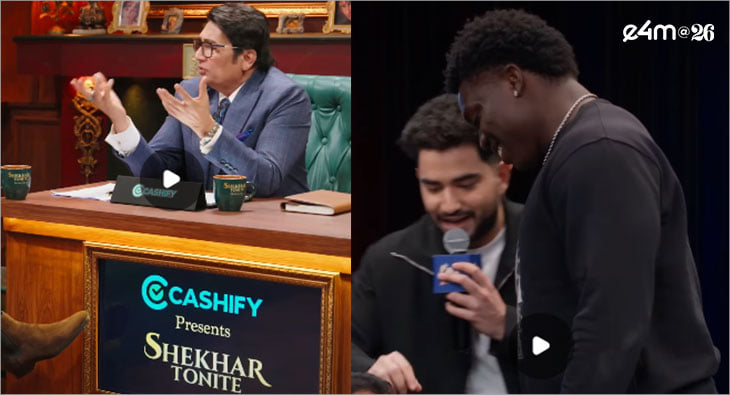

- Influencer marketing is evolving from simple transactions to long-term investments in creator-led entertainment properties, with brands like Cashify creating portfolios of multiple formats to build audience recognition over time.
- Brands are increasingly integrating their products into comedy and creator-led shows, allowing for a more organic connection with audiences, as seen in collaborations with comedians and actors on various platforms.
- The effectiveness of these creator IPs is being evaluated not just on immediate viewership but also on metrics like repeat viewing, social engagement, and audience sentiment, indicating a shift towards long-term brand association.
- Legacy brands are entering the creator IP space, adopting strategies that leverage existing creator audiences and cultural contexts, leading to a more complex investment landscape focused on sustained brand presence rather than one-off campaigns.
For years, influencer marketing largely operated on a simple transaction: a creator, a brief, a post and a campaign report. The newer bet is less tidy. Brands are increasingly putting money behind creator-led properties that can run across episodes, formats and seasons, with the expectation that audiences will remember the entertainment and, somewhere along the way, remember the brand attached to it.
That shift is visible in the way brands are showing up around comedy and creator-led entertainment. Cashify, for instance, is investing across multiple properties rather than treating each collaboration as a standalone integration. Its portfolio includes formats such as Nation Wants To Know, Relationshit Advice and Lie Hard, which the brand describes as part of its broader “Cashify Comedy Universe”.
Cashify Co-founder and CMO Nakul Kumar told e4m reporter, the brand does not look at an IP simply as a longer version of a creator campaign. “A one-off campaign can help generate visibility around a specific campaign or message, while an IP gives us the opportunity to build something audiences can recognise and return to over time,” he said.
That changes the question brands are asking. Instead of only asking how much an influencer integration costs, marketers now have to consider what it costs to repeatedly occupy a particular entertainment universe, and whether that presence can create familiarity that survives beyond a campaign window.
For Cashify, the answer has been to build a portfolio rather than put all its money behind one property. Kumar said the brand invests in multiple creator IPs simultaneously, with viewership only one of several signals used to decide whether to continue or increase investment. Repeat viewing, completion rates, sharing, social conversations, branded searches and audience sentiment are also part of the evaluation.
The logic is particularly relevant for a category such as refurbished smartphones, where consumers are unlikely to be in-market every week. The brand therefore has a reason to remain culturally visible even when a consumer is not actively looking to sell, repair or upgrade a device.
This is where comedy enters the picture.
Stand-up and creator-led comedy have moved from being a relatively niche digital format to becoming a more established part of entertainment and marketing conversations.
Nabeel Nawaz, who works across stand-up comedy, live entertainment, touring strategy and IP development, at Saregama India pointed to the growing frequency with which campaign conversations now include the question: “Can we do something with a comedian?”
"The change is visible across entertainment formats as well. Collaborations involving actors and comedians on creator-led shows are increasingly blurring the distinction between advertising, entertainment and IP. What once looked like an experimental digital association is becoming part of the broader campaign planning conversation."
Examples of this trend can be seen across the industry, with Alia Bhatt and Varun Dhawan appearing on India’s Got Latent, Huma Qureshi featuring on Judge Me If You Can, and Vikrant Massey and the cast of Musafir Cafe joining Manhar Seth’s crowd-work show, among several other such collaborations.
But the more interesting development is not simply that brands are sponsoring comedy. It is that some are allowing the comedy to retain its own personality.
That matters because Gen Z does not necessarily need another polished brand message. It can remember the brand that allowed itself to become part of the joke.
The recent rise of roast culture has made this especially relevant. Brands are increasingly finding themselves referenced, teased, parodied or deliberately placed inside formats where they do not have complete control over how the joke lands. The commercial calculation is straightforward: surrender some control in exchange for cultural participation.
The India’s Got Latent ecosystem offers a useful illustration of how far this model can be pushed. Avvatar Protein's association with the show has used the format itself as part of the brand communication rather than relying only on a conventional product plug. In one activation, the product was brought into the show's unscripted, irreverent environment, including an interaction involving creator and guest Deepak Kalal.
https://www.instagram.com/reel/DdTHxguNmS3/?stkn=MXRoem83eG5jdHYwYw==
The show's panel and audience became part of the entertainment rather than sitting outside it as passive recipients of an advertisement. The wider format has also demonstrated how sponsor integrations can become content moments in their own right.
The point is not whether every brand should hand over its communication to comedians. In fact, the industry remains cautious about exactly that.
Jeet Thakur, who works in consumer insights at Atomberg, observed that brands may be paying around ₹1 crore for a single India’s Got Latent episode integration, but questioned whether the resulting search interest has a comparable long-term tail. “These episodes have a long tail, while the brands did not,” he told e4m.
Thakur’s analysis of Google Trends data points to a sharp post-episode spike for several brands, followed by a decline in search interest.
According to the data he shared, AI+ Nova, which sponsored Episode 1, reached an index of 100 on June 21 before falling to 14 three days later and six after a week. Avvatar Protein’s index moved from 88 on the episode date to 29 after three days and 24 after seven days, while Wild Stone moved from 76 to 55 and 52 over the same period. Thakur’s broader argument is that while creator IPs can generate significant attention for brands, the commercial value of that attention depends on whether the association extends beyond the initial entertainment moment.
Sumit Gupta, Founder of Viral Pitch, told e4m, humour can contribute to long-term recall when it is rooted in both the creator's personality and the brand's identity.
But creative freedom still has a ceiling. Gupta said, "brands remain cautious about giving creators complete freedom to roast or joke about them, particularly when there is a possibility of the humour being misunderstood."
The emerging model, he said, is about finding a balance between preserving the creator's natural voice and keeping the brand comfortable with the message.
That tension may ultimately decide how far creator IP investment goes.
The growing maturity of creator-led businesses is also evident in how creators are approaching risk management around their IPs.
Samay Raina’s reported decision to have a 12-member legal team associated with the India’s Got Latent relaunch reflects a greater emphasis on protecting the creator, the format and its commercial ecosystem from potential legal and reputational exposure. For creators building large-scale IPs, legal preparedness is increasingly becoming part of the business infrastructure, particularly as controversial content can have implications not only for the creator but also for platforms, brand partners and future monetisation opportunities.
Because the economics of an IP are different from those of a single creator post. A campaign can be evaluated through reach, engagement, clicks or conversions. An IP has a longer memory curve. Brands are paying for the possibility that the audience will return, that the format will develop its own following and that the brand will become familiar through repeated association.
Cashify's approach reflects that thinking. Kumar said the brand deliberately gives its creator-led formats room to exist as entertainment rather than turning them into extended advertisements. The creators, characters and formats are allowed to build their own identity, while Cashify remains the enabling brand behind them.
https://www.instagram.com/reel/DcvjxNRTEVD/?stkn=cWxuZTZ3MjBvbWR0
That also explains why repeat spending is becoming an important part of the conversation. The question is no longer simply whether an IP delivered views in its first season. It is whether audiences returned, whether the format generated conversations without paid prompting and whether the association strengthened awareness and consideration over time.
There is another signal in the market: creator IP is no longer being treated purely as the playground of digital-first brands.
https://www.instagram.com/reel/Dc6izGlzhfU/?stkn=MWV0YXdkanhwMHE4MA==
Legacy brands are beginning to enter the format with a different playbook. DS Group's Pulse, for example, has associated with Teen Taal, the Hindi comedy podcast known for its irreverent treatment of current affairs, social issues, viral moments and popular culture. The recent association extends across Pulse Candy, Golmol Imli Goli and Pulse Pop Masala Jelly, with the products being integrated into the show's existing language and segments rather than appearing simply as conventional sponsor mentions.
The integration is instructive because the brand is not attempting to manufacture a new entertainment property from scratch. Instead, it is entering an existing creator-led universe whose audience already understands its tone. The result is a different kind of media buy: one where the brand borrows not only reach, but the show's established vocabulary, humour and cultural context.
For marketers, this creates a more complicated but potentially more interesting investment question. How much is an IP worth if the audience comes for the creator but leaves with a memory of the brand? And how much more is a brand willing to spend when that association can continue across episodes and seasons instead of disappearing after one sponsored post?
There is no single industry price tag yet. Creator IP investments vary according to the scale of the creator, format, number of episodes, production requirements, exclusivity, distribution and the level of integration a brand wants. What is becoming clearer is that some marketers are prepared to spend repeatedly rather than make a single bet.
The bigger shift, therefore, may not be from influencer marketing to creator marketing. It is from buying attention to buying association.
And in an internet culture where a perfectly polished advertisement can disappear in the scroll, being the brand that gets roasted, referenced, joked about or woven into an audience's favourite format may have a different kind of value.
Read more news about Marketing News, Advertising News, PR and Corporate Communication News, Digital News, People Movement News
For more updates, be socially connected with us onInstagram, LinkedIn, Twitter, Facebook, YouTube & Google News