The creator effect: How influence is rewriting corporate communications
Industry leaders explore how creators are shifting the balance of influence and reshaping communications
 by
by
Published: Aug 25, 2026 4:29 PM | 21 min read
 Follow Us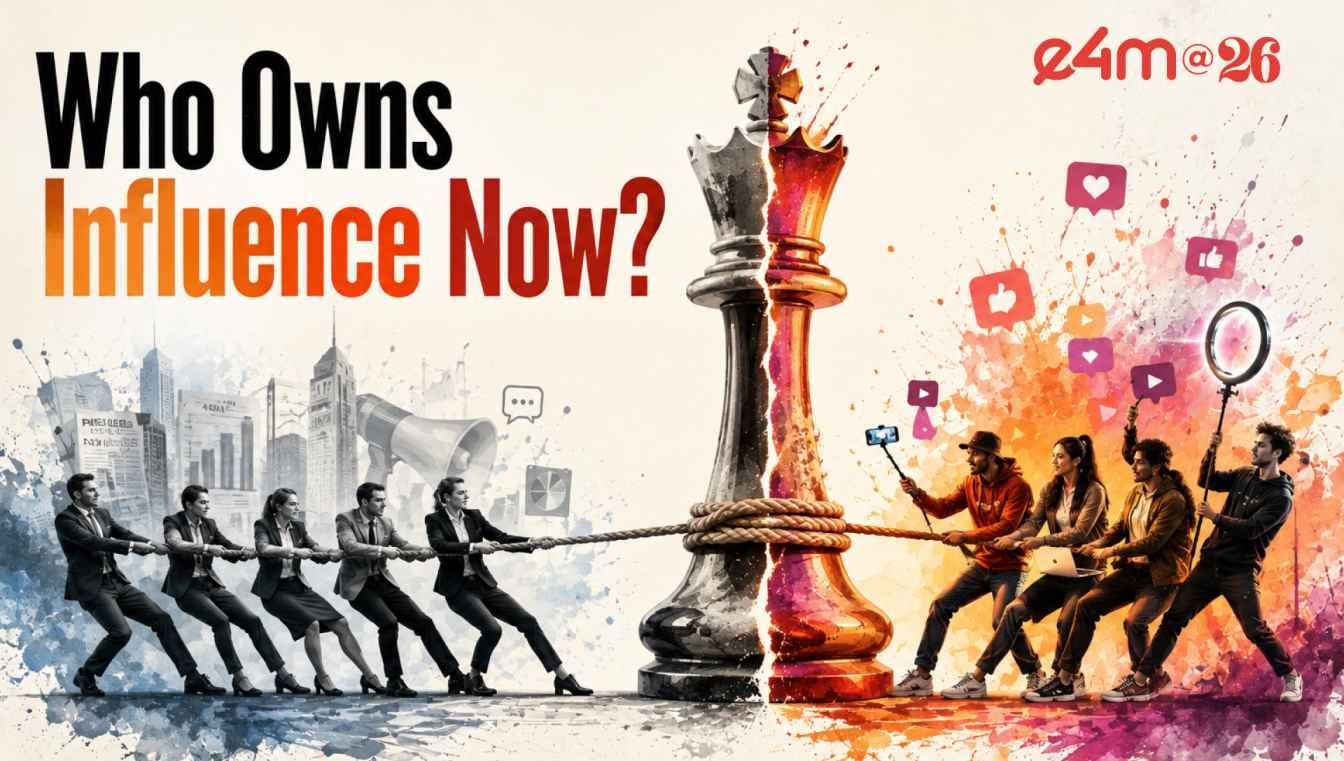

- Influencers have evolved from being mere content distributors to becoming significant independent institutions of influence, actively shaping conversations on various topics, including technology, finance, and social issues, as seen during events like the Jantar Mantar protests.
- The creator economy is estimated to be worth around $250 billion in 2023, with projections nearing $480 billion by 2027, prompting brands to integrate creators into their communication strategies to enhance trust and relatability with audiences.
- As creators gain prominence, traditional PR roles are shifting from message management to influence management, requiring communicators to engage with a broader ecosystem of stakeholders and adapt to a decentralized influence landscape.
- The relationship between brands and creators is evolving towards long-term partnerships focused on authenticity and trust, with brands needing to navigate the complexities of creator influence while maintaining transparency and ethical standards in their communications.
For years, the creator was largely treated as the last mile of a communications strategy. However, something has changed in the last few years.
Influencers are now actively influencing spaces that were once dominated by institutions, journalists and corporate spokespeople. They are increasingly becoming the people who start the conversation, explaining AI, influencing investment behaviour, commenting on workplace culture, shaping product discovery, interpreting social issues and, increasingly, becoming the first point at which audiences encounter a story.
The recent Jantar Mantar protests offered a striking example where creators were on the ground, documenting what they were seeing, speaking to people at the protest and taking the story directly to their audiences. Their content became an immediate source of information and opinion for people following the movement online. What made the moment significant was not simply the scale of their reach. It was the communication strategy, speed, and nature of the influence.
The similar shift is now visible in the business world.
Brands are increasingly using creators to launch products, explain ideas, build communities and influence purchase decisions. In some cases, consumers may look first to digital creators and online communities for interpretation rather than wait for an official corporate statement, making influencers a big part of the influence infrastructure itself.
Goldman Sachs estimated the creator economy at around $250 billion in 2023 and projected that it could approach $480 billion by 2027.
From, how can a brand use creators to amplify its message?
To, Who are audiences listening to, why do they trust them, and what happens when those voices begin shaping the meaning of a brand or issue before the organisation gets to do so?
The bigger change is that creators have built a direct and trustworthy relationship with an audience, something brands have spent decades trying to build. But as brands give them more narrative space, another question is whether communications teams are gaining a new route to audiences or is this costing them the control of the conversation.
To understand how deeply that shift is being felt, exchange4media spoke to corporate communications and agency leaders about what creators are changing, where brands are placing them in their communication plans, what agencies are having to build around them, and what happens to the traditional role of PR when creators become a primary route to public attention.
Are creators the new independent institutions of influence?
Karan Bhandari, Managing Director - Integrated Media Comms, Weber Shandwick India, describes the shift, citing, “One of the biggest shifts in communications over the last few years is that creators have evolved from content distributors to independent institutions of influence. People don’t just follow them for recommendations; they increasingly rely on them to interpret the world around them. Whether it’s deciding what to buy, where to travel, what to eat or understanding broader cultural conversations, creators increasingly shape what people trust.”
Akanksha Jain, Assistant Vice President-PR and Communications, Swiggy, frames it as a broader redistribution of trust, “The rise of creators reflects a much larger shift in how influence and trust are being built in today's times. Influence is no longer concentrated within traditional institutions, media or brands but is increasingly distributed across individuals and communities that have earned their relevance and are seen as credible information sources for the specific audience.”
The creator is becoming the first layer of interpretation & trust builders
The creators’ influence is growing not because of the follower count but more because of their power to build trust, connect, interpret, and translate information that audiences recognise.
“Trust today is built differently. Influence is far more distributed, and often the most credible voice in a conversation does not necessarily belong solely to an organisation or a traditional media house. We have to understand why creators are increasingly becoming important trust builders. It is because they bring community, relatability, and cultural context. They are making complex stories more human, relevant, and relatable, which is why audiences are engaging with them and placing their trust in them. For communications leaders, this is a shift we cannot ignore,” says Sulakshna Mukherjee, Associate Director & Head of Department - Corporate Communications, McDonald's.
Kanika Bedi, Communications Leader, sees this as a fundamental change in how people consume information.
“The rise of creators is one of the most significant shifts in the communications landscape over the past decade. What makes creators influential isn't just their reach, but the trust and credibility they have built with highly engaged communities. Today, people increasingly turn to creators for context, interpretation and informed opinions, whether the topic is technology, business, sustainability or social issues.”
“What is particularly interesting is that creators are no longer just amplifying conversations; they are shaping them. A technology creator can demystify AI for millions, a finance creator can influence investment behaviour, and a leadership creator can spark debate on workplace culture and careers. In many cases, creators are helping audiences make sense of complex topics in ways that traditional communication channels cannot,” Bedi further highlights, underlining the important role of creators in connecting the right dots for brands with the right audience.
A brand can still decide what it wants to say. A communications team can still prepare its messaging but if audiences encounter that issue first through a creator's explanation, reaction or commentary, creators automatically take away the right from organisations to be the first interpreter of its own story.
Sonam Bhagat, CEO, Vygr News Network, explains, “Creators are now part of the public sphere. Not just the last block of a marketing plan. They help audiences interpret brands, institutions and social issues in real time. Through the lens of language, locality, personal experience and community values. Creators are not just amplifiers but emerging voices.”
She adds that this is particularly significant for younger audiences, who increasingly encounter issues first through short-form content rather than traditional bulletins. “This changes the role of PR and corporate communications. It is no longer enough to distribute a consistent message. The work is to understand where trust sits. It is to participate credibly in relevant conversations and ensure that facts can withstand scrutiny across multiple voices and platforms.”
Gitanjali Sirwal, Chief of Corporate Communications, Micro Mitti, adds another dimension stating that creators are also becoming translators between institutions and audiences. “I believe creators play a significant role in amplifying communication and making it more accessible to audiences. Today, creators are not just content producers; they are role models for the communities they've built. They create niche audiences who trust their opinions, recommendations, and perspectives. That trust gives them tremendous influence in shaping public conversations.”
The real currency is shifting from reach to trust
At the brand level, creators were initially often treated as an extension of influencer marketing. Today, that relationship is becoming more strategic as brands look for ways to communicate without making every piece of content feel like advertising.
At Wow! Momo, Sylvia Dutta, Lead - Corporate Communications & PR, says the role of creators is increasingly tied to how naturally they can connect a brand with their communities.
“Creators have changed something basic about how brands communicate. It is no longer a matter of putting out a message and waiting for people to listen. Most people now find brands, products and ideas through the creators they already follow and trust, and that has made creators a real part of the conversation.”
Dutta talked about the Indian Momo League as a case highlighting creators' impact.
“At Wow! Momo, they help us reach consumers in a way that feels natural rather than staged. Food is visual and experiential, so a creator can bring a new product or a campaign to life in ways that a straight brand message often cannot. Our Indian Momo League (IML) campaign is a good example. We took the energy around cricket and tied it to momos through city-inspired flavours and formats, and creators carried that idea well beyond the campaign itself, starting conversations and experiences that people could relate to and pass on.”
However, she also highlights what the brand does not use as its primary measure while measuring the creator's impact.
“For us the value was never really about follower counts or view numbers. What matters is whether a creator can drive discovery, get people talking and actually push someone to try the product. The good ones know their communities properly, so they can tell a brand story in their own voice instead of making it sound like an ad.”
Sirwal's Micro Mitti example marks an important departure from the old influencer equation, “At Micro Mitti, creators are an important part of our communication strategy. Real estate is often perceived as a complex subject, and there is still a significant gap in awareness, particularly around real estate investments in Tier II and Tier III markets. If these concepts are communicated using industry jargon, the message doesn't reach the audience effectively. This is where creators, especially regional and local creators, make a real difference. They simplify complex topics, explain them in the audience's own language, and make investing feel more relatable and less intimidating.”
For communications teams, influence is becoming harder to buy and more dependent on credibility.
The creator is no longer the last mile
For agencies, this is already changing how clients approach creator partnerships.
Maddiee Amrutkar, Founder & CEO, Glad U Came, says creators are no longer simply the “last block” of a campaign. He shares his observation of the change in client behaviour, “Creators today are no longer just amplifying campaigns; they are shaping public opinion, building trust, and influencing consumer decisions. This has fundamentally changed the role of PR from managing media narratives to manage influence across multiple touchpoints.”
“For brands, credibility today is built through a combination of earned media, authentic creator partnerships, and transparent storytelling, rather than relying on a single channel. At Glad U Came, we’ve seen clients move away from one-off influencer collaborations towards long-term creator relationships that align with their brand values,” he further explains.
That movement from one-off activation to longer-term relationship is one of the clearest signals that creators are moving closer to the centre of communications strategy.
From One-Off Influencer Campaigns to Long-Term Trust Relationships
If creators are trusted because of their relationship with a community, a single sponsored post can only go so far. The more sophisticated model emerging is one in which brands seek sustained relationships with creators whose identity, expertise and audience have a genuine connection with the brand.
Bhandari says clients are already making that shift, stating his observation of how clients respond by moving beyond campaign-led creator engagement towards longer-term trust building. “Brands looking to connect with younger audiences and the next wave of consumers across India, influence is becoming more distributed, more personal and more contextual,” he underlines.
Bhagat points to this movement through the lens of the changing talent market, highlighting, “Job posting data shows requirements for creator-related skills rose 919% between 2020 and early 2026. That indicates brands are moving beyond one-off influencer activations. They are now embedding creator, content and community capabilities and moving more deeply into their marketing and communications systems.”
She argues that the better approach is to stop treating creators simply as a media-buying channel, “Brands are increasingly seeking long-term relationships with people who have genuine category relevance and hold credibility in specific communities. The focus is shifting from a single branded post to sustained participation and creator-informed storytelling.”
Jain argues that organisations need to move away from short-term campaign thinking. “It also calls for a more strategic approach to creators. We need to move beyond the approach of campaign-led influencer engagement aimed at creating buzz for a short duration. Organizations need to identify voices that can genuinely shape opinion in their category, see where there is authentic alignment, and how those relationships can be built over time without compromising on the independence and credibility that make creators influential in the first place.”
The distinction matters because a creator's influence is not necessarily transferable in the same way as traditional media inventory. A brand can buy an ad slot but it cannot buy the underlying trust that a creator has accumulated with a community. That trust has to survive the partnership.
And that is where the creator economy gets complicated!
The more brands depend on creator credibility, the greater the risk when audiences perceive the relationship as artificial. It creates credibility issues for brand, influencer, and the influence they have created so far.
Bhagat points directly to the growing resistance to repetitive sponsorships and forced partnerships. “Reach does not automatically mean trust. Audiences are now becoming more aware and sometimes even averse to repetitive sponsorships. There is a detest towards artificial-looking content and forced partnerships that don't match a creator’s identity. Authenticity cannot be engineered.”
This introduces an important contradiction into the creator economy. The very thing brands want to access, the creator's perceived authenticity, can be weakened by the way brands attempt to commercialise it.
“Editorial teams, creators and brand partners have to sit together much earlier in the process. Narratives have to remain accurate and responsible even as they travel through creator-led formats,” she further asserts to explain how brands can make the partnership more authentic.
Follower count is only one part of the equation. Brands and agencies increasingly need to assess whether the creator has category credibility, whether the community is relevant, how audiences respond to the creator, whether the partnership feels culturally natural and whether the creator can communicate the issue accurately.
In this context, she also shares the new evaluation framework more explicitly, mentioning, “Agencies need to build creator intelligence, regional and cultural understanding, social listening, stronger measurement, and crisis readiness. They must assess audience quality, sentiment, credibility, community fit and message understanding. Relying only on impressions or follower counts could be a flawed strategy.”
In other words, influence is becoming more difficult to quantify precisely because it is becoming more valuable as a qualitative asset.
Communications is moving from Message Management to Influence Management
This is perhaps the most consequential shift communications industry should be ready for!
If creators are becoming independent institutions of influence, then the role of communicators may no longer be as narrative managers.
Jain articulates what the shift means inside the corporate communications function, “Today, organizations are not the sole authors of their narratives, they are participants in a much broader conversation around their brand, business and reputation. This is why the overall strategy from a Communications and PR standpoint needs to evolve to focus a lot more on managing overall influence and building as well as safeguarding trust.”
She continues, “Communications leaders need to focus on a wider ecosystem of stakeholders including media, creators and influencers, employees, customers, experts and key opinion leaders, and communities and strategize how they can ensure their narratives land well across. Listening, understanding cultural nuances and the ability to engage credibly in real-time will become as important as traditional storytelling.”
Mukherjee describes this as the emergence of an integrated influence ecosystem, explaining, “The future of corporate communications is therefore about creating an integrated influence ecosystem in which earned, owned, and paid channels work together alongside employees, leaders, and communities.”
With this, she also argues how it is changing the job description itself.
“To put this into context, the role of the communications leader is evolving from being merely a custodian of reputation to becoming a curator of influence and trust, with a clear understanding of which voice, platform, and story can create the most meaningful connection with each audience,” she says.
Agencies now need to build an influence function
The agency impact is different from the corporate impact. For a corporate communications leader, the immediate challenge is understanding where creators fit into the brand's larger communication strategy.
For an agency, the challenge is building the capabilities to manage this new form of influence alongside PR.
Bhandari describes the shift as a move beyond influencer management. He states that agencies need to combine communications strategy, creator partnerships, cultural intelligence, AI-enabled insights and measurement to help brands navigate a far more complex influence ecosystem.
He describes the larger part of creators in execution brand messaging, “Essentially, creators are not just another channel for execution – they are becoming a part of the trust infrastructure. Shaping how brands are discovered, experienced and talked about.”
Amrutkar broadly discusses the agency requirement, underlining, “For agencies, the need of the hour is to combine PR, influencer marketing, social listening, and reputation management into one integrated strategy. The brands that succeed will be the ones that prioritise authenticity over reach and build trust through consistent, credible communication.”
That convergence could have consequences for agency structures themselves.
The old distinction between PR, influencer marketing, social media, content and reputation management becomes harder to maintain when the same creator can simultaneously act as a media personality, community leader, commentator and brand partner.
The creator economy may create a governance problem
Creators may have the audience, but brands continue to carry the consequences.
A creator can shape how a product is perceived, but a company remains responsible for the product. A creator can comment on a corporate issue, but the organisation still has to answer for its actions. A creator can accelerate a conversation, but cannot necessarily control where that conversation ends. This is particularly consequential during moments of controversy.
The speed of creator-led communication can be an advantage for brands seeking relevance, but it can also accelerate misinformation, criticism and reputational risk. That makes social listening, creator intelligence and crisis preparedness increasingly important capabilities for agencies.
Bhagat argues that agencies need to assess more than impressions. Audience quality, sentiment, credibility, community fit and message understanding become critical measures of whether a creator is genuinely appropriate for a brand.
This is where governance becomes equally important.
Creator influence brings disclosure obligations and ethical considerations, particularly when communication involves areas such as finance, health or education. Paid relationships need to be transparent, claims need to be substantiated and audiences need to understand where editorial opinion ends and commercial messaging begins.
In other words, the more powerful creators become as communication channels, the more important communication discipline becomes.
Bhagat highlights the need for explicit guardrails, illustrating, “ASCI requires clear disclosure when there is a material connection between a brand and creator. Any payment, gifts, trips, barter or affiliate benefits must be mentioned to the viewer. In finance, health, education and other sensitive categories, claims must be substantiated. Expertise must not be implied where it does not exist.”
She suggests that ethical guardrails have to be established before content is created. Creators need to be sensitised to basic disclosure norms and a clear code of ethics. People watching them have a right to know when something is genuine editorial content and when it is paid for by a brand.
Creators are influential partly because their communication feels native to the environment in which their audiences already engage. Once that communication begins to look like a conventional advertisement forced into a creator's feed, the very credibility that made the creator valuable can begin to weaken. This pushes the creator's conversation just from the campaign effectiveness.
She guides, “For most of us, creators are now the first layer of interpretation on many complex issues. That makes it even more important that they are transparent about sponsorships. They have to not only be careful with facts but also clear about where their opinions end and paid messaging begins. Our role as media is to support that with context and clear guardrails rather than trying to control the conversation.”
If creators are increasingly shaping public understanding, it’s time that the industry also starts thinking about responsibility alongside influence.
The next communications battle is not about creators versus PR
The easy narrative available is that creators are replacing traditional media, influencer marketing is replacing PR, and younger audiences no longer care about institutional communication. But this shift is more nuanced.
It shows that even with the evolving role of creators or influencers, traditional media remains part of the influence ecosystem, corporate channels remain important, and PR also remains responsible for consistency, reputation and credibility.
Dutta confidently mentions that creators sit alongside, rather than replace, PR. “None of this makes traditional PR less relevant. If anything, it puts more weight on corporate communications. Information moves quickly and conversations are scattered across platforms, so a brand needs one clear and consistent story running through all of it. PR has to protect that story while staying alert to how the conversation is shifting across media, creators and digital communities.”
Bedi cites the shift in terms of the communicator's mindset, “For corporate communications and PR professionals, this means moving beyond a message-distribution mindset towards a trust-building mindset. The future of influence will be more distributed, community-driven and dialogue-led. While traditional media and corporate channels will remain important, communicators will increasingly need to engage with a broader ecosystem of creators, experts and trusted voices.”
And in an environment where audiences are surrounded by more information, the hierarchy of influence may continue to change.
“In an environment where information is abundant, authenticity, credibility and relevance will become the most valuable assets for both creators and brands,” she concludes.
Sirwal describes the evolution as an expansion of the communications professional's role, “I see the future of corporate communications and PR becoming even more dynamic. Our role is no longer just about managing media relations; it's about orchestrating conversations across multiple platforms and voices. Whether it's through podcasts, short-form videos, creator collaborations, or AI-enabled content, we now have countless ways to educate, engage, and build credibility.”
So what does the creator shift really mean for the communications industry?
Creators are not necessarily taking the place of communicators. They are changing the conditions under which PR and corporate communications used to operate.
The brand no longer speaks into an empty room and waits for audiences to respond. It enters a conversation already populated by creators, communities, journalists, experts, employees and increasingly influential individual voices. The communications professional therefore has a different job ahead.
It is to understand where trust is forming, who has the credibility to shape a conversation, where the organisation has a legitimate role, and how to protect reputation when the story travels far beyond the channels the brand controls.
This evolving nature of industry requires a different kind of communicator, someone who understands media but also creators, reputation but also culture, corporate messaging but also community behaviour, campaign performance but also sentiment, and most importantly, someone who can identify when a brand should speak, when another credible voice should speak and when the organisation should simply listen.
Jain concludes, “Ultimately, the creator economy does not make corporate communications less relevant- it raises the bar for the function. As influence becomes more decentralized, Communications has an even greater role to play in helping leadership navigate reputation, anticipate shifts in public conversation and build sustained trust. The organizations that succeed will be those that are not simply louder in the conversation, but more credible, relevant and connected to the communities they serve.”
Creators may have started as amplifiers but if the current trajectory continues, their more consequential role will be as agenda-setters, interpreters and participants in the infrastructure of trust itself.
And that leaves communicators with a bigger question than whether to work with creators. It has to decide how to operate in an influence ecosystem where it no longer owns the conversation, but is increasingly responsible for navigating it.
It does not mean the communicators are becoming irrelevant, it means the old communications hierarchy is becoming harder to sustain.
There was a time when a brand had a small number of important routes to public attention.
Today, there are many.
Creators are one of them, but they are increasingly becoming one of the most powerful because they do not just deliver information. They already have a relationship with the people receiving it. That is why the real change is that influence has moved closer to the individual.
A creator can build an audience without a newsroom, a media company or a large corporate structure behind them. They can create a point of view and, over time, build trust around it.
That trust is now valuable enough for brands to buy, PR agencies to manage and communications leaders to think seriously about.
The future of communications will not belong to whoever can speak the loudest. It will belong to those who understand which voices people trust, why they trust them, and how to earn a credible place in the conversation.
That is why creators are not replacing communicators. They are pushing them to become better at understanding influence.
Read more news about PR and Corporate Communication News, Internet Advertising, Marketing News, Digital Media News, People Movement News
For more updates, be socially connected with us onInstagram, LinkedIn, Twitter, Facebook YouTube & Google News