Prasoon Joshi on authenticity, perspective and ethics in AI-driven media
At an industry event, Prasoon Joshi said AI can scale creativity, but the human instinct behind it remains irreplaceable amid social media and shrinking attention spans
 by
by
Published: Feb 27, 2026 8:34 AM | 6 min read
 Follow Us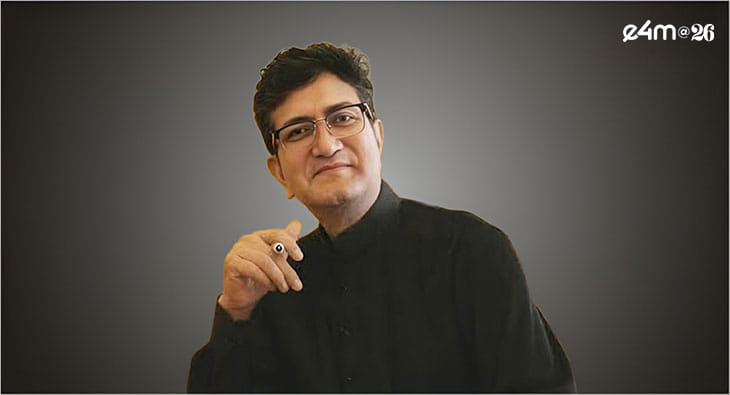

At a time when artificial intelligence is rewriting content workflows, social media is shaping public opinion in minutes, and attention spans are under constant scrutiny, lyricist and former CBFC chairman Prasoon Joshi delivered a sharp reminder: Technology may scale creativity, but it cannot replace the human instinct that births it.
At an industry event, in a wide-ranging fireside conversation, Joshi anchored the discussion around authenticity, perspective, and the ethical frameworks that will define the future of AI-led industries, including advertising, cinema and media.
Authenticity over amplification
Joshi began by tracing his creative instincts to a deeply personal memory from childhood. He recalled feeling fear and vulnerability when his mother, a teacher, had to leave home for a training programme. He never expressed that fear at the time, but the emotional truth stayed with him.
For Joshi, creation begins with such unarticulated experiences. Authenticity, he argued, is not a stylistic layer but the foundation of meaningful storytelling. One cannot write everything one sees. The writer must choose what is emotionally true.
He recounted a conversation with classical vocalist Pandit Jasraj who once told him that during a performance he would mentally identify one person in the audience and sing only for that individual. Joshi applies the same approach in advertising. Rather than addressing an abstract “consumer”, he imagines a real person, perhaps a family member, and writes with honesty for that one individual.
If you speak truthfully to one person, he said, you end up speaking truthfully to everyone.
Navigating censorship in the social media era
Reflecting on his tenure as chairman of the Central Board of Film Certification, Joshi acknowledged that balancing creative expression and regulation has become significantly more complex in the age of digital immediacy.
Today, films are judged within minutes of release. Social media reactions, both praise and outrage, begin almost instantly. The global interconnectedness of audiences means that content released in one geography can trigger responses across borders within hours.
Rather than treating disagreements as battles, Joshi said his approach was to replace confrontation with dialogue. Most filmmakers, he believes, do not set out to hurt sentiments. Conflicts often arise from differing perspectives.
Using a metaphor, he explained that a river can appear aggressive to someone swimming against its current and calm to someone standing on its banks. The river remains the same. What changes is the vantage point. His effort, he said, was to bring conflicting vantage points into conversation and see whether common ground could be found.
AI and the limits of data-driven creativity
On the question of AI being trained on his body of work and potentially replicating his style, Joshi offered a nuanced view. He rejected the idea of individual authorship as absolute, describing himself as a medium through which ideas pass rather than their sole originator.
He also challenged the assumption that artificial intelligence is entirely “artificial”. AI systems are trained on human experiences, expressions and data. In that sense, they reorganise what already exists.
The distinction, however, lies in what has not yet been said. AI can process and recombine existing information. But genuine creativity, Joshi argued, often emerges from the unexpressed. It is not merely a clever permutation of words but an instinctive leap into new territory.
If creativity is reduced to structural manipulation, AI can replicate it. But if it stems from intuition and deeper emotional insight, that space remains inherently human. That, he said, is why he does not feel threatened by AI.
At the same time, he cautioned against underestimating its impact. AI is already capable of generating full songs and even films without direct human intervention. Its influence spans journalism, advertising and entertainment. The shift is structural and must be taken seriously.
Attention spans and evolving formats
Addressing concerns about shrinking attention spans, Joshi argued that human behaviour has always accommodated multiple formats of engagement. While short-form content dominates mobile screens today, long films, podcasts and in-depth narratives continue to find audiences.
He suggested that the fragmentation of formats is not new. Historically, communities consumed information in snippets, through informal conversations and local discussions, while also turning to trusted figures for clarity when needed.
The formats have evolved. The human need for stories, validation and authority has not.
Breaking the mould
Joshi sharpened his critique of AI-driven creativity by arguing that the technology often produces what he termed the “lowest common denominator of exceptional”. If asked to generate a profound thought about journeys and destinations, AI might produce a widely accepted philosophical line. It resonates because it is familiar and validated by cultural repetition.
Human originality, he argued, works differently. True exceptionality breaks the mould. AI operates within established patterns. Once it produces something, that output becomes part of the mould for future iterations. Human creativity, in contrast, disrupts the pattern itself.
He also stressed that humans are more than calculating minds. There exists an emotional dimension that resists analytical dissection. Love, trust and integrity cannot be meaningfully reduced to data points without losing their essence.
The real debate is about values
For Joshi, the future of AI will not be determined solely by technological advancement but by ethical anchoring. Artificial general intelligence and increasingly autonomous AI agents may soon become mainstream realities. Hyper-personalisation and real-time marketing will intensify.
The real question, he said, is who draws the line.
AI will execute tasks with precision. But its direction will depend on the value systems of those who deploy it. Ethical frameworks, education and moral anchoring will shape whether the technology manipulates or empowers.
To illustrate the role of integrity, Joshi cited a story by Russian writer Anton Chekhov, in which manipulation is ultimately defeated by trust rooted in moral conviction. The decision to resist manipulation does not arise from logic alone, he argued, but from an internalised value system.
In closing, Joshi returned to a civilisational perspective. Humanity, he suggested, must avoid overestimating its centrality. Individuals are part of a larger creative order. When one recognises that scale, anxiety reduces and clarity emerges.
In an era defined by automation, algorithmic curation and speed, Joshi’s message was direct and hard-hitting: creativity must break moulds, not fit into them. And as AI reshapes industries, the real investment must be in conscience.
Read more news about Digital Media, Internet Advertising, Marketing News, Television Media, Radio Media
For more updates, be socially connected with us onInstagram, LinkedIn, Twitter, Facebook, YouTube & Google News