Celebrity x brand mismatch is driving the buzz. Does ROI follow?
Brands are using unexpected collabs to trigger conversations, reach and social amplification; industry experts say while it is a smart marketing move the need is to start meaningful associations
 by
by
Published: Sep 18, 2026 8:54 AM | 7 min read
 Follow Us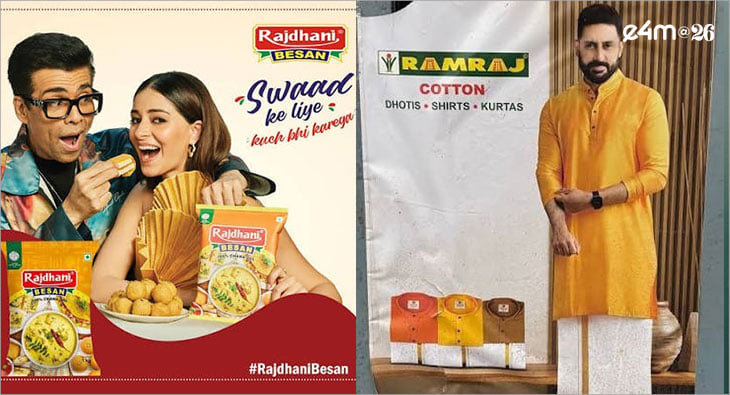

- Sydney Sweeney's recent ad for Novig, featuring her nude with sports equipment, has sparked criticism for allegedly sexualizing women's sports, raising questions about the effectiveness of celebrity-brand mismatches in advertising.
- Marketing experts suggest that while unexpected celebrity pairings can generate attention, they must also create meaningful connections with the brand to ensure long-term impact and avoid being perceived as mere noise.
- The shift in advertising strategy emphasizes shareability and cultural relevance, with brands increasingly seeking to create memorable moments rather than simply leveraging celebrity fame.
- Experts caution that while mismatched pairings can attract initial interest, the true measure of success lies in whether they lead to increased brand awareness, customer engagement, and ultimately, sales conversions.
Sydney Sweeney is trending again, and not necessarily for a reason her brand partners would have scripted. (Or perhaps, precisely the reason the brand wanted!)
Her latest ad for sports-trading platform Novig, featuring her posing nude while using sports equipment for cover, has drawn criticism from athletes and fans who argue that it sexualises women’s sport. But the more interesting question isn’t the backlash. It’s how deliberate the pairing appears to be. Sweeney wasn’t cast because she is synonymous with sports trading or betting. She was cast because the disconnect itself creates curiosity, conversation and, ultimately, attention.
And this instinct isn't confined to the West.
In India, the same logic is playing out in campaign after campaign: Shah Rukh Khan for skincare brand Foxtale, Abhishek Bachchan for menswear label Ramraj Vesti, filmmaker Rohit Shetty for toilet cleaner Harpic and Smith & Jones Pasta Masala, Himesh Reshammiya endorsing OnePlus, or Karan Johar and Ananya Panday selling besan and reality-TV personality Rakhi Sawant roped in by multiple brands simply because she is, at the moment, relevant to the social and digital crowd!
It sounds like a simple question, but is deliberate mismatch a calculated brand move, or just noise masquerading as disruption? And once the buzz kicks in, do the earned media and social amplification it generates actually justify what brands are paying for it?
The brand view: attention is not the same as meaning
Rumi Ambastha, Marketing Head at Puresta, believes mismatch can be a deliberate strategy but only within limits. "An unlikely celebrity-brand pairing can be a deliberate creative strategy but personally to me the pairing needs to be meaningful," she said, pointing to Ayushmann Khurrana's association with The Man Company as the benchmark: "I believed that he was a living breathing gentleman and he stood for everything that TMC stood for." Without that anchor, she warned, "these kinds of associations generate views and conversation without building any meaningful connection with the brand in the long term and it just remains a momentary spectacle."
On what to actually measure, Ambastha pointed to three long-term indicators: "Brand awareness: Did the association increase awareness or recall among the intended audience? Brand association: Did consumers connect the celebrity with the brand's desired attributes? Brand equity: Did the association strengthen the brand's distinctiveness and make it more memorable, beyond the campaign period?"
And on ROI, she's unsentimental about virality. "The question that needs to be asked is did the campaign go viral with the right audience, for the right reasons, for the right sentiment. Otherwise what you will hear is a whole lot of noise but after the dust has settled, you will realise that the long term indicators are at a standstill. Because that's what the campaign was all smoke and mirrors with no gravity," she added.
Chetan Siyal, Founding Member & CMO at SNITCH, agreed that mismatch can work by design: "I don't think every celebrity-brand pairing needs to make immediate sense. Sometimes, the fact that it feels unexpected is exactly what makes people stop, talk and share." But he's precise about where the line sits.
"Attention is important, but attention without a story is just noise. For me, brand fit is not about whether the celebrity already looks like a SNITCH customer. It is about whether our customer would want to look or feel like them," he added.
On measurement, Siyal goes further than most. "The real question is not, 'How many people saw the celebrity?' It is, 'Did more people notice, search for and buy from SNITCH because of the celebrity?' We look at branded searches, direct traffic, new customers, product-page visits, conversions, store footfall and how quickly the featured products move."
His verdict on ROI is blunt. "If everyone is talking about the collaboration but nobody is searching for the product or buying it, we have created entertainment, not business." And his closing read on the trend cuts deepest: "I think brands are becoming less interested in buying a famous face and more interested in creating an unexpected cultural moment. But being unexpected is not a strategy by itself. The mismatch must make the campaign more memorable, not more confusing. Otherwise, the celebrity gets all the attention and the brand simply pays the bill."
Sajit Gopal, Head of Media at Jubilant FoodWorks, is the most cautious. "An unexpected pairing can be a smart way to get attention. When it's done well, the surprise is the idea," he said but insists brand tonality comes first.
"Attention matters, but it shouldn't come at the cost of brand fit. If people remember the celebrity but can't tell you the brand, you've paid for someone else's publicity. A celebrity is a multiplier, not a strategy. If the idea is weak, a famous face just makes more people notice that it's weak."
The agency view: shareability is now its own currency
Viren Vesuwala, Lead of PR, Communications and Strategic Partnerships at White Rivers Media, framed the shift as structural. "A celebrity used to be judged on fame and fit with the category. Now the test also includes whether people talk about the ad and pass it on. Celebrities have their own audiences and their own formats, so a brand is buying into a working channel, not just a face."
He's wary of anyone promising conversion numbers. "There is no reliable number, and anyone who offers one is guessing! A viral pairing does create real spikes in search and sharing. The problem is that people often remember the joke or the celebrity and forget who paid for it." On whether mismatch is now a deliberate lever, he said: "Often, yes, though it is usually one part of a wider attention plan. Surprise makes an ad travel past paid media, If the mismatch is only funny, it earns memes. If it also makes a point about the product, it earns consideration."
Prince Khanna, Founder & CEO of Eleve Media, reaches for the freshest Indian example: "A recent example is the Samay Raina × Mukesh Khanna campaign for Ai+ smartphones in June 2026. Given their very public disagreement earlier, nobody expected to see them together. That contradiction became the hook and immediately sparked conversation online."
He's careful to separate buzz from business: "It can, but virality alone isn't ROI. We look at what happens after the buzz: brand searches, profile visits, engagement, consideration and ultimately conversion."
His list of comparable Indian pairings: "Himesh Reshammiya fronting OnePlus, and Karan Johar and Ananya Panday selling Rajdhani Besan" leads him to a conclusion nearly identical to Siyal's, "There is a fine line between unexpected and random. Surprise gets attention; the creative idea still has to make that attention valuable for the brand," he added.
The strategist view: what mismatch does to brand meaning
Nisha Sampath, Founder of Bright Angles Consulting, offered the structural explanation for why this is happening at all: "The role hasn't been replaced. It has been unbundled. A celebrity endorsement used to do all three communication jobs: attention, credibility, and persuasion. One face did all three. Celebrities now primarily work at the topmost level of the funnel. Creators do the lower-funnel work of belief and conversion, because their audiences relate to them and trust them."
On when mismatch turns damaging, she's precise. "In India, celebrities carry huge social and emotional weight. So a mismatch reads louder here than it would in a market where fame is more transactional."
Sampath offered brands a checklist for weighing that risk before they commit to a pairing. The first question, she said, is simple: "Does the brand gain meaning from the celebrity association?" The second is whether there's real substance behind the surprise? Is there an idea under the mismatch? pointing to Rahul Dravid's "Indiranagar ka Gunda" campaign as an example that worked precisely because "the audience got the joke and the brand message." The third is about longevity: can the pairing "extend across campaigns," or is it "a single burst," after which the brand is forced to start over with someone new?
Across the different perspectives, there is broad agreement on one thing: mismatch can win attention. Where the views diverge is on what happens next. That leaves brands with a more difficult job. The mismatch may be what gets people to stop scrolling, but it cannot be the entire idea. The attention has to go somewhere. Because if consumers remember the celebrity, the controversy and the meme but forget the brand, the buzz may have been very real. The business value, however, is still up for debate!
Read more news about Marketing News, Advertising News, PR and Corporate Communication News, Digital News, People Movement News
For more updates, be socially connected with us onInstagram, LinkedIn, Twitter, Facebook, YouTube & Google News