Mumbai floating ads row: After outcry, minister says only 2 new boards proposed
Maharashtra Fisheries and Ports Development Minister Nitesh Rane’s clarification follows criticism from citizens, environmentalists and political leaders
 by
Published: Nov 2, 2026 9:26 AM | 6 min read
 Follow Us


- Maharashtra Fisheries and Ports Development Minister Nitesh Rane clarified that only two new floating advertising hoardings are proposed along Mumbai's coastline, countering reports of 20 hoardings that sparked criticism from environmentalists and political leaders.
- Rane emphasized that two of the hoardings are existing structures near the Bandra-Worli Sea Link, and he assured that he would not support initiatives harming Mumbai's marine environment or obstructing waterfront views.
- The clarification followed objections from various groups, including Shiv Sena (UBT) leader Aaditya Thackeray, who criticized the Maharashtra Maritime Board's (MMB) advertising plan for compromising the city's aesthetics and marine biodiversity.
- Environmentalist groups, such as Awaaz Foundation, argue that the broader advertising initiative could have detrimental effects on marine ecology and public health, calling for the withdrawal of regulations permitting such advertising along the coastline.
Maharashtra Fisheries and Ports Development Minister Nitesh Rane has clarified that only two new floating advertising hoardings are proposed along Mumbai's coastline, not 20, following mounting criticism from environmentalists, citizens' groups and political leaders over the Maharashtra Maritime Board's (MMB) plan to introduce outdoor advertising across waterfront locations.
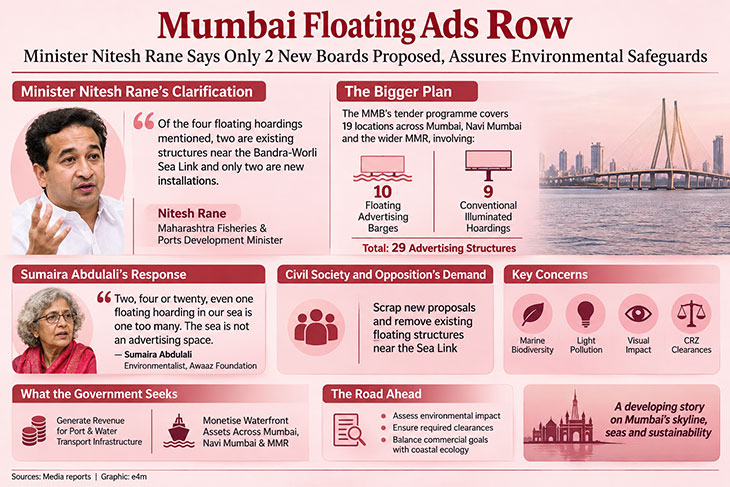
In a post on X on October 30, Rane said reports suggesting that 20 hoardings would come up in the sea were "completely false and misleading". Explaining the proposal, he said that of the four floating hoardings mentioned, two were existing structures near the Bandra-Worli Sea Link and only two were new installations.
The minister, who also chairs the MMB, said he would never support any initiative that compromises Mumbai's marine environment or obstructs its waterfront views. He also offered to engage with those seeking clarification and share relevant information transparently.
The clarification comes after the proposal triggered objections from environmental groups, residents' associations and political leaders, with concerns ranging from visual pollution and commercialisation of public spaces to the potential impact of illuminated advertising on marine biodiversity.
Shiv Sena (UBT) leader Aaditya Thackeray had on October 29 urged Maharashtra Chief Minister Devendra Fadnavis to intervene against the proposal, criticising the Maharashtra Maritime Board’s (MMB) decision to permit floating advertisements at prominent waterfront locations.
In a post on X, Thackeray described the arrangement with the contractor as a “disgusting deal”, arguing that the city’s aesthetics were being compromised by the growing commercialisation of public spaces. He also called for a reduction in excessively bright LED screens across Mumbai.
There appears to be considerable misunderstanding and misinterpretation surrounding the hoarding tender floated by the Maharashtra Maritime Board (MMB). Let me clarify the facts. Of the four floating hoardings proposed, two are existing structures near the Sea Link, and only two are new proposed installations. The information being circulated that 20 hoardings are going to come up in the sea is completely false and misleading. As the Minister for Ports and Chairman of MMB, I would like to put these facts on record. I am also a proud Mumbaikar, and would never support any initiative that compromises Mumbai’s marine environment or obstructs its beautiful waterfront views. We are happy to engage with anyone seeking clarification and share all relevant information transparently. Let us not unnecessarily politicise this issue. The Devendraji Fadnavis-led government is committed to both environmental responsibility and progressive development. The two must go hand in hand. I hope this puts the facts in perspective. @Dev_Fadnavis @CMOMaharashtra
— Nitesh Rane (@NiteshNRane) October 30, 2026
Rane’s remarks are being seen in the socio-political circle as a sign of the Maharashtra government softening its stance.
However, his clarification does not amount to a withdrawal of the wider advertising initiative. The MMB's tender programme covers several waterfront, jetty and bridge locations across the Mumbai Metropolitan Region (MMR), involving both floating advertising barges and conventional illuminated hoardings.
Also Read: Maharashtra Maritime Board plans floating ads at 20 Mumbai waterfront sites
Mumbai’s floating ad plan faces opposition from citizens, political leaders
Don't trim the plan. Drop it: Awaaz Foundation
Awaaz Foundation, led by environmentalist Sumaira Abdulali, has maintained that the issue goes beyond the number of floating hoardings. The foundation wants the Maharashtra Maritime Board (Regulation of Display of Advertisements) Regulations, 2026, withdrawn, arguing that commercial advertising along the coastline could have consequences for marine ecology, biodiversity and the character of public waterfronts.
The foundation had taken up the issue months before the latest controversy. In a letter dated May 9, 2026, addressed to Chief Minister Devendra Fadnavis, Abdulali sought his personal intervention against the regulations, which permit several forms of advertising along coastal areas under the MMB's jurisdiction.
These include illuminated hoardings, LED and digital displays, laser shows, hot-air balloons, aerial advertising, advertisements on vessels and barges, and floating structures.
Awaaz Foundation argued that the notification had been issued without adequate scientific assessment of the short-, medium- and long-term effects of advertising-related light pollution. It flagged the potential impact on migratory birds, mangroves, marine ecosystems and nearby residential areas, besides raising concerns over sleep disruption, public health and road safety.
Abdulali has specifically warned that LED lights from floating billboards near Worli, the Bandra-Worli Sea Link and Carter Road could penetrate up to 40 metres underwater, potentially disturbing marine organisms and disrupting the marine food chain. Speaking to a TV channel, she argued that the sea should not be turned into an advertising screen, adding that light pollution in marine areas needs to be taken as seriously as noise pollution.
The foundation has sought withdrawal of the notification, public consultations and a personal hearing before the concerned authorities. It has also called for scientifically informed restrictions on the brightness, animation, size and placement of advertisements, along with a prohibition on commercial advertising in areas of scenic beauty.
Awaaz Foundation has cited international examples, including New York and Tokyo, where illuminated advertising is restricted to designated commercial zones. Its position is that the government should first assess the ecological and public-health implications of such installations instead of relying solely on licensing conditions and statutory permissions.
The tender scope and the OOH opportunity
The MMB's September 2026 tender document reportedly comprises 19 location-specific tenders across Mumbai, Navi Mumbai and the wider MMR. According to the tender details reported by Media4Growth, 10 tenders concern floating advertising barges, while nine cover conventional illuminated hoardings. Collectively, the documents specify 29 advertising structures across the identified locations.
The floating advertising packages cover locations such as Juhu Beach, Lotus Jetty, Worli Jetty and the Bandra-Worli Sea Link jetty in Mumbai, besides Vashi Bridge, Airoli Road Bridge, Mumbra Creek, Vasai Creek and Mandwa Terminal. The conventional hoarding proposals include Marve Jetty, Kadeshwari Promenade, Carter Road and locations in Navi Mumbai and the wider region.
The distinction is important: the 20-location figure refers to the broader waterfront advertising initiative, not 20 new floating hoardings in Mumbai's sea. Rane's statement addresses the number of floating structures he says are proposed, while the wider tender programme includes multiple advertising formats and locations.
Under the Design, Build, Finance, Operate and Maintain (DBFOM) model, selected agencies would finance, install and maintain the advertising infrastructure in return for advertising rights. The proposed licensing period can extend up to 10 years, subject to statutory permissions and other approvals. For instance, the Juhu Beach floating barge tender specifies a minimum annual licence fee of approximately Rs 31.63 lakh, while the Vashi Bridge package specifies approximately Rs 1.02 crore annually.
For outdoor advertising companies, the initiative could open up a new category of inventory beyond conventional roadside hoardings, offering high-visibility locations across waterfronts, bridges, promenades and maritime infrastructure. For the MMB, the stated objective is to monetise its assets and generate revenue for port facilities and water transport infrastructure.
However, the commercial opportunity comes with regulatory and environmental questions. The Maharashtra Coastal Zone Management Authority has reportedly flagged the absence of requisite Coastal Regulation Zone clearances for proposed installations. The tender framework also requires successful bidders to obtain statutory permissions and structural approvals before executing projects.
Read more news about Out of Home, Internet Advertising, Marketing, Digital Media, TV Media
For more updates, be socially connected with us onInstagram, LinkedIn, Twitter, Facebook, YouTube & Google News
