The great Pujo land grab: Brands compete for space on Kolkata’s streets
From a 50% increase in SUTA’s OOH spend to 75,000 sq. ft. of festive branding by Emami’s WeMe, brands are turning Pujo’s cultural capital into advertising real estate
 by
by
Published: Oct 13, 2026 9:17 AM | 6 min read
 Follow Us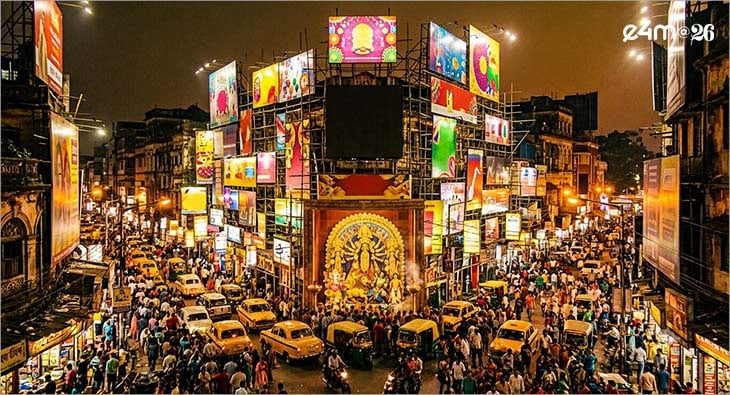

- Durga Puja festivities in Kolkata are underway, with increased foot traffic expected in the final days as the city prepares for pandal-hopping and food trails.
- Brands are capitalizing on the festival through various advertising strategies, including pandal sponsorships, temporary structures, and experiential marketing to engage consumers.
- Notable increases in outdoor advertising spending have been reported, with some brands, like Eden Realty Group, increasing their budgets significantly compared to last year.
- Local businesses are also leveraging the festival for visibility, using targeted sponsorships to strengthen brand recall within their communities.
Durga Puja has begun, and Kolkata’s streets are getting decked up for the final three days of festivities, when footfall is expected to peak. The pandals are taking shape, neighbourhoods are lighting up, and the city is preparing for its annual ritual of pandal-hopping, food trails and long queues that stretch well into the night.
For brands, it is also time to claim their spots.
Pandal entrances are being branded, temporary structures are carrying advertising, and large-format billboards are competing for attention across the city. Elsewhere, food stalls, product sampling, installations and sponsored celebrations are giving advertisers ways to get closer to consumers. During Pujo, the advertising opportunity extends well beyond the conventional hoarding. The festival itself becomes the medium.
Read: Durga Puja’s hidden OOH economy: Is AdEx missing a chunk?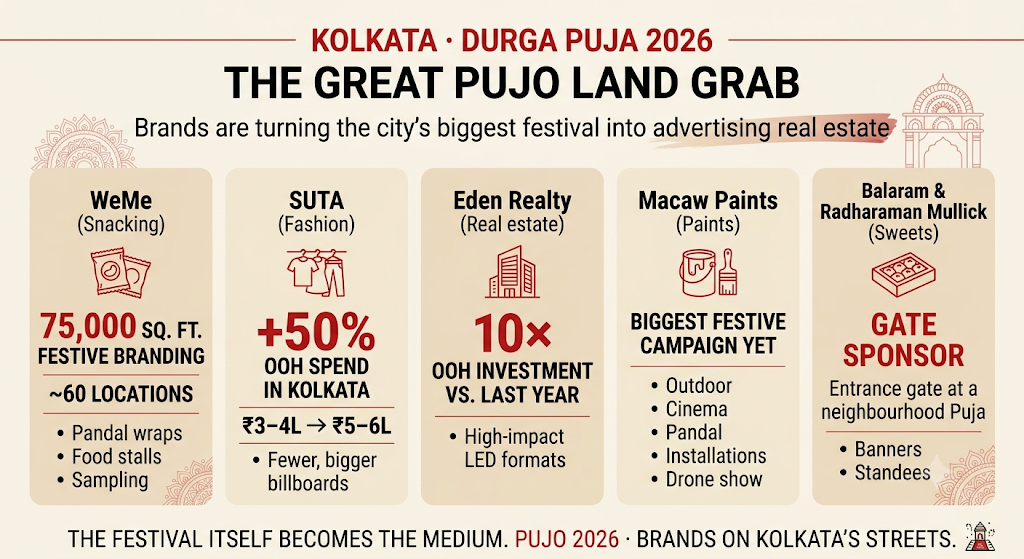
The commercial activity around the festival extends beyond conventional outdoor advertising. Industry players point out that temporary structures, pandal sponsorships and other festival-linked formats often fall outside traditional OOH accounting, despite their growing visibility across the city’s festive landscape.
The scale of individual campaigns gives a sense of how brands are approaching the opportunity this year. Emami Agrotech’s snacking brand WeMe has taken up temporary outdoor inventory across around 60 strategic locations in Kolkata, covering more than 75,000 sq. ft. of festive branding. The campaign includes pandal wraps, stretch banners and other high-visibility formats, alongside school engagement initiatives, residential welfare association programmes, food stalls and product sampling.
“Given the central role that food, community and festivities play during Durga Puja, pandal and neighbourhood activations provide a highly relevant platform for the brand to engage meaningfully with consumers across Kolkata,” an Emami spokesperson said.
For a snacking brand, the logic is straightforward. Pujo is a time when people are out in groups, exploring neighbourhoods and spending time around food. Being present at these locations gives the brand an opportunity to do more than put its name in front of consumers; sampling can bring the product directly into the experience.
The spending is rising, too, although not every brand is approaching the medium in the same way.
SUTA founders Sujata Biswas and Taniya Biswas said the brand has increased its Kolkata OOH investment from approximately ₹3–4 lakh last year to ₹5–6 lakh this year, a rise of roughly 50%. It has also invested in OOH in Bhubaneswar as part of its Puja campaign.
The shift is not simply about spending more. Last year, the brand used pole kiosks, train station TV screens and mobile vans. This year, it has moved towards large-format billboards in prime Kolkata locations. “We wanted to create fewer but bigger brand moments, rather than simply increasing the number of touchpoints,” the founders said.
For a brand that typically operates within a digital ecosystem, the festival offers an opportunity to establish a physical presence in the places where consumers are spending their time. The aim is not necessarily to generate an immediate sale from every placement, but to make the brand more visible and memorable during a period of heightened public activity.
Eden Realty Group has taken a more aggressive spending approach. Baisakhi Sarkar Datta, DGM, Marketing, said the company’s OOH investment is ten times higher than last year. Its campaign uses high-impact LED formats and other outdoor media to strengthen its presence during the festival.
“Durga Puja is a high-impact moment in the cultural calendar. A great opportunity for brands to stay top of mind and connect with people when the city comes alive in celebration,” Datta said.
The tenfold increase is striking, though the company has not disclosed its absolute investment, making it difficult to assess the scale of the increase in rupee terms.
Macaw Paints, meanwhile, is combining conventional OOH with a more experiential approach. Its campaign includes premium outdoor placements, cinema, pandal branding, large-format installations and festival-led experiences, with Eastern India at the centre of its Durga Puja and Dussehra activity. “This is Macaw Paints’ biggest festive campaign yet, and our investment this season is significantly higher than last year,” said Megha Beriwala, Director of Marketing at Macaw Paints.
The brand is expanding its Puja pandal at Central Park, Salt Lake, and increasing its association with the Dussehra and Ravan Dahan celebrations at the same venue. The plans also include a drone show, alongside premium outdoor placements across West Bengal and other parts of India.
Here, the line between advertising and entertainment begins to blur. A branded installation or sponsored celebration can offer a consumer something to look at, photograph and share. It can make the brand part of the occasion rather than simply another message competing for attention.
But there is a catch. People may remember the installation, the spectacle or the drone show without necessarily remembering who paid for it. The bigger the activation, the more important it becomes to connect the experience to the brand.
GRPHK
The opportunity is not restricted to large advertisers with substantial festive budgets. For local businesses, neighbourhood Pujas can offer a more targeted route to visibility.
Balaram Mullick & Radharaman Mullick Sweet has sponsored an entrance gate at a Durga Puja near its Jyangra outlet, close to Chinar Park, through an association with the local MLA’s Puja. The sponsorship includes venue branding, banners and standees.
The sweetmaker says its outdoor strategy also extends beyond the Puja window. Its representatives, Goutam Mallick, Sole Proprietor and Director, and Rishav Mullick, Director, said consistent outdoor visibility had strengthened brand recall and led to more direct enquiries and business generation.
For a neighbourhood sweet shop, the value of a Puja association may be less about reaching the largest possible audience and more about staying familiar to people who live nearby. The festival provides a reason to be visible at a time when consumers are already thinking about gatherings, gifts and food.
Perhaps that is the paradox of Pujo marketing. The festival gives brands, big and small, a chance to become part of the city’s collective experience. But while securing a spot at a pandal or along a busy street may be the first step, earning a place in the consumer’s memory is a different challenge.
When the lights dim and the temporary structures come down, the real measure of a campaign may be what people carry home with them: not just memories of the festivities, but a brand they can recall long after Pujo is over!
Read more news about Festive Season, Marketing, PR and Corporate Communication, Internet Advertising, People Movement
For more updates, be socially connected with us onInstagram, LinkedIn, Twitter, Facebook, YouTube & Google News
