How Dhruv Rathee turned video essays into real-world clout
Dhruv Rathee has turned video essays into real-world influence, using a massive digital following to shape public debate and challenge traditional media and political power structures
 by
by
Published: Oct 13, 2026 9:11 AM | 5 min read
 Follow Us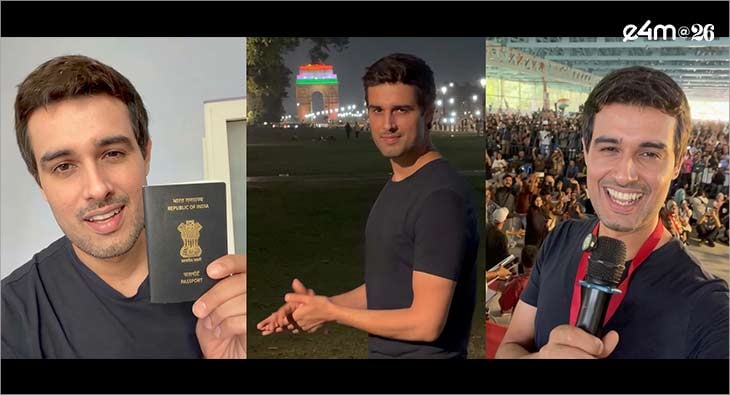

- YouTuber Dhruv Rathee, who has over 33 million subscribers, held a formal press conference in New Delhi after being released from police detention, highlighting the evolving role of digital creators in shaping political discourse in India.
- Rathee's rise from a small YouTuber to a significant political voice reflects a strategic shift in content, combining political analysis with high-production documentaries, which has attracted a large and diverse audience.
- His recent detention and subsequent press conference underscore the tensions between traditional media and independent creators, as Rathee operates without the constraints faced by legacy news organizations.
- Despite facing legal challenges and criticism from political figures, Rathee's ability to mobilize a substantial online following demonstrates the growing influence of digital platforms in civic engagement and political authority.
When a creator commanding 33 million subscribers trades a European recording studio for a microphone-jammed briefing table in the national capital, the traditional boundaries of the creator economy dissolve.
On Sunday evening, hours after walking out of preventive police detention in Gurugram, YouTuber Dhruv Rathee did something almost unheard of for an internet creator: he convened a formal press conference for legacy national newsrooms.
Read On: Why brands are looking beyond reach to turn creators into revenue drivers
“A small YouTuber from a small village in Haryana is giving a press conference,” Rathee told a room packed with camera crews. “Our Prime Minister has not been able to give a press conference in 12 years. Press Conferences: Dhruv Rathee 1, Narendra Modi 0.”
The quip immediately captured social feeds, but the real story lies in the structural shift behind it. Ten years ago, Rathee was an engineering student in Germany filming smartphone travelogues for 14,000 subscribers. Today, his network commands over 40 million followers and 8.7 billion collective views. His recent detention, ahead of protests surrounding the Cockroach Janta Party’s (CJP) demonstration at Jantar Mantar over electoral roll discrepancies, signals that India’s top digital explainers are no longer just commenting on the news cycle. They are shaping it on the ground.
Engineering the 33-Million Funnel
Rathee’s transition into a political counterweight is rooted in a deliberate commercial strategy.
View this post on Instagram
While YouTube remains the sole battlefield where Rathee’s flagship channel (~33.2 million) marginally edges past Prime Minister Modi’s official feed (~31.4 million), Meta’s visual arena illustrates the real chasm in institutional reach. On Instagram, Rathee commands a formidable creator-tier following of ~19.5 million. Yet, that footprint is dwarfed more than fivefold by Narendra Modi’s ~106.6 million followers—a global record that made him the first political figure to cross nine figures on the platform.
Read On: Netflix vs YouTube: How platforms are competing to keep top creators exclusive
The contrast sharpens the dynamic of Rathee’s challenge: an independent creator armed with high-engagement video retention and 19 million Instagram followers, testing his street-level leverage against an incumbent backed by over 300 million collective followers across the global web.
In the Indian creator ecosystem, explicitly political channels rarely scale into mass commercial ventures; they face demonetisation, legal notices, and advertiser boycotts. Between 2020 and 2023, Rathee re-engineered his content pipeline. He paired political analyses with accessible, high-production documentaries covering aviation disasters, nuclear energy, world history, and consumer finance.
The shift proved commercially and editorially decisive. The neutral, curiosity-driven videos opened up standard advertising inventory and drew millions of apolitical young Indians into his ecosystem. When election seasons or civic controversies arrived, Rathee already had an addressable audience that dwarfed the circulation of India’s top English print dailies. His 2024 general election series—anchored by videos questioning democratic backsliding—clocked tens of millions of views each, functioning as de facto informational collateral across north India.
Legal Hurdles and Brand Friction
That scale has brought substantial corporate and political friction.
In 2023, FMCG major Dabur India dragged Rathee to the Calcutta High Court over a video titled “The Dark Truth about Fruit Juices,” alleging commercial disparagement of its packaged fruit juice brand Real. The dispute dragged through courts before an amicable settlement in mid-2024 saw the offending branding scrubbed.
Months later, BJP functionaries filed defamation suits in Mumbai over his commentary on online trolling networks. Cultural critiques, including an AI-rendered video on Sikh history, drew objections from the SGPC and were promptly retracted.
Read On: How political expression is becoming an economic risk for creators
Yet, while traditional news channels navigate regulatory compliance and corporate ownership constraints, Rathee operates with a lean, agile setup: an offshore studio, distributed editors, and primary monetization driven by direct view volume, memberships, and courses.
Algorithmic Capital Meets the Street
Rathee’s arrival in Delhi and subsequent detention underscored the tensions of this shift. While traditional politicians questioned his motives and opponents alleged foreign backing—a claim Rathee brushed aside during Sunday’s press meet—his appearance demonstrated an undeniable reality: digital distribution has created a new kind of civic authority.
Though Rathee distanced himself from formal party politics at the briefing, stating he was acting purely in an individual capacity, the political fallout was immediate.
View this post on Instagram
The Sunday spectacle laid bare an uncomfortable truth for both legacy broadcasters and political strategists: distribution power has decisively migrated. Rathee does not rely on cable carriage fees, studio sponsors, or party press releases. Backed by a decentralised editing pipeline and 40 million subscribers who trust his screen more than an evening prime-time debate, he has built what legacy media spent decades constructing—unfiltered access to the Indian living room. When a video essayist can step off an international flight, spend a night in police detention, and summon the country’s broadcast cameras to keep score with the Prime Minister, the creator economy is no longer just selling consumer goods. It is negotiating sovereign political power.
Read more news about Influence Zone, Marketing, PR and Corporate Communication, Internet Advertising, People Movement
For more updates, be socially connected with us onInstagram, LinkedIn, Twitter, Facebook, YouTube & Google News
