#e4mXplains: Satellite internet is coming to India. Will advertising change with it?
As Starlink, Jio & Airtel services await clearance for commercial operations, the connectivity tussle raises an unfamiliar question for advertisers: what changes when the internet comes from space?
 by
by
Published: Oct 13, 2026 9:26 AM | 5 min read
 Follow Us

- Satellite internet services, including Elon Musk's Starlink, Jio's venture, and Bharti-backed OneWeb, are facing regulatory challenges in India as they prepare for commercial operations amid accusations of obstruction and favoritism.
- Jio and Airtel have signed agreements to potentially distribute Starlink services, indicating a collaborative approach among competitors in the satellite broadband market.
- India has a significant demand for satellite broadband, particularly in remote areas where traditional internet infrastructure is lacking, with a projected market value of $1.9 billion by 2030.
- The impact of satellite internet on India's advertising market remains uncertain, as it may increase connectivity but not necessarily expand the unique audience reach for advertisers.
Satellite internet hasn't quite arrived in India yet, but it's already generating some decidedly terrestrial drama. With Jio Platforms preparing for its much-anticipated IPO, Elon Musk has promised affordable Starlink connections while accusing powerful interests of obstructing the service's entry into the country.
The government has denied allegations of favouritism, even as Starlink, Jio's satellite venture and Bharti-backed OneWeb navigate the regulatory hurdles standing between them and commercial operations.
There is, however, a rather amusing plot twist. Jio and Airtel have also signed agreements to explore distributing Starlink services once authorised. So while the headlines suggest a three-way battle for India's satellite broadband market, the competitors could end up selling one another's services. Apparently, even when the internet comes from space, you still need someone on the ground to sell it.
But before we get to the business of selling it, a more basic question: what, exactly, are they selling?
Why everyone wants to be a media company? Read on
Satellite internet 101
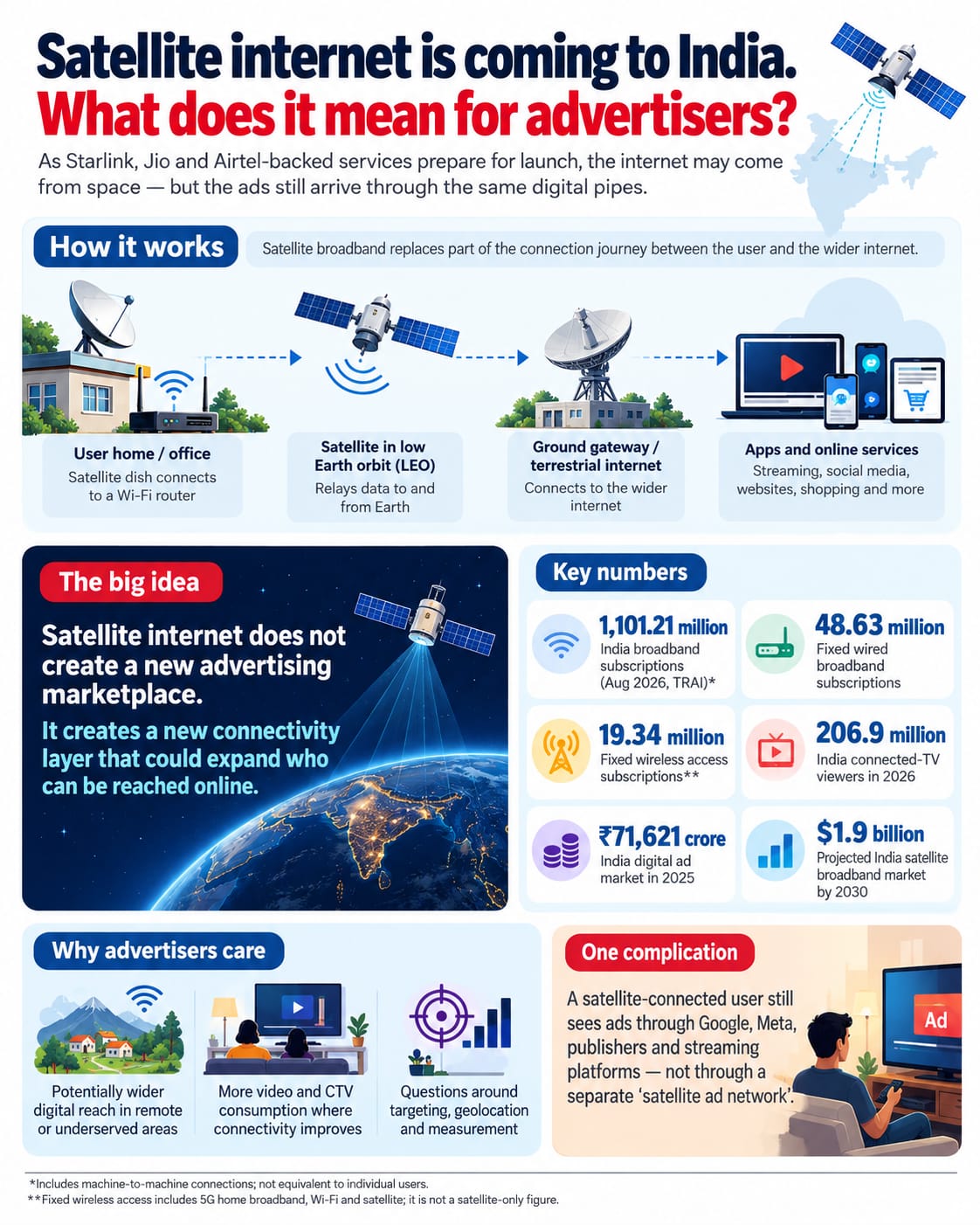
The internet travels through cables, towers and undersea networks. Satellite broadband replaces part of that journey: the connection between a customer and the wider network.
A terminal, usually a small dish, communicates with satellites overhead. They relay data to ground stations connected to the terrestrial internet, sometimes using inter-satellite laser links first. A router then provides ordinary WiFi inside the home or office. The WiFi itself is not coming directly from space; the connection feeding it is. Unlike direct-to-home satellite television, this is two-way communication: users send data as well as receive it.
As with so many other things, not all satellites are equal. Traditional geostationary satellites orbit about 36,000 kilometres above Earth.
Starlink's low-Earth-orbit satellites operate at roughly 550 kilometres, substantially reducing the distance signals travel and therefore latency, the delay between clicking something and receiving a response. Jio's partnership with SES also involves medium-Earth-orbit and geostationary capacity.
Different heights, different economics, same basic objective: provide connectivity where cables and towers struggle.
Why does India need another broadband network?
India is not exactly short of internet subscriptions. TRAI counted 1,101.21 million broadband subscriptions in August 2026, although that includes machine-to-machine connections and should not be mistaken for individual users. Excluding those connections, the figure was 1,010.28 million.
But access is uneven. Only 48.63 million subscriptions were for fixed wired broadband, against 19.34 million for fixed wireless access, a category covering 5G home broadband, WiFi and satellite, not satellite alone. Jio had 538.03 million broadband subscriptions across technologies, Airtel 386.39 million.
Satellite's opportunity is therefore less about replacing fibre in a well-connected Delhi apartment and more about reaching a remote village, mountain school, hospital, worksite or island where laying fibre is expensive and maintaining reliable mobile coverage is difficult.
The potential market is not insignificant, though its scale remains uncertain. A Deloitte estimate cited by Reuters projects India's satellite broadband services market at $1.9 billion by 2030. That is connectivity revenue, not a forecast for advertising.
And affordability is no footnote. India's mobile data costs roughly eight US cents per gigabyte, according to Reuters. Satellite terminals, subscriptions and limited network capacity must compete against that very terrestrial reality. Indian consumer tariffs have yet to be established.
How do you advertise on it?
Mostly, exactly as you do now.
Imagine a family in a poorly connected Himalayan town watching YouTube through a Starlink connection. The video comes through the satellite network. The advertisement still comes through YouTube's advertising systems. Google selects the ad; an advertiser pays through familiar buying mechanisms. Neither needs to purchase an advertising slot on a satellite orbiting overhead.
How YouTube is changing what success looks like
The same applies to Instagram, a news website or an ad-supported streaming service. Programmatic auctions, platform campaigns, targeting rules and measurement systems remain, fundamentally, internet advertising. The satellite operator supplies connectivity, not automatically a new advertising exchange. There is no reason to assume agencies will need a separate satellite CPM or buying desk.
The dentsu–exchange4media Digital Advertising Report 2026 valued India’s digital advertising market at Rs 71,621 crore in 2025, or 59% of overall ad spending. Satellite broadband would initially extend access to that existing advertising economy.
What could change is who gets connected, how reliably and on which screens.
Ormax Media estimates India had 664.9 million online-video viewers in 2026. Its connected-TV audience jumped 60% year-on-year to 206.9 million. Reliable broadband in currently underserved households could make long-form streaming and connected-TV viewing more practical, potentially increasing the audience available to digital video advertisers.
Who’s actually watching your CTV ad? Read on
But there is a distinction advertisers should insist upon: a household moving from mobile data to satellite broadband is not necessarily a new digital consumer. More connectivity can produce more viewing without producing more unique reach.
The measurement wrinkle
An internet connection has an IP address, often used as one clue to where a person is. Starlink's own support documentation says its IP geolocation may be several states or regions away from the customer's actual location. That matters for district-level targeting.
It doesn't mean location targeting stops working. Google, for instance, also draws on device location, search behaviour and other signals. But satellite routing illustrates why network location and audience location are not always the same thing, and why verified reach matters more than an impressive theoretical coverage map.
Ultimately, satellite internet may help close stubborn connectivity gaps. Whether it significantly expands India's advertising market will depend on household adoption, pricing, streaming consumption and, crucially, how many genuinely incremental audiences it creates.
For now, Musk, Jio and Airtel are competing over how Indians get online. The advertising industry has a simpler question to answer: once they arrive, will anybody new be watching?
In a follow-up, exchange4media will examine whether satellite broadband can unlock new audiences and advertising revenue, with insights from brands, agencies and ad-tech platforms on its implications for media buying, targeting and, not least, measurement.
Read more news about Digital Media, Internet Advertising, Marketing News, Television Media, Radio Media
For more updates, be socially connected with us onInstagram, LinkedIn, Twitter, Facebook, YouTube & Google News
