From ₹1 lakh budget to the big screen: How MSMEs are driving India’s CTV boom
For regional and MSME advertisers, the combination of a large-screen environment and local targeting is particularly attractive
 by
by
Published: Aug 24, 2026 9:00 AM | 8 min read
 Follow Us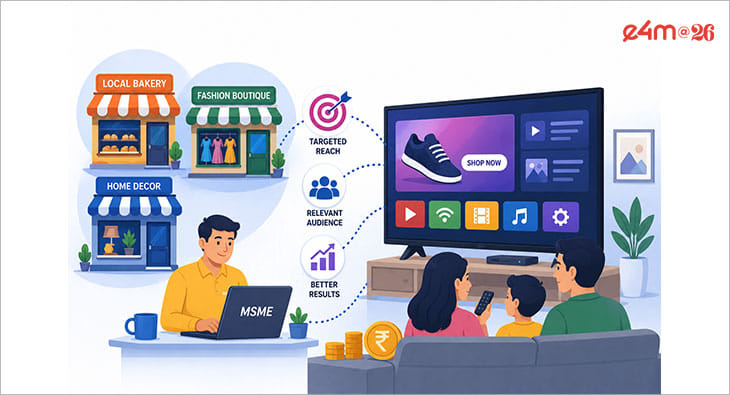

- Connected television (CTV) is rapidly growing in India, with an audience of 207 million viewers across 62-65 million households, a threefold increase since 2022, and significant growth in rural areas.
- Small and mid-sized businesses (MSMEs) are increasingly leveraging CTV for advertising, utilizing digital-style planning and measurement techniques, which allow for targeted campaigns with lower entry barriers.
- The MSME digital advertising market is projected to grow significantly, with estimates suggesting CTV advertising could reach ₹8,000 crore by 2026, driven by the rise of programmatic and self-serve buying options.
- CTV is transforming from a traditional advertising medium into a performance-driven platform, enabling smaller advertisers to access large-screen advertising without the complexities of conventional television buying.
Connected television (CTV) is emerging as the next major growth frontier for India’s advertising industry, but the opportunity is no longer limited to large national advertisers. Increasingly, small and mid-sized businesses are using the medium to combine the reach and impact of television with the targeting, flexibility and measurability associated with digital advertising.
The shift comes as CTV moves rapidly beyond India’s metros. A new report by WPP Media and The Trade Desk, in partnership with Ormax Media, estimates that India’s CTV audience has reached 207 million viewers across 62-65 million households, representing a threefold increase since 2022.
The report also finds that rural CTV viewership has grown 110% in the past year, compared with 55% growth in small towns, 46% in mini-metros and 21% in metros.
For MSMEs, this expansion is significant because the CTV proposition is beginning to look less like conventional television buying and more like performance-led digital media.
“Two years ago, television for an MSME meant a ₹50-lakh cheque and a sales rep who would not return the call. Today it means a dashboard,” said Vishal Khanna, Sales Strategist and Connected Television expert.
“Self-serve access on JioHotstar, YouTube CTV and Samsung Ads has done to television what UPI did to payments — removed the gatekeeper without removing the product.”
Khanna said MSMEs are increasingly buying CTV using digital-style planning principles, including geographical targeting, frequency controls, QR codes and outcome-based metrics.
“What I am seeing MSMEs do differently is telling. They buy CTV the way they buy Meta: geo-fenced to pincodes, frequency-capped, a QR code on every creative, and judged on cost-per-lead rather than GRPs,” he said.
A Nashik solar installer or a Coimbatore mattress brand, for instance, can now run 15-second spots targeted at households in its own district with a monthly budget of ₹1-2 lakh, Khanna said.
“That is not television advertising. That is performance marketing wearing a television costume,” he added.
A large and expanding MSME advertising pool
The opportunity is being supported by the rapid expansion of the MSME digital advertising market. According to the PMAR 2026, MSME digital advertising stood at ₹35,814 crore in 2025, an increase of 21% over 2024. The segment is expected to grow by around 20% in 2026 to approximately ₹42,976 crore.
That pool is larger than the entire print advertising market and represents a sizeable reservoir of potential incremental spending for emerging digital video and CTV platforms.
The development also fits with the broader direction of India's advertising market identified by WPP Media's This Year Next Year (TYNY) forecast. Its February 2026 India forecast projected advertising revenue to grow 9.7% to ₹2,01,891 crore in 2026. The report identified SME, along with technology and telecom, real estate, automotive and education, among the key category growth drivers.
WPP Media's June mid-year update subsequently forecast India's advertising market at about ₹2 trillion in 2026, with the long-term outlook supported by digital adoption, ecommerce, quick commerce and a large SMB base. Social and other digital advertising was projected to reach $8.3 billion, growing 13.2%.
For the CTV market, the implication is straightforward: as the overall SME advertising pool expands, a greater share of that spending can potentially move into television environments that offer digital buying and measurement capabilities.
CTV is no longer a metro-only proposition
The latest WPP Media-The Trade Desk-Ormax research indicates why this opportunity is widening.
CTV now reaches 207 million Indians, while 70 million of those viewers are in rural India. The report says more than 80% of CTV viewing takes place with family or other people, with an average CTV impression reaching 2.5 viewers.
The audience is also increasingly concentrated around premium, long-form consumption. Web series account for 69% of CTV viewing, cricket 64% and films 63%, according to the report. During the 8-10 pm weekday prime-time window, 78% of CTV users are on the big screen.
For regional and MSME advertisers, the combination of a large-screen environment and local targeting is particularly attractive.
A regional brand that previously had to choose between expensive broad-reach television campaigns and highly targeted digital campaigns can increasingly use CTV to narrow its audience to specific markets while retaining the visual impact of a television screen.
This is particularly relevant as CTV penetration rises in smaller markets, where the incremental audience opportunity is increasingly shifting away from metros.
Measurement is changing the MSME pitch
The other major change is measurement.
Saurabh Golani, Senior Vice President, Branding & Head of PrsmX, said MSMEs are looking for measurable reach, efficient frequency, stronger engagement and a clearer connection between media investment and marketing outcomes.
“They're also exploring more innovative formats like ads that show live updates such as weather, sports scores or stock prices alongside the content, giving them more creative ways to connect with audiences in the moment,” Golani said.
He said the growth trajectory of CTV is also encouraging advertisers to reconsider the role of the medium.
“India’s CTV ad spends grew nearly 35% in 2024 to approximately Rs 1,500 crore, and the segment has been projected to grow at around 40% annually,” Golani said.
“We are seeing increasing interest from MSMEs as programmatic access and flexible campaign models lower the entry barrier. Going forward, CTV is likely to become a more integral channel for brands looking to scale without sacrificing targeting or measurement.”
The latest market estimates put the size of the CTV advertising opportunity even higher, depending on the definition used. PMAR 2026 estimates CTV advertising at around ₹6,000 crore in 2025, approximately twice the previous year's level, and forecasts it to reach around ₹8,000 crore in 2026.
FICCI-EY, using a wider definition, estimates CTV advertising revenue at ₹9,900 crore, up 42%, alongside about 40 million weekly active CTV households versus 30 million a year earlier.
The differing estimates reflect differences in market definitions, but point in the same direction: CTV is moving rapidly from an emerging format into a meaningful advertising channel.
First-time advertisers are driving the next phase
For Russhabh R Thakkar, Founder & CEO, Frodoh, one of the clearest signs of CTV's democratisation is not simply the increase in spending by existing advertisers, but the number of brands entering the medium for the first time.
“What we are seeing operationally is that the number of first-time CTV advertisers, many of whom are regional and MSME brands, is growing significantly faster than total CTV ad spend growth,” Thakkar said.
“This reflects the democratisation dynamic: programmatic CTV has lowered the floor of entry, which means more small brands are running their first campaign rather than more large brands increasing their budgets.”
Thakkar pointed to Nielsen's 2025 Annual Marketing Report, according to which 56% of marketers globally planned to increase CTV investment, with a growing share of that intent coming from mid-market and regional advertisers rather than only national brands.
The India opportunity could therefore be less about large advertisers simply shifting existing television budgets to CTV and more about bringing a new class of advertisers into television altogether.
From television reach to addressable growth
The fundamental change is that CTV is beginning to bridge two historically separate advertising models.
Traditional television offered scale, premium content and the impact of the big screen, but was relatively difficult for smaller advertisers to buy with precision. Digital advertising offered granular targeting, flexible budgets and measurable outcomes, but largely played out on smaller personal screens.
CTV brings elements of both together.
The latest WPP Media-The Trade Desk-Ormax report found that 83% of CTV viewers take action after seeing an advertisement, rising to 89% among premium viewers.
That action-oriented behaviour is particularly relevant for MSMEs, for whom advertising is often closely tied to immediate business outcomes such as enquiries, website visits, store traffic, leads or sales.
The growing availability of programmatic and self-serve buying is consequently changing the economics of entry. Instead of committing to large television campaigns months in advance, smaller advertisers can experiment with limited geographic markets, test creative formats, measure response and scale campaigns based on performance.
For a regional retailer, education company, real-estate developer, healthcare brand, consumer durable business or local services provider, that can make the big screen considerably more accessible.
The next battleground: smaller advertisers
The global trend suggests that the expansion of the advertiser base could become as important as the growth in CTV audiences.
The IAB's 2026 digital video work, cited by industry experts, shows the share of smaller advertisers investing in CTV rising from 60% in 2024 to 85% in 2026. India appears to be moving along a similar curve, albeit over a shorter period as self-serve and programmatic CTV buying have arrived later in the market.
For India, the timing is significant. The country's MSME digital advertising pool is already growing at more than 20% annually, while CTV is expanding its reach into the very markets where many regional and emerging brands operate.
WPP Media's TYNY forecast adds another layer to the opportunity: SME is among the categories expected to contribute to advertising growth, while the broader market continues to formalise and digitise.
The result could be a fundamental change in the composition of CTV advertising.
Rather than being a premium extension of television bought primarily by large national brands, CTV could increasingly become an acquisition and growth medium for thousands of smaller advertisers — from a local solar installer targeting households in a district to a regional consumer brand seeking to build awareness beyond its home market.
For the television industry, that represents a new revenue pool. For MSMEs, it represents something potentially more important: access to the biggest screen in the house without having to buy television the way it was bought in the past.
Read more news about Digital Media, Internet Advertising, Marketing News, Television Media, Radio Media
For more updates, be socially connected with us onInstagram, LinkedIn, Twitter, Facebook, YouTube & Google News
