The visibility equation: How Q-comm is monetising every pixel
With recommendations and checkout nudges, Q-commerce players are turning the shopping journey into a growing pool of media inventory, say experts
 by
by
Published: Oct 8, 2026 8:45 AM | 9 min read
 Follow Us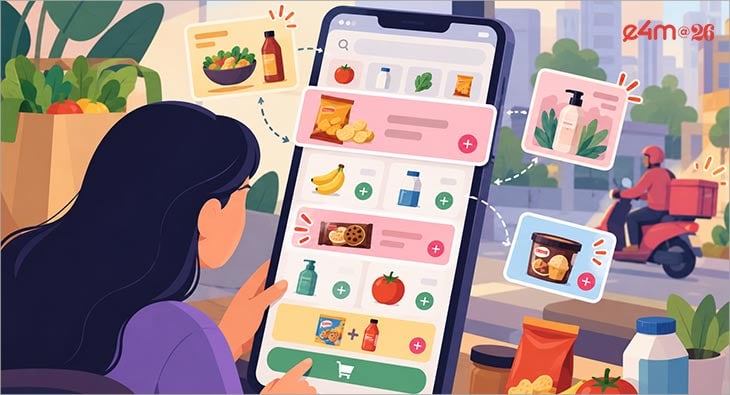

- Quick-commerce (q-commerce) is evolving from a simple delivery service to a media platform where brands can purchase visibility and influence consumer choices during the shopping journey.
- Brands are increasingly investing in search placements, category visibility, and homepage advertising to capture high-intent consumers who are close to making a purchase.
- The digital shelf is becoming competitive real estate, with brands needing to earn, buy, or compete for their visibility, particularly for impulse purchases and basket-building opportunities.
- As q-commerce integrates advertising into the shopping experience, brands are focusing on measuring the incremental impact of their advertising efforts on consumer behavior and sales, while still recognizing the importance of traditional platforms for brand awareness and consideration.
The next time you open a quick-commerce app looking for something as mundane as chocolate, milk or ice cream, pay attention to what you see before you actually buy!
The first product appearing in search. The brands occupying the top of a category. The products getting the most prominent thumbnails. The recommendation sitting underneath what you have already chosen. The suggestion to add something else to your basket. In the world of instant commerce, these are no longer just functional parts of a digital storefront. Increasingly, they are becoming media real estate.
Read more: Is retail media crowding the digital shelf?
That is the larger shift emerging from conversations with brands across chocolates, dairy, beauty, snacking, ice cream and personal care. Quick commerce is moving beyond fulfillment to become a place where brands can buy visibility, influence product choice and, increasingly, shape the consumer journey right up to the transaction.
The interesting question is no longer whether q-commerce is becoming a retail-media channel. It is how much of the shopping journey can become inventory.
The search result is inventory
Search has always been valuable in digital advertising because it captures intent. On q-commerce, however, that intent is sitting just a few clicks away from a transaction.
Read more: More festive touchpoints, but measurement trouble
For Bold Care, q-commerce plays a role in both discovery and conversion. Rajat Jadhav, Co-founder & CEO, Bold Care, said, "Q-commerce plays a role in both discovery and conversion for us, but its biggest advantage is converting high-intent demand."
He added, "On Q-comm, the consumer is already much closer to making a purchase, so visibility on the platform can directly translate into a transaction." The brand is willing to pay a premium for search and relevant category placements because they put it closer to the purchase decision. "We are willing to pay a premium for search and relevant category placements because they put the brand closer to the purchase decision," Jadhav said.
MARS Cosmetics sees a similar dynamic. Nilanjan Deb, E-Commerce Marketing Manager, MARS Cosmetics, said, "High-intent search placements are typically among the most valuable because the consumer is already expressing a clear purchase need."
That makes the search result more than a result. It is paid positioning at the point where intent can become a sale.
The category shelf is inventory
Walk into a physical supermarket and shelf placement has always mattered. Eye-level positions, end caps and prominent displays command a premium because visibility can influence choice.
Q-commerce is recreating that dynamic on a screen. For MARS Cosmetics, the value of q-commerce advertising changes depending on where a product is in its lifecycle. "For established products, the focus is generally on maintaining visibility, improving search rank and driving conversion. For new launches, discovery becomes much more important because we need to build visibility before the consumer actively starts searching for the product," Deb said.
Kanchan Anchpal, CMO, SMOOR, sees the same evolution from a premium-chocolate perspective. For a business where gifting contributes nearly 30% of revenue, reaching a consumer close to a gifting or immediate-consumption occasion can influence the purchase journey. "The ability to reach a consumer close to a gifting moment or an immediate consumption occasion can have a meaningful role in the purchase journey," he said.
The digital shelf, in other words, is no longer passive real estate. Brands increasingly have to earn, buy or compete for their place on it.
The homepage is inventory
Search and category placements are about intent. The homepage is different: it is about owning attention before the consumer has made a choice.
MARS says investments in homepage properties are increasing quarter on quarter, particularly fixed share-of-voice formats. "These placements usually command the highest premium because they offer scale, sustained visibility and stronger ownership of the platform environment," Deb said.
That is an important distinction. A brand is no longer necessarily waiting for a consumer to search for it. It can pay to be part of the environment in which the consumer begins shopping. This is where q-commerce starts behaving less like a delivery utility and more like a media platform.
The product thumbnail is inventory
Perhaps the most interesting piece of inventory is also the smallest. For The Healthy Binge, even the way a product appears in a thumbnail can affect whether it gets noticed. Karak Korke, Co-Founder and CMO, The Healthy Binge, said, "Search visibility, relevant category placement and strong product thumbnails can be more valuable than visibility in isolation because they reduce the distance between discovery and purchase."
That matters particularly for impulse categories. A consumer may not have opened a q-commerce app intending to buy a particular snack. They may simply be hungry, browsing or looking for something to eat.
For Call Me Chunky, that behaviour is central to the business. Ashish Tendulkar, Chief Operating Officer, Call Me Chunky, said, "As a young brand, our job is to get a new flavour in front of someone at the time they are deciding what to order."
The brand's average order is about ₹240, with single-serve 110 ml packs leading in every slot, even late at night. And 53% of orders come between 7 pm and 11 pm. "This is impulse, low-commitment buying, so we value placements tied to active search and category browsing, where intent is highest, over broad homepage visibility," Tendulkar said.
This is not simply fulfillment. It is media meeting impulse.
The recommendation is inventory
Once the consumer has made one choice, the opportunity does not necessarily end.
The opportunity extends beyond converting the product the consumer came looking for. For MARS, the platform can also increase the value of a session by influencing what else enters the basket. “Basket building is also becoming increasingly relevant, especially in beauty, where consumers may enter the platform for one product and add complementary products within the same session,” Deb said.
SMOOR similarly sees value in encouraging consumers to discover products, trade up or add something to their basket. "That makes it valuable not only for converting existing demand, but also for encouraging consumers to discover a product, trade up or add something to their basket," Anchpal said.
The implication is significant: the media opportunity does not stop when intent has been established. It can continue while the basket is being built.
The checkout nudge is inventory
This is where the boundary between advertising and commerce gets particularly thin. A recommendation to add another product. A swap for a premium variant. A complementary product surfaced just before payment. A limited-time offer. The consumer may experience these as shopping suggestions. For brands and platforms, they can increasingly represent monetisable touchpoints. That is why q-commerce's appeal to marketers is not simply that it can deliver a product in minutes. It can place advertising inside the transaction itself.
And that changes the media proposition. Meta can create awareness and desire. Google can capture search intent. Q-commerce can potentially influence what happens after the consumer has entered the shopping environment and before the payment is completed.
But is it really incremental?
There is one problem with this growing pool of inventory: proximity to purchase is not the same as creating the purchase. Every brand interviewed for this story comes back to some version of the same question.
For SMOOR, the bigger challenge is moving beyond attributed sales to understand what the advertising actually changed in consumer behaviour. “The real question is whether advertising created an incremental action, whether it brought a new consumer into the brand, influenced product choice, increased basket value or brought forward a purchase,” Anchpal said.
Bold Care tracks incremental sales, new customer acquisition and changes in purchase behaviour rather than relying only on ROAS. "Beyond ROAS, we track incremental sales, new customer acquisition and changes in purchase behaviour, while comparing performance against our usual baseline," Jadhav said.
MARS goes further, looking at paid versus organic sales, baseline sales, search rank, share of search, conversion rates, category share and overall sales uplift. "We look at paid sales versus organic sales, baseline sales before and after campaigns, changes in search rank, share of search, conversion rates, category share and overall sales uplift," Deb said.
The Healthy Binge looks at order-volume movement after promotional investments, brand-keyword performance and repeat behaviour. "Our own experience has shown a direct correlation between in-app promotional investments on Zepto and order-volume spikes within 48 hours, which reinforces the role of the platform in driving discovery as well as conversion," Korke said.
For Call Me Chunky, repeat is the more honest test. "On incrementality, repetition is our most honest yardstick," Tendulkar said. "If ad-led trials convert into repeat purchase, the spend is creating demand rather than harvesting it."
That distinction matters because retail media has an obvious attribution advantage: the ad and the transaction can sit almost next to each other. But just because the platform can see the sale does not mean the ad caused it.
The media mix is moving into the basket
None of these brands is suggesting that q-commerce replaces Meta or Google. SMOOR still sees social as important for desire, storytelling and consideration. "Social continues to be important for creating desire, storytelling and brand consideration, while search helps us capture an intent that already exists," Anchpal said.
MARS sees broader digital platforms retaining their role in brand building. "Those platforms continue to offer significantly higher reach, which makes them much stronger for brand building, creating awareness and increasing top-of-mind recall at scale," Deb said.
Bold Care describes q-commerce as complementary to social and search, with some performance budgets moving towards the channel.
The shift is subtler. The media plan is extending further down the funnel and into the retail environment itself. Akshayakalpa Organic offers perhaps the clearest indication of how consequential that environment has already become. Shashi Kumar, Founder & CEO, Akshayakalpa Organic, said, "Today, approximately 40% of our revenue comes through quick-commerce platforms, 40% through our own digital platform and 20% through modern retail." The company has also seen a materially higher basket value on q-commerce. "Our average order value on q-commerce is around ₹1,100, compared with under ₹600 for a regular customer," Kumar said.
For brands like these, q-commerce is no longer simply a distribution decision. It is becoming a consumer, commerce and media decision at once. The digital shelf was once where brands displayed what they sold. Now, brands are increasingly paying to decide what gets seen, what gets considered and what gets added to the basket. The new retail rule, perhaps, is not just to stock the shelf. It is to pay for the shelf!
Read more news about Marketing News, Advertising News, PR and Corporate Communication News, Digital News, People Movement News
For more updates, be socially connected with us onInstagram, LinkedIn, Twitter, Facebook, YouTube & Google News