From search to shortlist: AI enters India’s festive buying journey
As shoppers use AI to compare products and build shortlists, brands must win consideration earlier. This festive season, AI may not replace the funnel, but it is increasingly shaping who enters it
 by
by
Published: Oct 8, 2026 8:43 AM | 7 min read
 Follow Us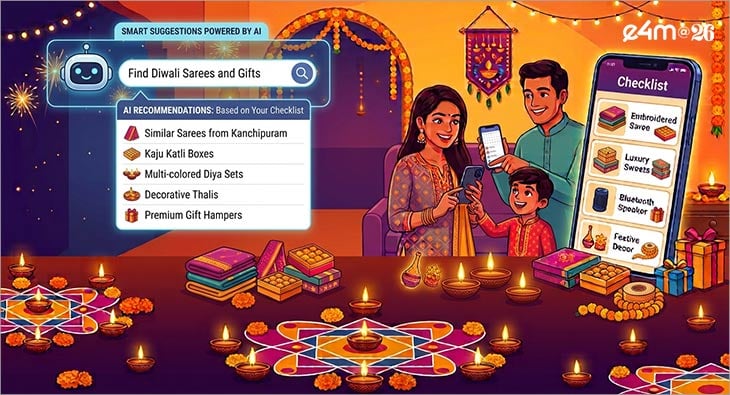

- Diwali shopping habits are evolving, with consumers increasingly using AI assistants like ChatGPT to compare products and influence brand choices, impacting the traditional shopping journey.
- Research indicates that AI-driven search influences 65% of brand selections among users, highlighting its growing role alongside social media in consumer decision-making.
- Brands are adapting their marketing strategies to incorporate AI, focusing on "Share of Recommendation" to ensure visibility in AI-generated suggestions, while still valuing traditional media channels for validation and conversion.
- The shift towards AI in product discovery may disrupt established brand advantages, as consumers can now start their searches based on specific needs rather than brand familiarity, although loyalty remains contingent on product experience.
Diwali is the time of year when even people who approach shopping as a minor administrative burden somehow find themselves comparing televisions, shoes, cookware, phones and things for the house that nobody had urgently needed in September. I remain convinced that a perfectly functional object should be allowed to die with dignity before being replaced, but both festive discounts and relatives have a way of testing such principles.
The ritual used to be familiar. You searched Google, wandered through Instagram, opened Amazon or Flipkart, stared at several nearly identical products, checked reviews, became suspicious of the reviews, and eventually bought something because the discount timer insisted civilisation would end in eleven minutes.
Read On: Beyond Reach: Can AI-generated ads turn attention into action?
Increasingly, however, there is another surface sitting before the digital shelf. Consumers can ask ChatGPT, Gemini or another AI assistant to compare the options, explain trade-offs and produce a shortlist before a marketplace ever gets opened. And for marketers preparing for India's biggest shopping season, that potentially changes where the fight for consideration begins.
BCG's latest research puts LLM search in 22% of Indian purchase journeys, against social media's 29% reach. But the more striking finding comes further down the funnel. Among consumers who use it, LLM search influences final brand choice in 65% of journeys, narrowly ahead of social media at 64%.
That 65% needs qualification: it is not 65% of all Indian purchases. It refers to consumers who encountered LLM search during the journey and said it influenced the brand eventually selected. Even so, it is a striking degree of influence for a relatively new consumer habit. More than half of LLM-assisted journeys in BCG's research also introduced consumers to brands they might not otherwise have considered.
Nielsen IQ (NIQ), looking separately at shoppers across India's top eight metros, points in the same broad direction, finding widespread use of AI for shopping-related tasks ranging from comparison and reviews to product discovery.
For Rajiv Dubey, Head of Media at Dabur, the important change is not the replacement of older channels, but the addition of a new one at a critical stage of the journey.
“Brand discovery is no longer a TV only game. The consumer journey is increasingly TV + social + digital, and LLM-based search is fast becoming an important new layer in consideration,” he says.
His formulation of what comes next is sharper still. Traditional Share of Voice, Dubey argues, may increasingly need to be complemented by “Share of Recommendation,” how frequently and favourably a brand appears in AI-led answers and recommendations.
Read On: Sponsored first, organic later: Is retail media crowding the digital shelf?
“The objective is not to replace traditional media, but to ensure that the brand is part of the consideration set when consumers move from awareness to evaluation,” he says.
For a large incumbent advertiser, that is a meaningful shift. The question is no longer only how loudly a brand speaks, but whether it appears when a consumer asks an AI what to consider.
The fight begins earlier
Gaurav Mangla, CEO – Checkout & Ads at Shiprocket, says that once AI has helped narrow a consumer's choices to two or three brands, performance media has to work harder to move the shopper towards purchase.
The larger opportunity, he argues, lies earlier: becoming one of those two or three recommendations in the first place.
“As AI starts influencing product discovery, understanding the signals that shape these recommendations will become an important part of building consideration and reaching consumers earlier in their purchase journey,” Mangla says.
Brands are already acting on that premise.
Read On: Diwali was once the brief, now Q4 itself is the campaign
Gaurav Sharma, CMO at Campus Activewear, says the company has started working on generative engine optimisation, or GEO, and is seeing consumers discover and purchase products through AI-led searches. Campus is also studying how consumers search across AI platforms and optimising content accordingly.
Yet Sharma does not see that as replacing the rest of the media funnel. Search, social and retail media remain important for validating and converting an existing choice, while social in particular can compress multiple stages of the funnel into a single piece of content.
That matters because the downstream media pool is already enormous. Indian e-retail advertising reached Rs 17,601 crore in 2025, according to the dentsu-e4m Digital Advertising Report, after growing nearly 56% year-on-year.
AI therefore does not need to displace retail media to matter commercially. It only needs to take over part of the discovery and comparison work that previously happened on search engines, social platforms and marketplaces.
From discovery to defence
Niharika Joshi, Co-Founder of Cumin Co., describes that change in more commercial terms.
“For a decade, search and retail media have largely been demand-harvesting — you pay to be visible at the point of purchase,” she says. “If the consideration set is now formed before the shopper arrives at a marketplace, then paying for shelf visibility increasingly means paying to be seen by someone who has already decided.”
Her formulation is that retail media increasingly becomes about “conversion and defence rather than discovery.”
Read On: Search had keywords. Social had audiences. Can ChatGPT sell context?
Cumin Co. has also seen branded searches multiply several times over in a year, Joshi says. That does not establish AI as the cause, but it illustrates the behaviour marketers are watching for: consumers moving from generic category searches towards arriving with a brand name already in mind.
Isha Chakarborty, Head of Marketing at Clinikally, sees the jobs being redistributed similarly: search increasingly supplies proof, social supplies trust, and retail media operates closest to the transaction, where price, offers and visibility can close the sale.
The channels survive. What changes is when each becomes most useful.
Can challengers get onto the shortlist?
The second implication is potentially more disruptive.
Large brands have traditionally entered a shopping journey carrying an obvious advantage: familiarity. An AI query can begin elsewhere entirely.
Instead of asking which cookware brand is best, a shopper can ask which pan suits a particular stove, budget and material preference. Instead of beginning with a familiar beauty label, the question may begin with pigmentation, hair fall or sensitive skin.
Joshi argues that this makes specificity more valuable. Certifications, test results, warranty terms, material disclosures and structured product information are more retrievable than vague claims such as “premium quality.”
Read On: Google turns 28: Searching for answers in a world it helped create
Jasbir Singh, Branding & Digital Marketing Head at E3 Group, makes a related point: conversational AI can capture combinations of intent (price, design, durability, functionality) that are harder to express through a conventional search query, potentially matching consumers with brands at a much more specific moment of consideration.
But Syed Sibtain Iman, Head of Communications and Media at Honasa Consumer, offers an important brake on the more exuberant interpretation.
AI, he argues, can make the consideration set more fluid without suddenly making challenger brands equal to incumbents. In beauty and personal care, a consumer beginning with a specific problem may indeed encounter a brand they had never considered before. But discovery is not loyalty, and recommendation is not conversion.
“AI can get a consumer to try an unfamiliar brand,” he says. “It cannot make that consumer stay with it if the experience doesn't live up to the recommendation.”
That may be the useful way to think about this festive season. AI is not abolishing established media channels, nor making decades of brand-building irrelevant. The consumer still checks the price, reads the reviews, watches the creator video and notices the discount.
But increasingly, they may arrive at all of those places after asking another surface to do the first bit of thinking for them.
And if the shortlist is being made before the shopper reaches the marketplace, brands may have to start fighting for it before they get there.
Read more news about Digital Media, Internet Advertising, Marketing News, Television Media, Radio Media
For more updates, be socially connected with us onInstagram, LinkedIn, Twitter, Facebook, YouTube & Google News
