ShareChat and Moj spotlight cultural moments reshaping India’s festive marketing playbook
At Culture Intelligence Summit 2026, hosted by ShareChat and Moj, industry leaders discussed how brands could participate in cultural nuances of a moment, while staying true to what it stands for
 by
by
Published: Aug 20, 2026 8:07 AM | 5 min read
 Follow Us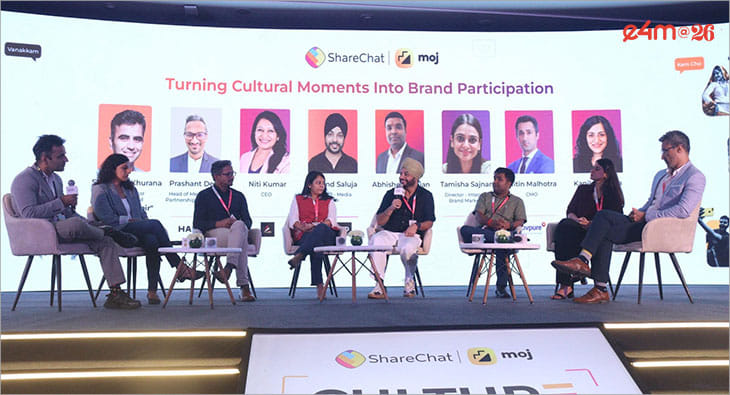

- Marketers in India are shifting focus from major festivals like Diwali and Holi to smaller cultural moments that reflect the country’s diverse traditions and celebrations, as highlighted at the Culture Intelligence Summit 2026.
- ShareChat and Moj report significant traffic spikes during local festivals, indicating the potential for brands to engage with consumers through culturally relevant campaigns beyond the traditional festive calendar.
- Experts emphasize the importance of understanding cultural nuances and human truths to create meaningful connections with consumers, rather than relying on generic advertising templates during festivals.
- Successful brand strategies involve sustained engagement and cultural awareness, allowing brands to participate authentically in community celebrations and build trust with consumers over time.
For marketers, India’s festive calendar has largely revolved around Diwali, Holi and Eid. Increasingly, however, the bigger opportunities are emerging from the thousands of smaller cultural moments that shape how people live, celebrate and connect across the country.
The question for brands is no longer simply how to make a festive campaign relatable. It is how to understand the cultural nuance of a moment well enough to participate meaningfully, while staying true to what the brand stands for.
That shift, from simply being present during festivals to understanding the culture around them, emerged as a key theme at the Culture Intelligence Summit 2026, a two-city event hosted by ShareChat and Moj earlier this month
Ankush Sachdeva, Co-founder and CEO of ShareChat and Moj said that their platform sees a huge traffic spike during the major festivals of Holi, Diwali, but there are spikes that are recorded every week on the platform despite there being no major festival. “These are the days when smaller festivals were being celebrated in some parts of the country which most of us didn’t even know about. This just shows you that there are so many culturally significant moments that we can leverage while factoring our campaigns,” said Sachdeva.
India’s sheer cultural diversity with 1,300+ languages makes this increasingly important. Ankush Sachdeva, Co-founder and CEO, ShareChat and Moj, pointed to the unexpected traffic spikes platforms see around local celebrations. For instance, during recent occasions such as Guru Purnima and Sawan, ShareChat and Moj saw a 30–40% spike in downloads.
A brand's ability to tap into these smaller moments is something that will take them closer to the community. “Your ability to connect with the consumer through multiple aspects is an opportunity that you have and festivals present this opportunity well and if you can add culture to the mix, it is a win-win for all,” said Prasanth Kumar, CEO - South Asia, WPP Media, pointing to language, festivals and other cultural nuances as increasingly important to how brands build connections.
Priya Rege Jaggi, Head of Content & Advocacy, L'Oréal, said the human truth is what holds a brand’s communication together, while culture determines how that truth is expressed across different parts of India. Consumers, she noted, want to “stand out while fitting in” to feel special in their own way while remaining connected to their communities.
That creates a delicate balance for brands. Cultural expression may be hyperlocal, but the underlying consumer truth can remain consistent. Rajiv Subramanian, VP Marketing, Pidilite, similarly argued that marketers need to look beyond transient cultural expressions and identify the more permanent human insight that can carry a brand forward.
The distinction matters particularly during festivals, when brands often rush to establish relevance through familiar symbols, greetings and advertising templates.
AMFI took a different approach during Onam in Kerala, sponsoring a local team in the traditional boat race. The organisation also activated around the Kumbh Mela, where more than 60 lakh people participated.
In both cases, the brand entered a cultural moment that already existed rather than trying to manufacture one.
“For us, it's about our customers' trust in us and so we have to be relatable,” said Punit Dharamsi, Executive Vice President - Marketing, Association of Mutual Funds in India. Giving an example from the Onam campaign in Kerala, Dharamsi said “The collective effort of hundreds of people rowing together became a way to communicate the idea of mutual funds as a product built through collective effort. That is the kind of relatability we look for in campaigns.”
That approach also changes how marketers think about reach. Ankit Desai, Head - Media & Digital Marketing, India & Global Centre of Excellence, Marico, said brands need to first identify the human truth they want to stand for and then translate it into local language, traditions and ways of communicating.
But cultural relevance cannot be built through occasional bursts of activity. The more important question, Desai raised, is whether a brand is “renting reach or earning it over time”. Sustained engagement, he argued, is what ultimately helps brands build trust.
For marketers whose planning is built around a national festive calendar, such moments can easily be missed.
Cultural intelligence, therefore, is not simply about knowing that a festival exists. It is about understanding why it matters to a particular community, what people are doing around it and what role, if any, a brand can legitimately play.
Kaushik Vedula, VP Marketing, Castrol India, made a similar point about communities. Brands, he said, need to participate in consumers’ lives rather than viewing them only through models and datasets. Even something as specific as a weekend ride among a group of riders can reveal a culture, with its own rituals, interests and points of connection.
The opportunity, then, is not simply to make advertising more festive. It is to make brands more culturally aware.
That could mean finding a genuine consumer insight within a major festival, recognising a community celebration that never makes it onto the national marketing calendar, or using new storytelling formats to adapt the same brand truth to different cultural contexts.
For brands navigating an increasingly fragmented India, that may be the more useful way to think about cultural intelligence. It is becoming central to how brands build relevance, earn attention and create lasting connections. The brands that understand not just what people are celebrating, but why it matters to them, are already finding more meaningful ways to participate in their lives.
Read more news about Marketing News, Advertising News, PR and Corporate Communication News, Digital News, People Movement News
For more updates, be socially connected with us onInstagram, LinkedIn, Twitter, Facebook, YouTube & Google News
