In the age of AI, brands risk entering a ‘Sea of Sameness’
As AI enables faster testing, optimisation, and scale, marketers at the e4m Pitch CMO Summit 2026 discussed how to drive sustainable growth without eroding trust, equity, or relevance
 by
by
Published: Mar 16, 2026 10:15 AM | 11 min read
 Follow Us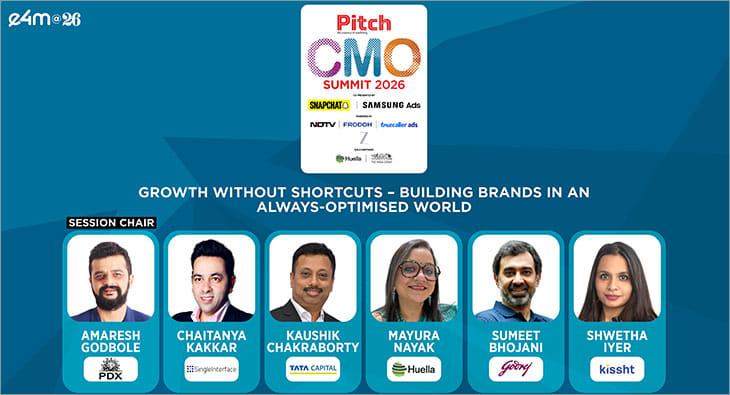

At the e4m Pitch CMO Summit 2026, a panel discussion on brand building in an AI-driven world brought together marketing leaders to examine the tensions between optimisation and brand equity, and debated where human judgement must hold firm against the pull of automation.
Moderated by Amaresh Godbole, CEO, PDX India and Chief – AI Experiences and Solutions, Publicis Groupe India, the session titled "Growth Without Shortcuts – Building Brands in an Always-Optimised World" featured insights from Chaitanya Kakkar, VP, New Business Development, SingleInterface; Kaushik Chakraborty, Head of Marketing and Corporate Communications, Tata Capital; Mayura Nayak, Co-founder, Huella; Sumeet Bhojani, Head, Brand and Strategic Insights, Godrej Enterprises Group; and Shwetha Iyer, SVP and Head of Marketing, Kishht.
Godbole opened by citing a remark that had stayed with him. "The biggest threat to a great brand is not just a competitor but its own marketing automation stack," he said. Coming from the digital world himself, Godbole acknowledged the irony but maintained there was real truth to it.
In a world saturated with data, measurement, and optimisation, he argued that the need for a strong brand has not diminished. If anything, fragmentation of attention has made it the single biggest differentiator.
He then posed the opening question to the panel: what is the biggest myth that marketers believe about data-driven growth?
Kakkar was direct. "We let the data guide and let the human decide. It's more of a data-led approach, but human intuition cannot be missed when making a decision," he said. Working across diverse geographies, he noted that demographics and consumer behaviour varied too widely for any single campaign to apply uniformly across regions.
Chakraborty took aim at the assumption embedded in the term itself. "The myth remains in the name. Data-driven growth doesn't mean that more data equals more growth," he said, stressing that the real skill lies in finding the sweet spot - the point at which data serves the strategy rather than substituting for it.
Nayak echoed this, pointing out that data only captures what already exists. "Data is fact. Brand building cannot happen on pure data. Data is a great amplification mode," she said, warning that marketers who chase data at the expense of brand love risk losing the core essence of what they are building.
For Bhojani, it is a question of sufficiency. "Having good data is necessary, but it is not a sufficient condition to grow," he said. In his view, data must be layered with human insight, creativity, and other inputs to enable truly sustainable growth.
Iyer brought a more pointed observation to the table. "When you beat the data hard enough, it will confess what you want to see," she said. The real danger, she explained, is confirmation bias, i.e. using data not as an honest mirror but as a tool to validate a hypothesis already formed. "If you are looking at data, then you should be open to being defeated by it."
As the discussion turned to optimisation and its implications for brand building, Iyer was candid about the trade-offs she had witnessed in FinTech. Different levers get optimised for different parameters, she said, but somewhere in that process, creativity takes a hit. "Some of us old school marketers still believe in the power of narrative, strong storytelling, appealing to ‘the humanness’. Some of those factors get lost to metrics when you over-optimise."
She pointed to the tension between platform-prescribed frameworks and creative instinct. Google's ABCD framework, for instance, recommends that the brand appear within the first five seconds of a video. "But we build videos where the brand comes towards the end, and those videos work perfectly fine," she said. The key, she argued, is storytelling compelling enough to hold an audience. "If you are telling a story that is so compelling that people stay hooked, your brand can come at the end. But if it's one of your average promo creatives, then maybe all those guidelines make sense."
Kakkar approached it from the vantage of local SEO, an area in which SingleInterface has developed considerable expertise. Clear guidelines, something as fundamental as consistent name, address, and phone number formatting, are non-negotiable, he said. The risks of ignoring them are real. "Suspension rates went up by 80% last year for global brands that had not followed Google Business Profile guidelines," he noted, underscoring that optimisation is both an opportunity and a discipline.
The conversation then moved to one of the more persistent tensions in marketing: the difficulty of measuring brand building against the immediate legibility of performance marketing.
For Chakraborty, the financial services industry actually offers a useful lens here. "We do not have a product that customers can touch and feel. As a result, we have to have a trustworthy, dependable image, and as a brand, one has to invest in that for the long term," he said. At Tata Capital, performance marketing spends are reviewed weekly, dissected by product, and jointly owned with the business. Brand activity, by contrast, is a strategic decision taken at the start of the year alongside the CEO, and held to a different standard. "As long as something major doesn't happen during the year, you stick to it."
When pressed on how the brand's Women's Premier League sponsorship is justified against hard performance metrics, Chakraborty was unequivocal. "It is not comparable," he said. The WPL association, he explained, functions as cultural marketing. It moves the brand into earned media, builds relevance among younger audiences, and generates commercial returns that manifest as increased website visits, app engagement, and eventually, new loan customers. "These people come and search for my brand. My app engagement is increasing. So across the board, whether you are impacting the brand for the long term or becoming part of the cultural discourse, it flows through to commercial outcomes."
A reframe that drew a clear line under the brand-versus-performance debate was offered by bhojani. "I don't think it's brand versus performance marketing. Both have the same goal of sustainable, profitable growth. It's a matter of what timeframe you're measuring," he said.
At Godrej, brand health is tracked through metrics such as mental availability, salience, preference, consideration, and share of search. Performance marketing, meanwhile, is held to cost per acquisition, ROAS, and similar indicators. "That clarity, that there are different objectives, different timeframes, and different ways to measure them, is extremely important."
He went further, making the case for brand as infrastructure. "Brand is a force multiplier for performance marketing. Anyone with a credit card can outbid you on a keyword. It's brand real estate that protects you from that kind of attack," he said. Equally, he cautioned, brand-only spending without performance marketing means leaving money on the table. "Eventually, if you do only performance marketing, you hit a plateau and realise you have to go back."
Iyer illustrated the point through her own journey at Kishht, a stark contrast to the brand-first environments of IBM and Vodafone where she had previously worked. "My founders live and die by an Excel sheet. Everything is about business. There was no brand, no PR, no social, and no content," she said.
With crores going into performance marketing and only a few lakhs into brand building, her first years involved sustained evangelisation. The breakthrough came from meeting founders in their own language. "Don't go to them with metrics they don't understand. I started with elements like ASO, search, SEO, the things that fit into an Excel sheet. There is a graph you can show them." The patient accumulation of credibility eventually paid off. "This December, we onboarded Sachin Tendulkar as our brand ambassador. That was a huge deal for our organisation.”
The panel then explored how partners and solution providers help brands navigate the line between optimisation and over-optimisation.
Nayak described Huella's experience introducing interactive CTV as a case study in building a new category from the ground up. "We always have to show proof by showcasing benchmarks that marketers understand," she said. Beyond impressions and CTRs, their technology tracks engagement on large screens, adding a layer of measurability that brings comfort to brands investing in connected television. "Changing the metrics, adding a few more layers of what you can track beyond simple impressions becomes very comforting," she said.
She acknowledged that reaching core performance-driven brands remains a longer road, but pointed to media agencies as natural partners rather than gatekeepers. "A media agency finds it very difficult to come up with new solutions to take to brands."
Kakkar positioned SingleInterface's work as complementary to brand-building efforts rather than a replacement for them. The firm works with around 450 enterprises managing roughly half a million physical locations, focused on the phase of the digital journey that begins with a search. "50% of the 8.5 billion daily searches on Google carry local intent, and 90% are unbranded which means a customer knows exactly what product or service they want, but not which brand to engage with," he said. That is where local optimisation matters.
He also flagged an emerging shift. "Earlier, you optimised yourself for search keywords. Now, it is about how many times an LLM will cite you as the answer to a customer's query."
When the moderator asked whether AI risks making brands faster but less distinctive, Bhojani was unsparing. "It's no longer a risk because it's already here," he said. The "sea of sameness," as he described it, is a direct consequence of brands defaulting to off-the-shelf LLMs for content generation. "These models are trained on public data, they regress towards the mean, and they give you very safe answers. Over time, brands start looking, feeling, and sounding very similar."
Godrej's response has been to build in-house. The company has developed Amethyst, a proprietary SLM built on a public LLM but trained specifically on Godrej's brand assets, tone of voice, and imagery. "Using brand assets to train the platform so that it follows brand guidelines is something very important," Bhojani said.
The firm also intentionally introduces friction in the creative process. "Sometimes it is important to choose a slightly more provocative headline, tweak the image a little, to break through the clutter. AI, by its nature, will give you very safe headlines and very safe images." The final safeguard, he argued, is human oversight. "AI will give you speed and velocity. But without a human to direct it, the fastest way to enter that sea of sameness is to let it run unchecked."
Chakraborty built on this, drawing a line between efficiency and creativity. "AI is making you more efficient. Use it for bidding, pricing, distribution. But when it comes to creativity and brand building, a lot more human intervention is required," he said.
He also made a case for measurement as a discipline. "Measure brand at the same breadth as performance. It will always push you to think harder and make the brand more long-term and efficient."
"Protect creativity. You have the budget and the ability to convince people in your organisation to invest in the right way. Protect money so that you can experiment with creativity," he closed.
The session closed with a rapid-fire round on industry practices that everyone does but no one should.
Kakkar pointed to keyword stuffing in Google Business Profile names, a shortcut that brands use to boost local discoverability but that signals to Google's crawlers an attempt to game its algorithm. "Suspension rates have grown by 80% year on year. That is one practice which needs to stop."
Chakraborty flagged the overreliance on last-click attribution. "Google takes away the cake many times, but the brand is built over years. A customer remembers your brand when they need it because you are top of mind across various other media as well."
Nayak argued for evaluating campaigns holistically rather than platform by platform. "In such a fragmented media world, optimising a single platform cannot judge the effectiveness of a campaign alone. Optimising across multiple platforms will define whether a brand communication has worked or not."
And Bhojani took on perhaps the most universal frustration in marketing, which is the demand for virality on command. "Whenever you go to make a campaign and ask for money, the response is: ‘why don't you just make it viral?’ It doesn't work that way. Virality is not something you can generate out of your pocket." A fitting note on which to close a conversation about building brands with patience, discipline, and a refusal to take the easy way out.
Read more news about Marketing News, Advertising News, PR and Corporate Communication News, Digital News, People Movement News
For more updates, be socially connected with us onInstagram, LinkedIn, Twitter, Facebook, YouTube & Google News