e4m × Techmagnate roundtable: Marketers rethink visibility in the AI era
As AI changes how consumers discover brands, marketers are balancing traditional search, conversational queries, unified visibility, content credibility and conversion
 by
by
Published: Aug 11, 2026 5:50 PM | 7 min read
 Follow Us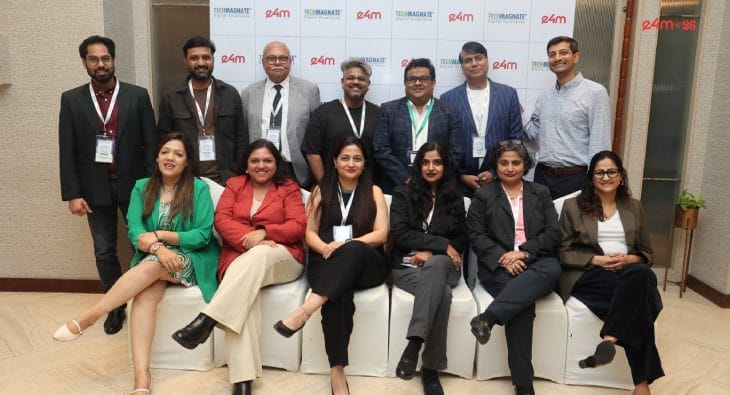

- The landscape of search marketing is evolving, with consumers increasingly using AI assistants for queries, leading to a shift from traditional keyword-based searches to more nuanced, intent-driven inquiries across various formats like AI Overviews and local results.
- Marketers face challenges in creating and managing content at scale, as the complexity of search journeys grows and requires tailored content for diverse consumer intents and contexts.
- The discussion at the e4m × Techmagnate Roundtable 2026 emphasized the need for marketers to balance traditional SEO with AI-led discovery, recognizing that both approaches are essential for maintaining visibility and authority in a fragmented search environment.
- The role of agentic AI was highlighted as a potential solution for optimizing large-scale content processes, but the importance of human judgment in ensuring accuracy and compliance remains critical, especially in regulated industries like healthcare.
For years, search marketing came with a relatively straightforward objective: get the right keyword, rank high enough and drive the user to your website. That equation is becoming considerably more complicated.
Consumers are increasingly asking AI assistants questions they would once have typed into Google, while search itself is expanding into AI Overviews, local results, video, apps and other formats. At the same time, marketers are grappling with a more immediate operational challenge: how to create, optimise and manage content at the scale these fragmented search journeys demand.
The shift was a key theme at the e4m × Techmagnate Roundtable 2026, held in Mumbai under the theme ‘Marketing Is Changing Faster Than Our Operating Models’. The discussion brought together marketing leaders to examine agentic SEO and PPC, unified search and the changing nature of discovery in the AI era.
Opening the discussion, Techmagnate CEO Sarvesh Bagla pointed to a growing disconnect between search activity and traditional website traffic. “Search is increasing, but referral traffic is decreasing across all platforms,” he said, arguing that marketers may increasingly need to think about visibility and impressions rather than clicks alone.
But the roundtable quickly moved beyond the question of whether AI will replace Google. The more immediate concern for marketers was how to operate when consumers are searching differently, across more surfaces and with far more specific intent.
The search journey is getting more complicated
One of the biggest challenges raised by marketers was scale. As search becomes more conversational and audiences become more fragmented, creating one piece of content for one broad audience is becoming less effective.
For businesses operating across micro-markets, the same product or service can have multiple search intents attached to it. A rental home, for instance, may need to be positioned differently for a student, a working professional or someone prioritising proximity to an IT park.
That means content has to reflect not just the product, but the consumer's context, location, lifestyle and intent. The challenge is particularly relevant as AI-led search moves away from short, keyword-based queries towards detailed questions. Instead of searching simply for the “best coffee shop”, consumers can ask for a quiet coffee shop in a particular neighbourhood, with Wi-Fi, suitable for working and serving pastries.
AI systems can then conduct multiple searches, process information from different sources and present a consolidated answer. That fundamentally changes what brands need to optimise for.
As the discussion highlighted, the focus is moving from one keyword to the nuance and intent behind the prompt.
Traditional search isn't going away
For marketers, however, moving into AI search does not mean abandoning the fundamentals of traditional SEO. One participant described the challenge as effectively having to operate with “two legs”: one rooted in traditional search and another moving towards evolving, AI-led discovery.
The point was less about choosing between the two and more about getting the balance right. For challenger brands in particular, traditional search remains an important foundation because established brands already have years of accumulated visibility, content and authority. Moving towards AI-led discovery while neglecting that foundation could create another problem rather than solve one.
The discussion also broadened the definition of search itself. Today, a consumer may encounter a brand through a conventional result, featured snippet, AI Overview, video result, image result, local pack or app listing. Optimising only for the traditional blue links therefore leaves significant parts of the discovery journey unattended.
“Every surface has to be addressed,” was the larger message emerging from the discussion.
Healthcare exposes the credibility problem
If fragmented search makes marketing more complex generally, healthcare adds another layer: trust. Healthcare marketers at the roundtable spoke about the difficulty of creating content that is not only discoverable and engaging, but also medically accurate and defensible.
One participant pointed out that even seemingly simple claims can require extensive verification. Words such as “first” or “best” cannot be used casually when medical journals, competing doctors and other authoritative sources could contradict the claim.
“When you claim first, you have to ensure that it's not there anywhere in the news. You have to ensure in all of the medical journals it is mentioned.”
AI makes that issue even more significant because consumers are increasingly receiving what appear to be ready-made answers rather than simply being directed towards doctors, hospitals or services. For healthcare marketers, the concern is that medical treatment is inherently contextual. An AI-generated answer may sound authoritative while failing to account for individual circumstances.
The result is a tension between information access and information authority.
The balance of power is also changing. As one participant observed, patients now arrive with considerably more knowledge about treatment protocols, pricing and procedures, changing the traditional trust dynamic between doctors and patients.
Discovery may happen online. Conversion doesn't always
Another important thread in the discussion was the gap between discovery and conversion. For some categories, especially high-consideration purchases, search is only the beginning of the journey. A bridal brand, for instance, may see consumers discover products online but complete the purchase offline. In such cases, the marketer cannot measure search purely through a website conversion.
The objective becomes mapping the entire journey, from the first search through performance marketing, local discovery, offline interactions and eventually purchase.
This also changes the definition of a successful search strategy. Traffic may be useful, but traffic without business impact is not necessarily a win. One participant stressed the need to look at both traffic and conversion, and to understand whether the additional visitors are actually translating into purchases, leads or other meaningful outcomes. That distinction becomes even more relevant as AI referrals grow.
The discussion cited research suggesting that AI-referred visitors can have stronger conversion intent because they have already used AI to conduct part of their research before reaching a brand's asset.
Agentic AI promises scale, not a replacement for marketers
The operational answer to the growing complexity may lie in agentic AI. The discussion moved from generative AI, where marketers provide prompts and review individual outputs, towards systems that can connect multiple tasks into a workflow. For SEO, that could mean automating processes such as keyword research, topic generation, content briefs, page optimisation, auditing and publishing.
The appeal is particularly clear for large websites. Instead of teams manually optimising a limited number of pages, AI agents can work across thousands of pages and apply similar processes at scale.
In one example discussed during the roundtable, an online pharmacy was able to optimise hundreds of blogs in days rather than relying entirely on manual execution. Another case involved auditing 20,000 pages in four days, identifying a large proportion of issues that could then be reviewed by humans.
But the discussion repeatedly returned to an important caveat: scale does not eliminate judgement. Especially in regulated categories, AI can accelerate execution, but human teams still need to decide what is accurate, compliant, relevant and appropriate for the brand.
From SEO to a wider visibility equation
Perhaps the biggest shift discussed at the roundtable was that SEO can no longer be treated as an isolated discipline.
The search ecosystem now includes traditional rankings, AI Overviews, local results, video, apps and generative AI. And visibility in one does not automatically guarantee visibility in another.
AI-led discovery also introduces a new layer: brands need to be mentioned by credible third-party sources, not merely have optimised pages on their own websites.
The discussion highlighted digital PR, industry publications, authoritative domains, aggregators and online discussions as increasingly relevant to how brands surface in AI-generated answers. That means the old question: Where do we rank? is becoming only one part of the conversation.
The more useful question may now be: When a consumer asks AI about our category, are we part of the answer? For marketers, the challenge ahead is not to pick between Google and AI. It is to build enough relevance, authority and visibility to remain discoverable wherever the consumer chooses to search.
Read more news about Marketing News, Advertising News, PR and Corporate Communication News, Digital News, People Movement News
For more updates, be socially connected with us onInstagram, LinkedIn, Twitter, Facebook, YouTube & Google News