Walk-ins, enquiries, price premiums: Are proxies enough to prove advertising works?
From matched-market tests to organic-channel tracking, marketers say visibility is easy to count, proving incremental sales remains the harder problem
 by
Published: Nov 10, 2026 8:38 AM | 7 min read
 Follow Us


- Marketing professionals face challenges in attributing brand growth to advertising, as high visibility does not necessarily translate to increased sales or demand.
- Companies like Crompton Greaves and SleepyCat emphasize the importance of analyzing consumer response and purchase behavior, rather than solely relying on reach metrics.
- Attribution models are debated, with some experts advocating for more comprehensive methods to assess the true impact of advertising on consumer behavior and sales.
- The effectiveness of advertising varies by market maturity, with emerging brands often relying on advertising to create demand, while established brands focus on maintaining consumer trust and satisfaction.
A campaign can clock millions of views and still leave a sales team asking where the customers are. That gap sits at the centre of a question every marketing head eventually faces: how much of a brand’s growth can honestly be credited to advertising? While brands have several ways to track visibility and consumer response, establishing whether advertising has generated additional demand remains a more complicated exercise.
When big numbers prove little
Crompton Greaves Consumer Electricals puts its advertising and promotion spend at approximately 3.5-4% of revenue. In Q1 FY27, the company’s digital initiatives delivered over 52 million in reach, while influencer collaborations generated more than 60 million views. The company also reports a 60 basis point gain in fans between FY23 and FY26, and says premium fans now contribute nearly 25% of fan sales.
Tanmay Prusty, Chief Marketing Officer at Crompton, is careful about what the first set of numbers can and cannot show. “Reach, by itself, does not establish incremental demand; understanding its contribution also requires looking at consumer response and purchase behaviour,” he said.
Marketing consultant Dhruv Goel, founder of Brand Catapult, sharpens the point. The metric that matters, he argued, is not exposure. “It becomes critical to assess not just the number of consumers that were exposed to an advertisement, but how many consumers were influenced to buy the product,” Goel said.
The attribution problem
If reach is the easy number, attribution is the contested one. Last-click models tend to reward whichever channel sits closest to the sale, and Goel believes that distorts the picture. “Paid media, including display and search, has become very effective at capturing lower-funnel intent,” he said.
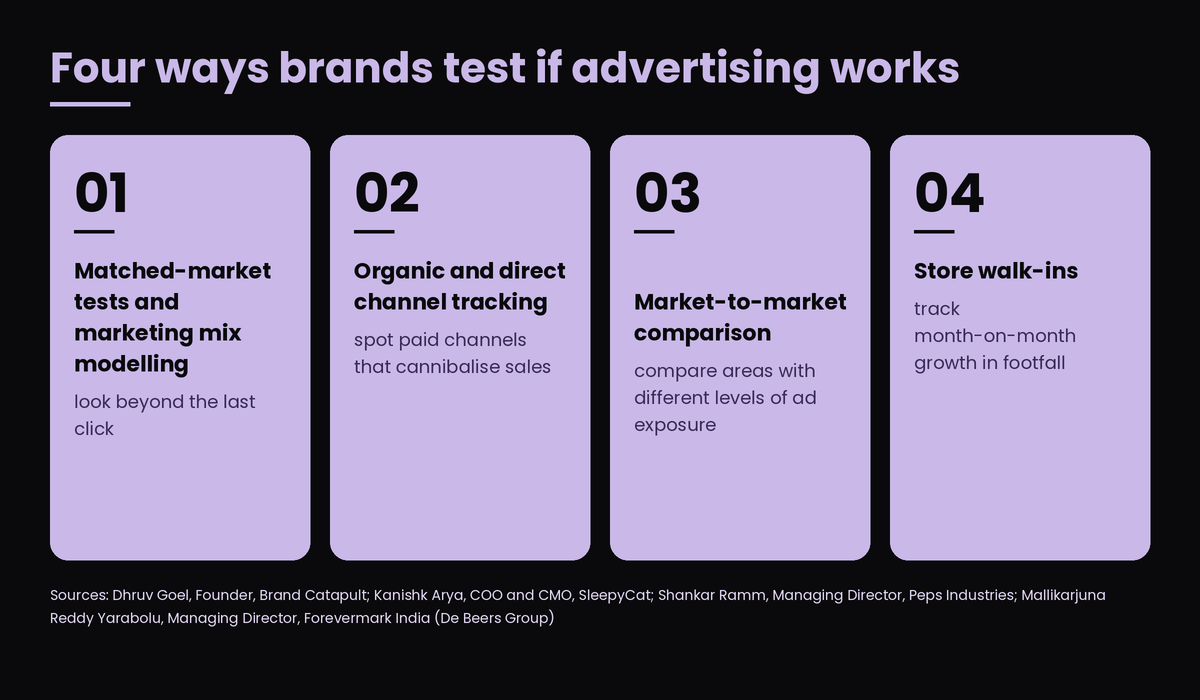
His remedy is methodological: “Therefore, beyond the final click, brands should look to design audience tests with a matched-market framework, and employ marketing mix modelling.”
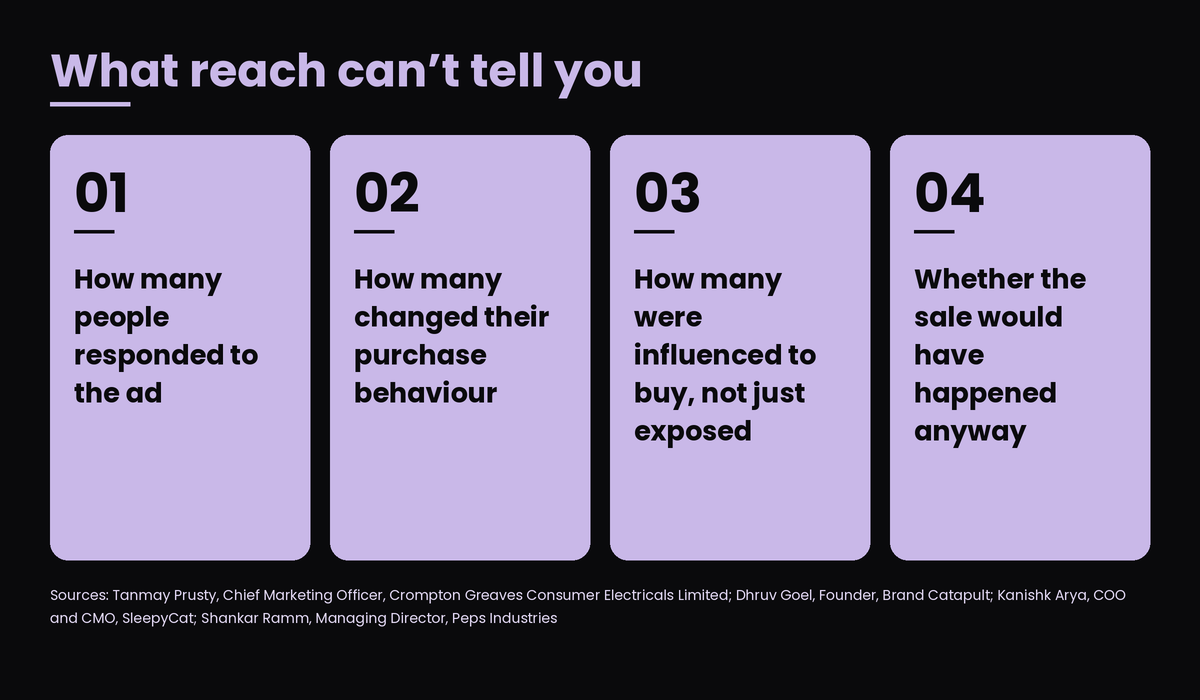
Kanishk Arya, COO and CMO at SleepyCat, does not dismiss attribution tools but does not trust them blindly either. “Attribution tools may sometimes overstate or understate it, but no one can deny the effect,” he said. He is candid about the limits. “This is one of the hardest problems in marketing: pinpointing which spend is generating new demand and which customers would have come to you anyway.”
Arya’s workaround is to treat organic and direct channels as a control group of sorts. “These channels generally do not move up or down very quickly, so if they have dropped, you can check which paid channel is cannibalising them and simply claiming the attribution,” he said. His benchmark remains overall business ROAS, followed by a closer look at how many people a channel brings in are genuinely new to the platform.
Peps Industries takes a geographic route. Shankar Ramm, Managing Director at Peps Industries, described the logic. “We also compare performance across markets with different levels of advertising exposure to understand whether campaigns are attracting new consumers or influencing purchases that would have happened anyway,” he said. Peps also tracks first-time purchases, store enquiries and ecommerce enquiries against its usual business trends.
Creating categories vs converting intent
How much credit advertising deserves seems to depend on where a brand sits in its category’s life. For a challenger in an emerging product, the case is stark. SleepyCat says it is now the number one online player in mattress toppers, a market Arya says barely existed at launch. “This category has been created entirely through advertising,” he said.
Even in a mature category, he claims, effort showed up in results. “Even in an established category like mattresses, as we pushed harder on advertising this year, our market share improved by a few percentage points,” Arya said. He added that pricing strategy had not changed, and that the dealer channel, where older brands’ distribution remains strong, has not been disrupted directly.
Peps, a legacy mattress brand, frames advertising’s role more modestly. Ramm sees it as a starting point, not the whole journey. “Ultimately, advertising brings consumers to the brand, but the product experience, consumer satisfaction and our strong retail network play a critical role in converting that interest into sustained sales,” he said.
The two views are not irreconcilable. One brand is teaching a market that a product exists, the other is competing for trust in a category consumers already know. But they do suggest that “what advertising delivers” has no single answer.
The sale after the sale
For SleepyCat’s Arya, the payoff from advertising does not end at acquisition. Customers, he points out, rarely belong to one brand. “Advertising keeps you relevant and top of mind when they do,” he said, referring to the moments when buyers re-evaluate their options.
He sees a second effect in how much customers buy. “Customers would not have come to us for these products if we were not advertising them,” Arya said, pointing to SleepyCat’s expansion into pillows, sheets, comforters and recliners.
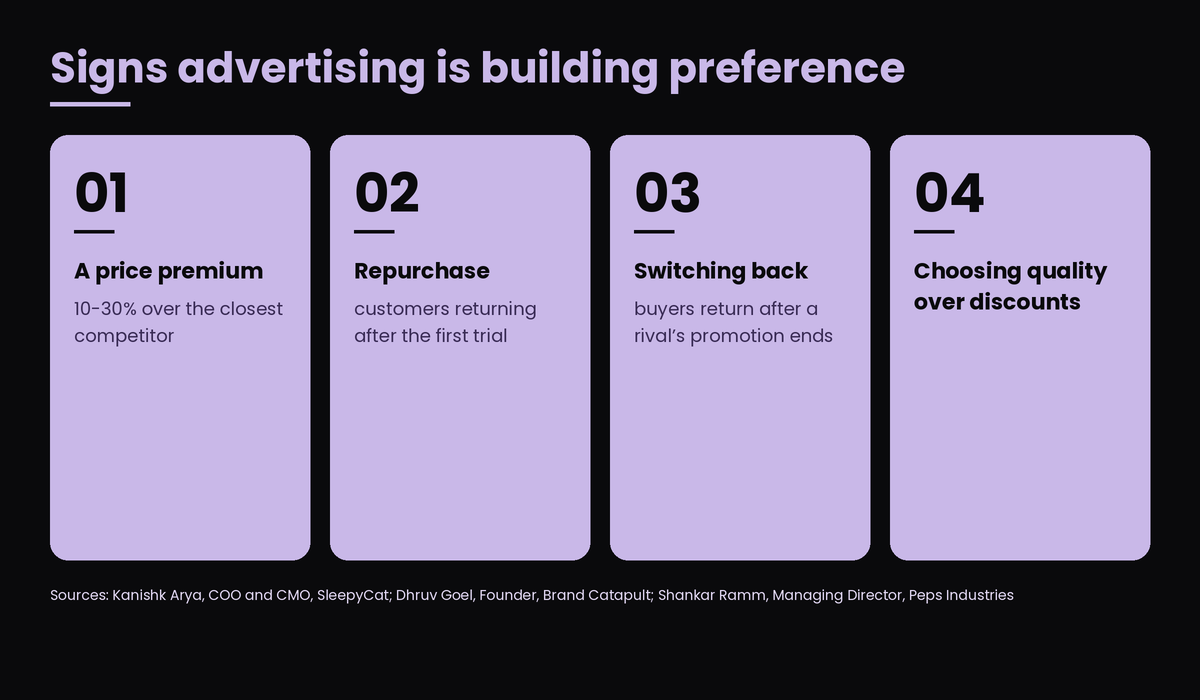
Willingness to pay is another test of whether advertising is building preference or merely renting attention. Arya offered a simple yardstick: “Willingness to pay is not that hard to measure.” A 10%, 20% or 30% premium over the closest competitor signals it, though he cautions that the harder question is whether it can be achieved at scale, and whether customers return after the first trial.
Goel finds the same signal in switching behaviour. “When customers purchase a competing brand only to switch back to your brand when the competitor runs a promotion, that builds a case for brand preference and pricing power,” he said.
Peps measures differentiation along similar lines. “Ultimately, successful differentiation is when consumers recognise the value we offer and are willing to pay for it, repurchase, rather than making decisions based solely on discounts,” Ramm said.
Spending levels and the cost of being new
All of this raises the question of how much is enough. Brands are wary of equating bigger budgets with better outcomes. Ramm described where he thinks the returns turn. “We believe diminishing returns begin when increased spending generates visibility but does not translate into a proportionate increase in consideration or sales,” he said.
Crompton’s Prusty arrived at a similar place. “Our focus is not simply on increasing spends, but on making sure our investments strengthen brand consideration and preference,” he said.
Forevermark India, part of the De Beers Group, sits at the other end of the spectrum. The brand is about 13 months into the market. “Our marketing spends are significantly higher than the revenue as of now,” said Mallikarjuna Reddy Yarabolu, Managing Director at Forevermark India.
Its yardstick is deliberately physical. “Every month, we see a growth percentage increase on walk-ins. That’s the right measure of whether our advertising and store experience are delivering results,” Yarabolu said.
Forevermark is also not asking advertising to close sales immediately. “What matters is that they come in, experience and explore the store,” Yarabolu said. For a young brand in a high-value category, getting consumers through the door appears to be the first measurable milestone.
Proof still the missing metric?
The industry has never lacked ways to count advertising. What it has lacked is agreement on what counts as proof that a campaign changed what people bought. Until measurement is built to question spends rather than justify them, reach will keep passing for results. The more consequential question is who in the ecosystem, whether brands, agencies or platforms, will hold that standard when the numbers look impressive but the demand is unproven.
Read more news about Marketing News, Advertising News, PR and Corporate Communication News, Digital News, People Movement News
For more updates, be socially connected with us onInstagram, LinkedIn, Twitter, Facebook, YouTube & Google News