The cost of growth: What happens when ad spends outpace revenue?
As several companies report advertising growth outpacing revenue, the numbers raise questions about incremental returns, profitability and long-term demand creation
 by
Published: Nov 3, 2026 9:06 AM | 11 min read
 Follow Us


- Recent financial disclosures from various consumer goods companies reveal a trend of increasing advertising expenditures that outpace revenue growth, raising questions about the effectiveness of these marketing investments.
- Nestlé India and Marico reported significant increases in advertising spending (46% and 44%, respectively) while their sales growth was lower, highlighting a divergence between marketing costs and revenue performance.
- Some companies, like HUL, demonstrated that reduced advertising spending can coincide with strong revenue growth, suggesting that higher advertising budgets do not always correlate with better business outcomes.
- Experts emphasize the importance of evaluating advertising effectiveness through metrics such as customer acquisition costs, contribution margins, and long-term brand health, rather than solely focusing on immediate revenue growth.
Advertising budgets are meant to drive growth. But when marketing expenditure rises substantially faster than revenue, the relationship between the two becomes harder to explain. Is a brand investing ahead of future demand, defending its market position against competition or spending more to generate the same incremental business?
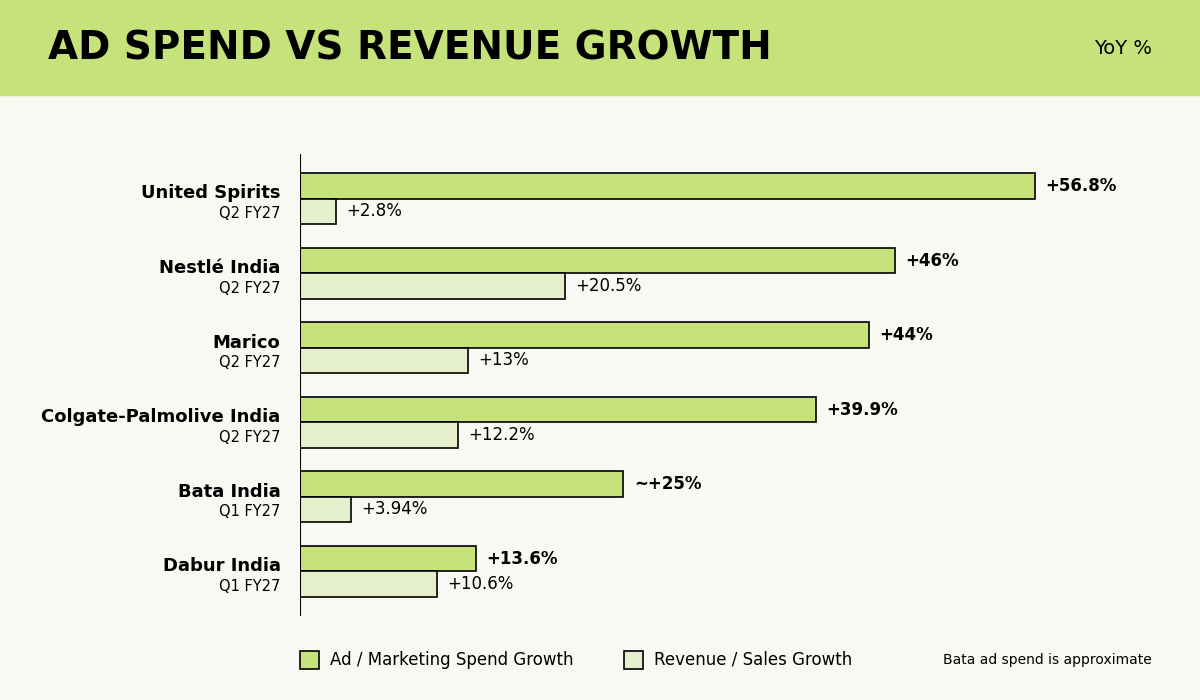
Recent financial disclosures across consumer goods, fashion, e-commerce and home services reveal different versions of this equation. Nestlé India increased advertising and marketing expenditure by 46% in Q2 FY27, while total sales grew 20.5%. Marico raised advertising and sales promotion expenditure by 44% to Rs 451 crore, against 13% revenue growth. United Spirits increased advertising and sales promotion expenditure by approximately 57%, while net sales value grew just 2.8%.
Some companies have also recorded stronger revenue growth without a proportionate increase in advertising expenditure, reinforcing the need to examine how effectively incremental marketing investments translate into business growth.
Read more: Early FY27 results point to higher ad spends amid cost pressures
When advertising grows faster than the business
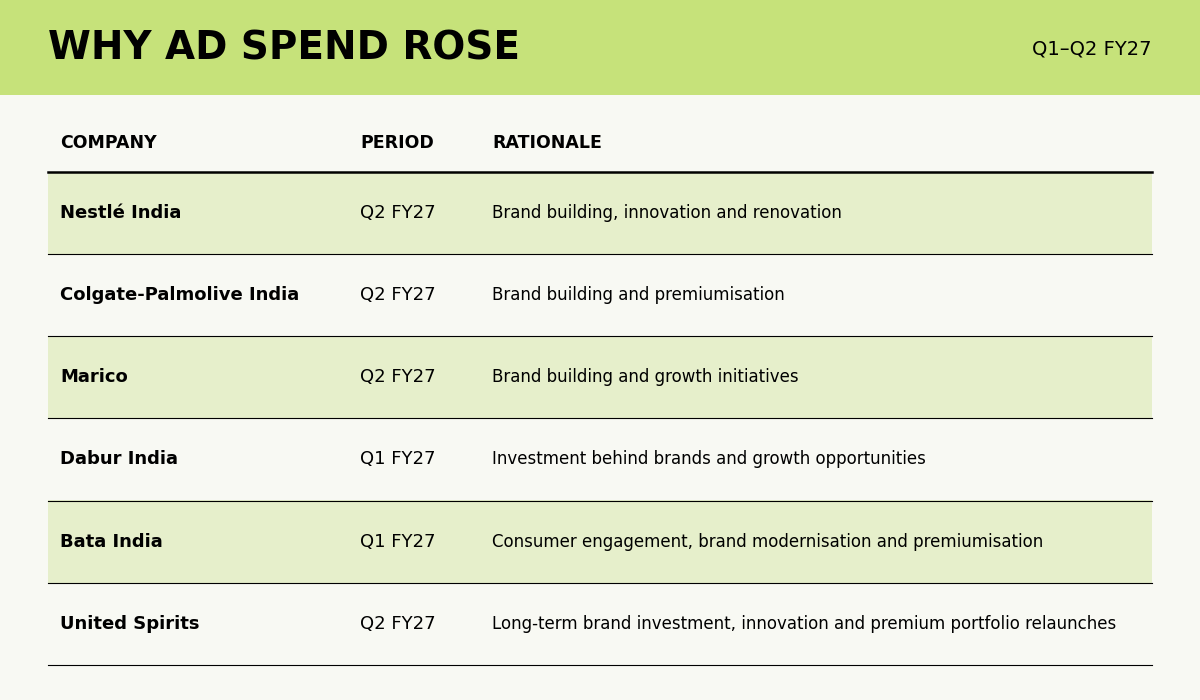
Among consumer businesses, Nestlé India and Marico illustrate the scale of recent increases. Nestlé India reported Q2 FY27 sales of Rs 6,782.2 crore, up 20.5% year-on-year, while advertising and marketing expenditure increased 46%. Profit after tax rose 36.3% to Rs 1,026.8 crore.
Read: Nestlé India hikes ad spends 46% in Q2 FY27
Marico's advertising and sales promotion expenditure increased to Rs 451 crore from a restated Rs 313 crore in Q2 FY26. Revenue from operations grew 13% to Rs 3,897 crore, while profit attributable to owners increased 31% to Rs 550 crore. The comparison needs to account for the company's restatement of certain customer-related promotional expenses, which changed the year-on-year base.
Read: Marico's ad spends jump 44% to ₹451 crore as profit growth hits a 51-quarter high
Colgate-Palmolive India also stepped up its investment. Advertising expenditure increased 39.9% to Rs 314.82 crore in Q2 FY27, while net sales grew 12.2% to Rs 1,691.57 crore. Dabur India reported a narrower divergence in Q1 FY27, with advertising and publicity expenditure increasing 13.6% to Rs 229.46 crore against 10.6% growth in consolidated revenue to Rs 3,764.39 crore.
Emami presents a different picture. Its FY26 advertising and promotional expenditure increased approximately 7%, while consolidated revenue declined 1% to Rs 3,779 crore. The company has framed its marketing investment as a long-term brand-building exercise rather than a response to short-term revenue movements.
“Our marketing investments are guided by long-term brand-building and growth objectives. While spending may at times outpace short-term revenue growth, it reflects our focus on strengthening brand equity, driving category penetration, supporting innovation and building future demand. We evaluate effectiveness through a mix of business, brand and consumer metrics with a focus on expanding reach, driving incremental consumption, strengthening brand preference and creating sustainable long-term growth,” said Emami spokesperson.
“Marketing investments are evaluated through a comprehensive framework that balances short-term business outcomes with long-term brand creation. We monitor a range of business, consumer and brand metrics to assess effectiveness, while maintaining a clear focus on value creation, profitability and sustainable growth. Ultimately, our objective is not to optimize for marketing spend alone, but to ensure that every investment contributes meaningfully to strengthening our brands and building long-term shareholder value,” the spokesperson added.
These cases illustrate why expenditure and revenue growth cannot be read in isolation. Higher advertising investment may coincide with strong profit growth, as at Nestlé India and Marico, or with muted revenue performance, as at Emami. Neither relationship, by itself, establishes the incremental contribution of advertising.
When lower spending does not mean slower growth
HUL offers a counterpoint. Its advertising and promotion expenditure declined 9.3% to Rs 1,481 crore in Q2 FY27, while consolidated turnover reached Rs 18,071 crore. Underlying sales growth stood at 15%, with underlying volume growth of 7%.
Bajaj Consumer Care reported advertising and sales promotion expenditure growth of 7.1% to Rs 41.65 crore in Q2 FY27, while revenue from operations rose 25.4% to Rs 332.83 crore.
Bata India increased its advertising investment by nearly 25% year-on-year in Q1 FY27, while revenue from operations grew 3.94% to Rs 978.95 crore. Net profit rose 23.05% to Rs 63.98 crore, with the company attributing topline growth to premiumisation and volume growth. The figures highlight a significant gap between advertising and revenue growth, although the increase in profitability suggests that the business delivered stronger earnings despite modest topline expansion.
Amol Mohandas, Founder and Principal Advisor at Weave Through, a marketing and media advisory, cautions against interpreting the divergence as an automatic warning sign.
“Advertising investment growing faster than revenue is not necessarily a red flag. It needs to be evaluated against the brand's life stage, competitive landscape and business ambition. A new brand entering a market, an established brand defending market share or a business pursuing aggressive expansion will have very different investment-to-growth trajectories.
The concern arises when higher spends consistently fail to deliver corresponding improvements in market penetration, customer acquisition, brand consideration or share of market. The key is to distinguish between investment for future growth and expenditure that is delivering diminishing returns.”
These cases challenge the assumption that revenue growth depends on ever-increasing advertising budgets. However, the gap between advertising and revenue growth alone does not establish whether spending is effective or wasteful. Atit Mehta, Marketing, Media & Growth Consultant for Startup & Growth-Stage Companies, argued that the duration of the divergence matters. “Spend growing faster than revenue is not a problem in itself. A launch, a category creation push or a defence of share can justify it for a planned window. It becomes a concern when the divergence outlasts that window and each additional rupee of media buys less revenue than the one before. Two or three consecutive quarters of that, with no improvement in awareness, repeat rate or pricing to show for it, is no longer an investment. It is an efficiency problem.”
Unlisted companies reveal the cost of chasing growth
The relationship becomes more complicated beyond listed consumer companies. Their financials offer contrasting examples of how advertising investment interacts with the cost of acquiring customers and scaling a business.
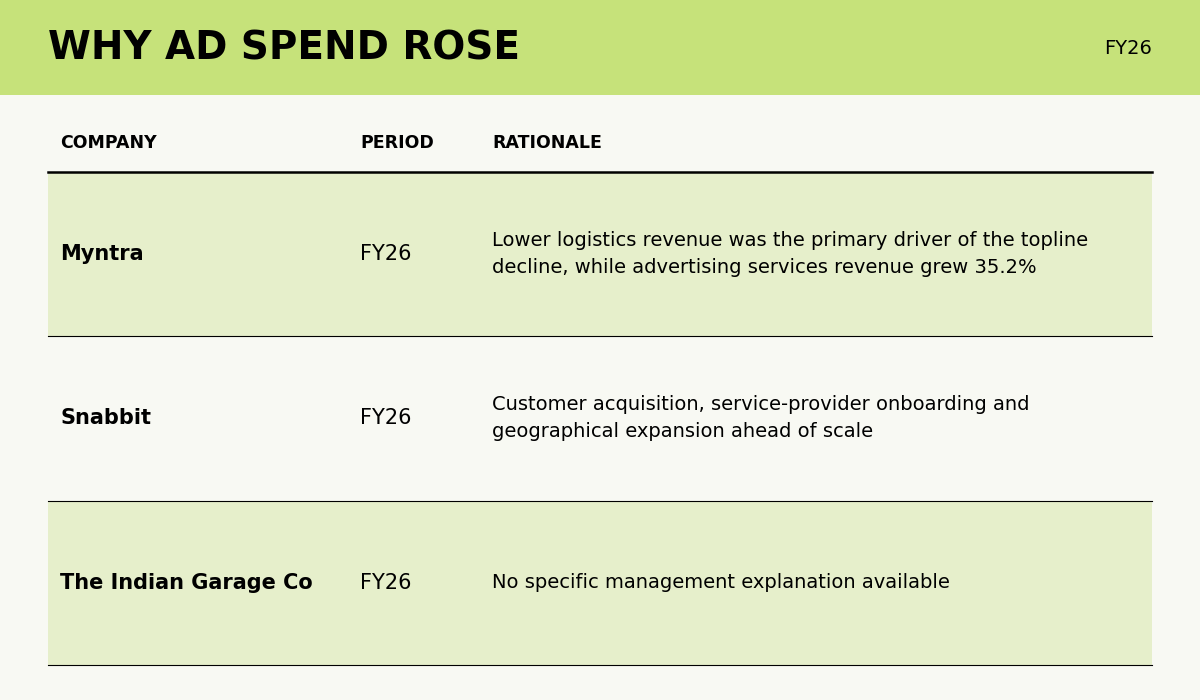
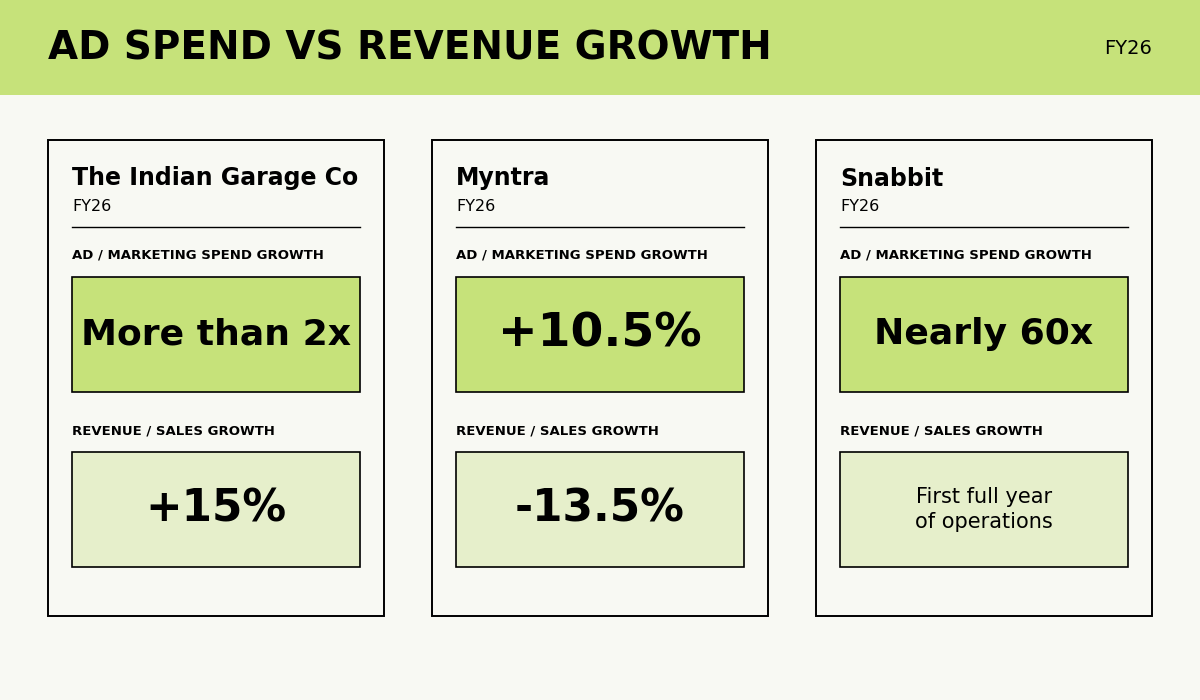
For example, Myntra, the Flipkart Group-owned fashion platform, spent Rs 2,326.5 crore on advertising in FY26, up 10.5%, while revenue from operations declined 13.5% to Rs 5,242.5 crore. It also reported a net loss of Rs 579.4 crore.
However, the overall revenue decline needs context. Myntra's logistics revenue fell 53.2% to Rs 1,119.2 crore. Excluding logistics and shipping services, operating revenue increased 12% to Rs 4,123.3 crore. Advertising services revenue, generated by selling advertising to brands and sellers on the platform, grew 35.2% to Rs 1,236.4 crore.
The Indian Garage Co, part of the Aditya Birla Group's TMRW portfolio, is another example where they increased advertising and promotional expenditure to Rs 29.3 crore in FY26 from Rs 14 crore. Revenue from operations grew 15% to Rs 234.6 crore, but its net loss widened 27% to Rs 28.7 crore.
Snabbit presents a more pronounced case of investment ahead of scale. Maestroedge Solutions, which operates the home-services platform, increased marketing expenditure from Rs 82.11 lakh in FY25 to Rs 48.69 crore in FY26. Revenue from operations rose from Rs 26.35 lakh to Rs 12.25 crore, while the company reported a net loss of Rs 167.75 crore. The caveat is significant: FY26 was Snabbit's first full year of operations, making the percentage increases particularly large against a small starting base.
Read more: Quick home services ad spends surge as sector eyes ₹13.2 billion run rate by Dec
The missing metric: What remains after marketing costs?
As competition for consumer attention intensifies, customer acquisition costs are becoming increasingly important. But a blended return on advertising expenditure can conceal whether the next customer is more expensive to acquire than the previous one.
“The cost of acquiring and retaining consumers is certainly becoming an important consideration as competition for attention intensifies. However, many brands today are increasingly operating through a performance-marketing and revenue-ROI lens. This can sometimes create an overdependence on paid acquisition. A brand's ability to convert consumer interest into sales is also a function of its credibility, salience and trust. Metrics such as Customer Acquisition Cost (CAC), Customer Lifetime Value (CLV), repeat purchase rates, conversion rates and incremental ROAS can help establish whether the cost of winning customers is rising and whether those customers are delivering sustainable value,” said Amol.
Mehta argued that brands need to look beyond topline returns. “The cost of attention is rising, most visibly in digital, where more advertisers chase the same audiences. The metric to watch is marginal CAC, the cost of the next customer, because blended CAC hides the decline. Track it alongside CAC payback period, the share of new customers coming from paid channels versus organic, direct and branded search and ROAS by customer cohort. If paid is winning a growing share of new customers while organic and direct stall, the brand is renting its growth.”
The distinction is especially relevant when revenue grows without a corresponding improvement in profitability. United Spirits increased advertising and sales promotion expenditure by approximately 57% to Rs 378 crore in Q2 FY27. Net sales value grew 2.8% to Rs 3,258 crore, while EBITDA declined 4.3% to Rs 643 crore and profit after tax fell 2.1% to Rs 462 crore. The company cited continued investment behind its brands and launches ahead of the festive season, while also reporting regulatory headwinds affecting its business.
The figures do not establish that advertising expenditure caused the decline in profitability. They do, however, demonstrate why marketing investment must be considered alongside margins, business conditions and other costs.
Mehta put the emphasis on contribution margin. “When sales rise but contribution margin does not, the growth is of poor quality. Judge advertising on contribution margin after marketing, not on topline ROAS. Look at discount depth, the share of sales made on promotion, returns, and which customers are being acquired. Growth bought through heavy media and heavy discounting has to be bought again every quarter. That is a treadmill, not a business.”
For longer-term evaluation, he recommended looking at customer retention and the strength of the brand itself. “To judge long term value, move from campaign returns to the health of the customer base. Cohort retention and repeat purchase rates, lifetime value against CAC, and price realisation, meaning the ability to hold price without promotion, show whether spend is building anything durable. On the brand side, track aided and unaided awareness, consideration, and share of voice against share of market. Sustained share of voice above market share of market should lead to share gains. If it does not, the spend is not working. Hold out test regions or audiences to measure what the advertising actually added, and use marketing mix modelling for the longer effects,” Mehta added.
Amol added that marketing cannot be evaluated separately from the rest of the business. “When sales grow but contribution margins and profitability do not keep pace, advertising effectiveness needs to be examined alongside the overall cost structure. Profitability is a function of both revenue and costs. Brands need to assess whether promotional intensity, discounting, channel commissions and acquisition costs are eroding incremental margins. Equally, there is an opportunity to improve operating efficiency through technology: automating marketing workflows, streamlining CRM systems, improving customer segmentation and using data to maximise the revenue potential of existing customers. Marketing effectiveness cannot be measured independently of business efficiency.”
The real test is sustainable growth
The lesson is not that brands should spend less. It is that they need to establish what the additional expenditure is buying. Is it generating new customers, increasing consumption, improving market share, building pricing power or strengthening the likelihood of repeat purchases?
Amol argued that advertising must be evaluated through both immediate commercial outcomes and longer-term business indicators. “Ultimately, advertising should be evaluated through a combination of short-term commercial returns and longer-term business indicators: incremental revenue, contribution margins, retention, repeat purchases, pricing resilience and market-share movement. The objective is to establish whether marketing investment is creating sustainable demand and strengthening the brand's competitive position. The quality of growth matters as much as its quantum.”
Mehta offered a final test for brands assessing how much of their growth depends on continued spending. “A simple test: if you cut spend by a fifth, how much of the business holds? Brands with real equity lose less than they fear. Brands renting attention find out quickly.”
As advertising budgets continue to compete for a finite pool of consumer attention, the central question for marketers is no longer just how much they spend or how quickly sales grow. It is whether the investment creates demand that endures, customers who return and growth that remains profitable after the campaign ends.
Read more news about Marketing News, Advertising News, PR and Corporate Communication News, Digital News, People Movement News
For more updates, be socially connected with us onInstagram, LinkedIn, Twitter, Facebook, YouTube & Google News
