TV ad activity drops 8.6% amid BARC blackout; digital surges 24.5%
Data from TAM AdEx for July 1 to September 28, 2026, shows television’s advertising index falling to 91.4, against a year-earlier base of 100
 by
by
Published: Oct 14, 2026 8:36 AM | 6 min read
 Follow Us

- Television advertising activity fell by 8.6% year-on-year, while digital advertising surged by 24.5%, reflecting a growing divide between traditional and digital media amid ongoing disruptions in audience measurement due to the suspension of BARC ratings.
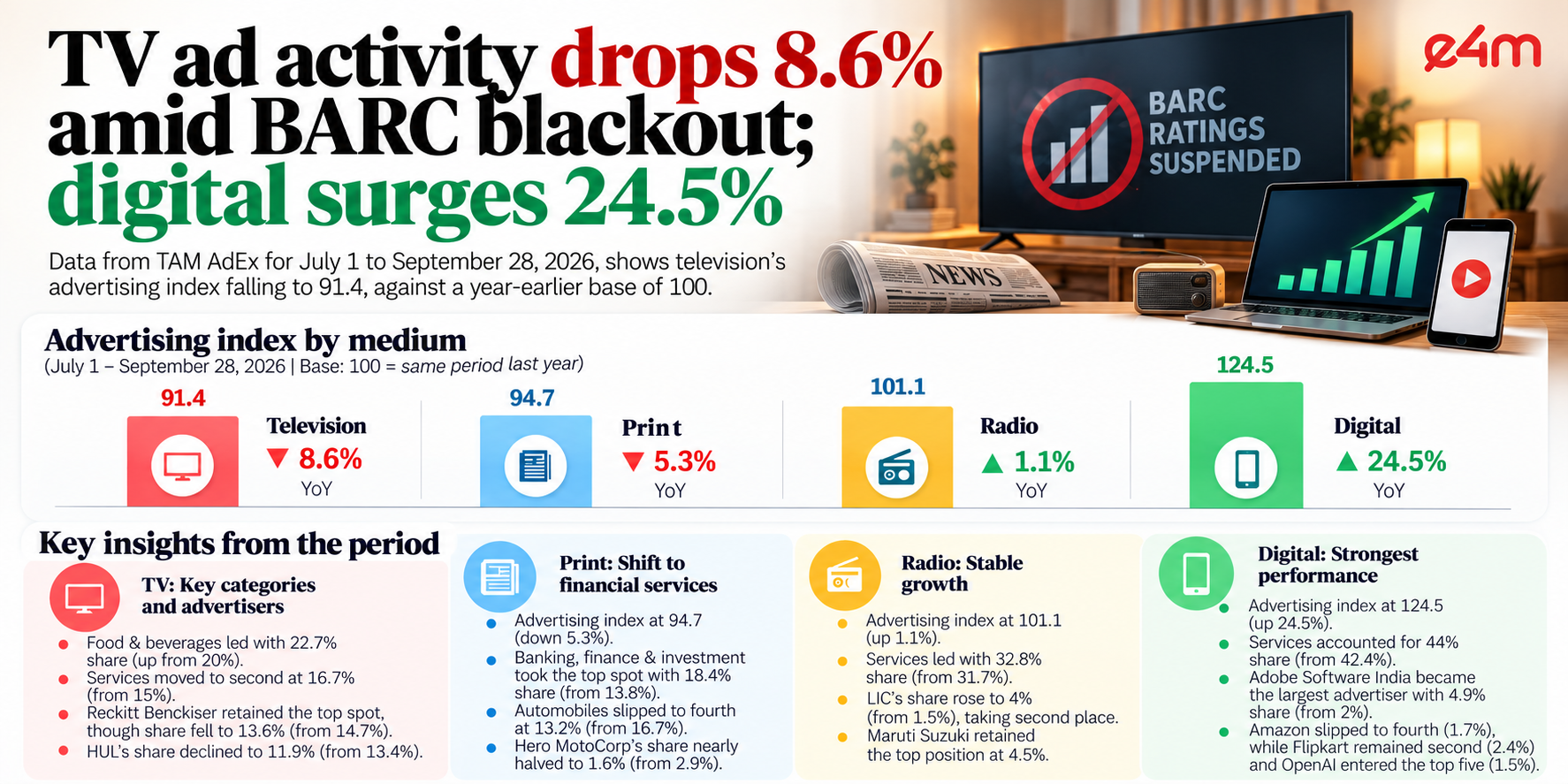
- The advertising index for television dropped to 91.4, with print also declining to 94.7, while radio remained stable at 101.1; digital advertising's index rose to 124.5 during the period from July 1 to September 28, 2026.
- Food and beverages maintained the largest share of television advertising at 22.7%, while banking and financial services overtook automobiles in print advertising, which remained below last year's levels.
- The absence of current ratings complicates broadcasters' ability to justify advertising rates, leading to a reliance on historical performance for negotiations, while digital platforms are increasingly favored for their measurable campaign performance.
Television advertising activity declined 8.6% year-on-year, even as digital advertising grew 24.5%. This highlights the widening divergence between traditional and digital media amid the continuing disruption in audience measurement following the Broadcast Audience Research Council (BARC) India's suspension of weekly television ratings.
Data from TAM AdEx for July 1 to September 28, 2026, shows television’s advertising index falling to 91.4, against a year-earlier base of 100. Print also remained below last year’s level at 94.7, while radio was marginally higher at 101.1. Digital advertising climbed to 124.5.
This period coincides with uncertainty over the resumption of BARC ratings following the government’s TV Ratings Policy 2026, which requires rating agencies to register with the Ministry of Information and Broadcasting before generating or publishing ratings. MIB directed BARC to suspend ratings for news and non-news genres starting July 2.
The ratings disruption has complicated broadcasters’ efforts to demonstrate audience performance, defend advertising rates and negotiate premiums for festive-season inventory.
“Television remains an important medium for reach, but advertisers need confidence in the audience numbers behind the inventory they are buying. When fresh ratings are unavailable, the conversation shifts towards historical performance, negotiated rates and the additional value a broadcaster can offer. That can make it harder for channels to justify premium pricing,” an advertising agency executive said, requesting anonymity.
The absence of current ratings leaves advertisers and media agencies relying more heavily on historical audience shares, programme profiles and previous campaign outcomes to assess the value of television inventory. This could strengthen their negotiating position, particularly when evaluating channels without a dominant audience share.
“Established channels with a strong track record may be better placed to retain advertisers, but the lack of fresh ratings creates uncertainty for the wider market. Advertisers are likely to be more cautious about paying a premium when they cannot independently assess recent audience delivery,” a media planner said, requesting anonymity.
Also Read: Selling cricket without hallmark: BARC blackout puts India’s bilateral premiums on trial
4 CEOs, 1 demand, zero impact: TV ratings blackout exposes limits of industry forums
BARC blackout puts linear TV’s ad business under pressure, say broadcasters
Uncertainty over BARC continuity threatens wider M&E industry, from advertising to TV jobs
Leading advertisers lose share
Food and beverages retained the largest share of television advertising activity during the period, increasing to 22.7% from 20% a year earlier. Services moved to second place with a 16.7% share, against 15% last year, while personal care and personal hygiene slipped to third at 14.3%, from 15.5%. Household products also lost ground, with their share declining to 10.2% from 11.8%.
The concentration among the largest television advertisers eased. Reckitt Benckiser (India) retained the top position, but its share declined to 13.6% from 14.7%. Hindustan Unilever remained second, with its share falling to 11.9% from 13.4%. Together, the two companies accounted for 25.5% of festive television advertising activity, against 28.1% a year earlier.
Cadbury India moved to third place, increasing its share to 3.6% from 2%, while Nestle India entered the top five with a 2% share.
The movement highlights a change in the distribution of advertising activity even as television's overall index remains below the previous year's level. However, a lower share does not necessarily indicate a reduction in absolute spending, since advertisers' rankings can change with movements in the wider market.
The implications for broadcasters extend beyond the volume of advertising sold. Without fresh ratings, television networks may find it harder to establish the relative value of channels and programmes during negotiations. Some could offer additional inventory or selective discounts to protect sales, while established channels may continue to command premiums on the strength of historical performance and popular programming.
“The immediate issue is not that advertisers have stopped buying television. It is that the basis on which inventory is evaluated has become less current. In such an environment, pricing depends more heavily on the strength of individual channels, the advertiser relationship and the ability to demonstrate value through other measures,” a senior television network executive said, requesting anonymity.
Print shifts from automobiles to financial services
Print advertising activity remained below the year-earlier level, with its index at 94.7. Automobiles, the largest print category last year with a 16.7% share, slipped to fourth place at 13.2%. Banking, finance and investment moved from third to first, increasing its share to 18.4% from 13.8%.
Hero MotoCorp’s share of print advertising nearly halved to 1.6% from 2.9%, while Maruti Suzuki retained the top advertiser position despite its share declining to 2.8% from 3.3%.
Radio was broadly stable, with an index of 101.1. Services continued to lead, accounting for 32.8% of advertising activity against 31.7% last year. Life Insurance Corporation of India increased its share to 4% from 1.5%, taking second place among radio advertisers, while Maruti Suzuki retained the top position at 4.5%.
The contrasting performance across media underscores the importance of distinguishing television’s ratings-related difficulties from broader shifts in category spending. The TAM AdEx figures do not establish whether advertisers have directly transferred budgets from television to print, radio or digital.
Digital grows as measurement expectations rise
Digital advertising recorded the strongest performance, with its index increasing to 124.5. Services accounted for 44% of digital advertising activity, up from 42.4%.
Adobe Software India became the largest digital advertiser, increasing its share to 4.9% from 2%, when it ranked third. Amazon Online India fell from first place, with its share declining to 1.7% from 2.7%, placing it fourth. Flipkart retained second position at 2.4%, while OpenAI entered the top five with a 1.5% share, replacing Google.
The growth comes as advertisers place greater emphasis on targeting, campaign optimisation and performance measurement. Digital platforms offer metrics to monitor delivery during campaigns, although the quality and comparability of those metrics vary.
Actual ad rates remain the critical question
The decline in television’s advertising index should not be interpreted as an equivalent fall in advertising rates or broadcaster revenue. TAM AdEx measures advertising activity, not the price paid for each commercial spot or the revenue recognised by television networks.
A decline in activity could reflect fewer advertisements, shorter campaigns, changes in advertiser participation or shifts in category mix. Broadcasters may retain published rate cards while offering discounts, bonus spots or other benefits, meaning effective rates could weaken without a formal revision of prices.
Experts state that the impact is also likely to vary by genre, audience strength and advertiser base. Networks with established programming franchises and strong historical ratings may be better positioned to retain pricing power than smaller or niche channels.
The restoration of regular BARC ratings would give advertisers and broadcasters a more current common benchmark for planning campaigns, evaluating audience delivery and negotiating inventory. Until then, television networks face the challenge of defending their commercial value in a market where digital advertising is expanding and current audience measurement remains disrupted.
Read more news about Television Media, Digital Media, Advertising India, Marketing News, PR and Corporate Communication News
For more updates, be socially connected with us onInstagram, LinkedIn, Twitter, Facebook YouTube & Google News
