BARC faces up to ₹150 crore hit over six months as ratings blackout drags on
News genre alone has cost the ratings body over ₹15 crore since March; a full-genre freeze from July could wipe out several times its annual revenue
 by
by
Published: Sep 1, 2026 9:13 AM | 5 min read
 Follow Us

- The Broadcast Audience Research Council of India (BARC) faces a potential revenue loss of ₹40 crore to over ₹150 crore over six months due to a ratings blackout affecting all television genres, initiated by the Ministry of Information and Broadcasting (MIB) on July 1.
- BARC's financial situation is strained as it continues to incur costs for meter maintenance and panel expansion, despite not receiving subscription fees from broadcasters during the blackout period.
- News subscriptions contribute approximately 10% of BARC's annual revenue, leading to an estimated direct loss of around ₹15 crore over six months, which exceeds BARC's entire profit for FY25.
- Experts warn that the ratings blackout could disrupt advertising pricing and campaign planning, with significant financial implications for both BARC and the broader television advertising market, particularly during the festive quarter.
The Broadcast Audience Research Council of India (BARC) is staring at a revenue hole of ₹40 crore to over ₹150 crore over a six-month window, as the ongoing ratings blackout keeps broadcasters from paying subscription fees even as the agency's costs — from meter maintenance to panel expansion — continue unabated, according to industry estimates.
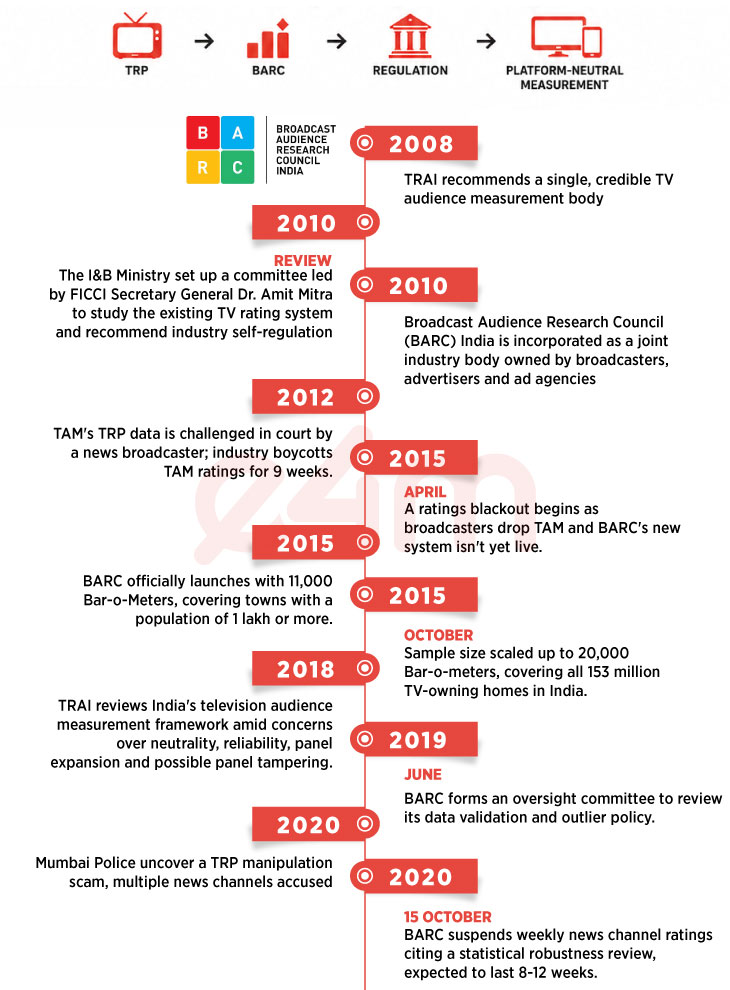
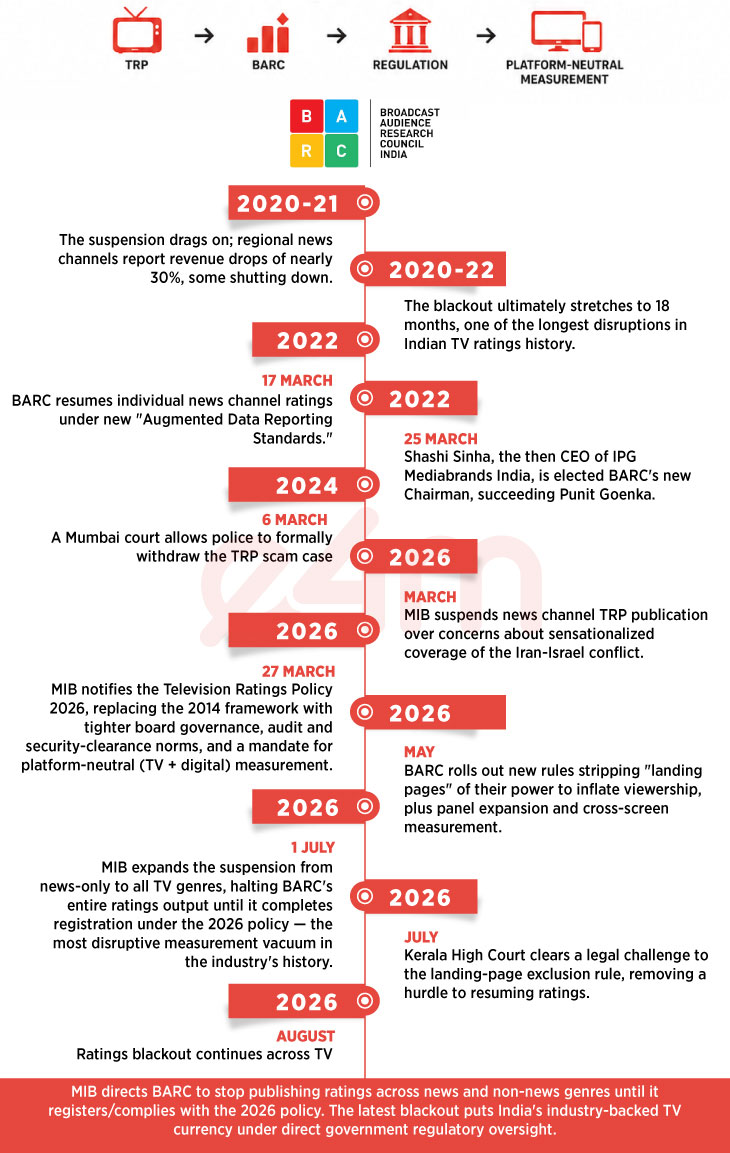
The Ministry of Information and Broadcasting (MIB) first suspended television audience ratings for news channels on March 6 and directed BARC on June 8 not to bill news broadcasters for the period, since no data was being delivered.
Has India’s TV currency moved beyond industry control? Read e4m report here
The ministry has since widened the suspension to cover all genres from 1 July, until BARC secures registration under the government's revised Television Rating Agencies policy — turning a genre-specific problem into an industry-wide one, for broadcasters and for BARC's own subscription-led model alike.
The arithmetic of the squeeze
BARC's FY25 revenue was about ₹305 crore, down 6% year-on-year, with profit of ₹15.7 crore, down 18%, against expenses of ₹283 crore, according to reported filings. Annualised, that is roughly ₹76 crore a quarter, or about ₹152 crore over six months — the ceiling against which the blackout's cost is now being measured.
Read related story - Another BARC?
Under BARC's FY27 pricing, broadcasters pay either 0.8% of net television advertising revenue or ₹20 lakh per channel a year, whichever is higher — so a channel with ₹25 crore in ad revenue pays the ₹20 lakh floor, while one with ₹100 crore pays closer to ₹80 lakh. Beyond base subscriptions, BARC earns from premium analytics tiers, SpotTrek spot-tracking services, and usage- and licence-based fees.
News subscriptions account for roughly 10% of BARC's annual revenue, or close to ₹30 crore a year, according to Pankaj Krishna, founder of Chrome Data Analytics. That puts the direct quarterly loss from news alone at about ₹7.5 crore — over ₹15 crore across six months, already exceeding BARC's entire FY25 annual profit.
Where is the blackout hurting? Read e4m analysis
The bigger exposure lies in what happens if every genre seeks the same relief news broadcasters have secured. Industry working estimates put BARC's six-month exposure at over ₹40 crore in a likely scenario, rising to ₹150 crore or more in a worst-case scenario where the waiver applies across all genres for the full period—effectively wiping out six months of revenue entirely.
Costs don't pause when billing does
BARC's cost base is largely fixed and doesn't shrink because it isn't billing. The roughly 70,876 meters installed in homes remain in place and paid for, Meterology Data Pvt Ltd (51% BARC-owned) continues maintaining them.
Layered on top is the government's mandate to expand the panel to 80,000, and eventually 120,000. Industry estimates put the first 60,000-meter expansion at around ₹60 crore — capital required exactly when subscription revenue is under pressure.
Ratings: The race against time. Read e4m report
Broadcasters are unlikely to simply stop paying without a formal mechanism. Industry executives expect most networks to seek adjustments rather than a flat refusal — asking BARC to set off dark-period fees against future quarterly invoices, mirroring the pattern already emerging among news broadcasters citing the MIB's June directive.
BARC has written back to the ministry asking for that directive to be withdrawn.
A structural, not just seasonal, risk
Industry experts cited that the ₹7.5 crore quarterly figure from news is "the immediate measurable loss", but that disruption to campaign planning, pricing benchmarks and performance evaluation across the ecosystem is harder to quantify and potentially larger.
Ratings blackout: Pressure on festive ad sales. Read earlier report
Vishal Khanna, founder of Sales Strategist LLP and a Connected TV expert, frames the issue as one of governance. "This isn't a ratings crisis; it's a trust-architecture crisis wearing a ratings costume," he said, arguing that BARC's ownership structure — where the broadcasters, advertisers and agencies being measured also own the measurement body — creates a built-in conflict a second ratings agency alone would not resolve.
Khanna's separate working estimate puts total television advertising revenue at risk over the six-month data-dark period at ₹1,000–1,500 crore, of which ₹100–150 crore falls on news and ₹900–1,350 crore on non-news genres, skewed by the blackout coinciding with the festive quarter.
He notes this isn't lost inventory — ads still ran — but lost price, as advertisers without ratings to benchmark against have pushed discounts of 30–40%, with some festive budgets shifting to digital permanently.
The path forward
Whether BARC's six-month exposure lands closer to ₹40 crore or ₹150 crore-plus depends largely on how quickly it secures registration under the new policy, and whether the news billing waiver is extended, negotiated down, or reversed as it applies industry-wide. Experts pointed to BARC's shelved 2017–18 digital measurement pilot as a template worth revisiting, alongside a longer-term shift toward deterministic, outcome-based measurement across television, OTT and digital.
Industry executives broadly agree the financial strain on BARC isn't merely a six-month accounting problem. If it delays the mandated panel expansion or compliance timelines, the blackout itself risks extending further—turning a regulatory pause into a structural setback for India's television measurement ecosystem.
Read more news about Television Media, Digital Media, Advertising India, Marketing News, PR and Corporate Communication News
For more updates, be socially connected with us onInstagram, LinkedIn, Twitter, Facebook YouTube & Google News