As BARC ratings blackout persists, CTV industry plans independent measurement framework
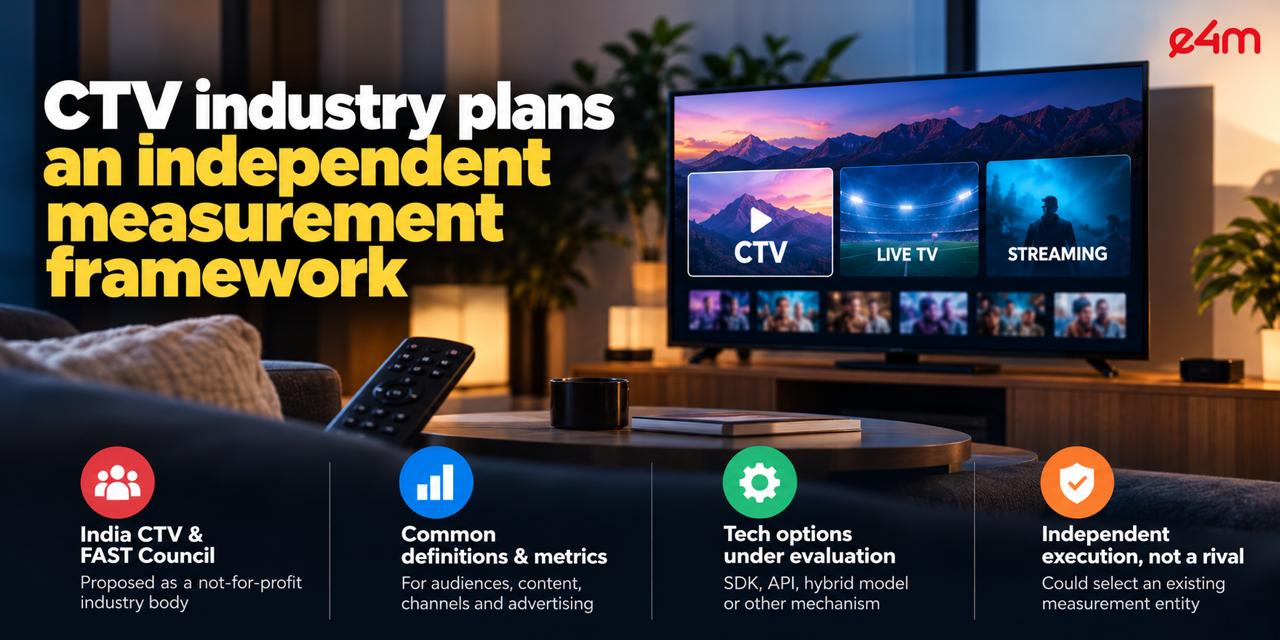
Potential approaches include a software development kit (SDK), an application programming interface (API), a hybrid model or another mechanism identified through a technical evaluation
 by
by
Published: Oct 16, 2026 8:57 AM | 9 min read
 Follow Us

- India’s connected television (CTV) and free ad-supported streaming television (FAST) industry is proposing the establishment of the India CTV & FAST Council (ICFC) to create an independent framework for audience measurement and advertising transparency amid the ongoing blackout of television ratings by BARC India.
- The draft Common Charter, developed with input from various industry stakeholders, aims to unify broadcasters, streaming platforms, advertisers, and measurement providers under a not-for-profit entity that will establish common definitions, technical standards, and independent validation mechanisms for audience metrics.
- The ICFC seeks to address the fragmented audience measurement landscape across CTV platforms and aims to provide a trusted, common framework for reporting that includes privacy safeguards and independent audits, without replacing BARC or creating its own measurement business.
- In addition to audience measurement, the Council plans to tackle advertising fraud and supply-chain transparency, promoting standard signals and reporting mechanisms while advocating for fair distribution practices and engaging with government regulations to ensure a balanced and effective industry framework.
India’s connected television (CTV) and free ad-supported streaming television (FAST) industry is moving to establish an independent, industry-led body to address audience measurement and advertising transparency, as the continuing blackout of television ratings by Broadcast Audience Research Council (BARC) India underscores the need for a credible measurement framework across traditional television and digital viewing platforms.
The Charter was developed based on the discussions, recommendations and priorities from organisations such as JioStar, Zee, Shemaroo, Magnite, The Trade Desk, Runn TV, CloudTV and others.
A draft Common Charter circulated to industry stakeholders proposes the India CTV & FAST Council (ICFC), a not-for-profit body that would bring broadcasters, streaming platforms, advertisers, advertising agencies, ad-tech companies and measurement providers under a common framework.
The proposal comes at a critical juncture for the television and advertising industries. With BARC’s weekly television ratings unavailable, broadcasters and advertisers have been grappling with reduced visibility into audience performance, complicating media planning, advertising negotiations and campaign evaluation.
The Ministry of Information and Broadcasting in its TRP Policy 2026, categorically mentioned the measurement of Connected TV as one of the eligibility criteria for the ratings body.
Meanwhile, the rapid adoption of CTV has increased the need for comparable measurement standards across television screens, streaming services and digital advertising ecosystems.
While ICFC is not intended to replace BARC or operate its own measurement business, its charter envisages developing common definitions, technical standards and independent validation mechanisms. It could also help select an existing measurement or ratings entity to execute the proposed framework.
CTV measurement emerges as a priority
The proposed Council’s immediate challenge would be to address fragmented audience measurement across connected-TV platforms.
Experts state that digital distribution can potentially provide census-based reporting of viewership and advertising activity, unlike conventional television measurement, which relies on a defined sample of households.
However, the charter notes that siloed platforms, inconsistent reporting practices and the absence of common validation benchmarks make it difficult to compare audience figures across services.
A CTV industry stakeholder said, "For advertisers, this complicates the evaluation of campaigns running across linear television, streaming applications and CTV inventory. While individual platforms can generate viewing data, their reports do not necessarily offer an independently verified, industry-wide measure of audiences."
The BARC ratings blackout has sharpened the urgency of establishing such standards. But the two challenges are distinct: restoring conventional television ratings requires a functioning measurement framework for linear TV, while CTV measurement must account for fragmented digital distribution, addressable advertising and platform-level data.
ICFC proposes a “trusted, common and independently governed framework” for audience measurement and reporting across CTV and the broader digital television ecosystem.
The framework would establish common definitions for audiences, content, channels and advertising, alongside uniform reporting principles and comparable metrics covering watch time, number of viewers, ad impressions, view-through rates, click-through rates and drop rates. It would also incorporate privacy safeguards, independent audits and quality benchmarks.
An industry-wide approach could reduce dependence on individual platforms’ reporting methodologies and give advertisers a more consistent basis for evaluating digital television investments. Its effectiveness, however, would depend on participation by major broadcasters, streaming services, advertisers and technology providers.
Council proposes independent execution
A key feature of the draft is its emphasis on institutional independence.
ICFC does not propose establishing a measurement subsidiary or building a commercial ratings business of its own. Instead, it would define technical requirements, measurement guidelines and implementation principles, and could help select an existing independent measurement or ratings entity through a transparent process.
The charter leaves the technology open to assessment. Potential approaches include a software development kit (SDK), an application programming interface (API), a hybrid model or another mechanism identified through a technical evaluation.
An SDK-based approach could enable standardised collection of relevant viewing and advertising data across participating services. Any implementation, however, would require agreement on data definitions, technical integration, privacy safeguards and the extent of access available to an independent measurement provider.
The charter states that the chosen mechanism would be subject to governance and independent auditing to prevent unauthorised tracking or misuse of data. It also identifies the Digital Personal Data Protection Rules, 2025, as a policy area for engagement.
An Audience Measurement Technical Committee, operating under the proposed Audience Measurement Working Group, would examine methodology, data architecture, privacy, interoperability, technical validation and auditing. It would also assess the feasibility of different measurement technologies.
Access arrangements, subscription models and other commercial aspects of the eventual service would be determined later through the Council’s governance process.
BARC blackout sharpens the need for a common measurement currency
The proposal comes amid a wider debate over the future of audience measurement in India.
BARC’s ratings blackout has disrupted the established mechanism through which broadcasters, advertisers and media agencies assess television audiences. Without regularly available ratings, market participants have had to navigate a more difficult environment for evaluating channel performance, planning campaigns and assessing advertising returns.
CTV adds another layer of complexity. Viewing is spread across smart-TV operating systems, streaming applications, broadcaster-owned digital services and other internet-delivered platforms. Audience data may be available within individual systems, but differences in methodology and reporting limit direct comparisons.
An independent industry framework could help establish common standards for digital television audiences, but it would not, by itself, resolve the regulatory, operational or institutional issues surrounding BARC’s ratings restoration.
The larger question for advertisers is whether India can develop a measurement ecosystem that allows television and CTV investments to be assessed on comparable, independently validated terms. This would require not only common technical standards but also broad adoption and confidence in the governance of the measurement process.
Ad fraud and supply-chain transparency form the second pillar
Alongside measurement, ICFC proposes making advertising fraud and supply-chain transparency a central priority.
CTV combines television’s large-screen experience with the targeting, addressability and measurement capabilities associated with digital advertising. However, inconsistent ad signals, fragmented reporting and limited visibility across the advertising supply chain can undermine transparency and make it harder to identify fraud or discrepancies.
The charter proposes standard signals and implementation guidelines, uniform definitions for ad requests and associated metadata, and common processes for signal validation and fraud detection.
It also envisages transparent reporting mechanisms to identify gaps or losses as advertising signals pass through the supply chain. A possible Registered List of Authorised Sellers is among the measures under consideration.
The Council would encourage the adoption of existing industry standards, including those developed by the Interactive Advertising Bureau (IAB), where appropriate, rather than creating duplicative frameworks. It would also promote standard advertising formats while allowing room for innovation.
The charter links these measures to more consistent implementation, clearer ad requests, better reporting and stronger validation, with the aim of reducing fraud and strengthening confidence in CTV advertising.
ICFC would not prescribe advertising prices or coordinate commercial terms among competing participants. Its work would focus on standards, transparency and implementation principles, with competition-law safeguards governing collaboration among members.
Distribution and policy advocacy on the agenda
Beyond measurement and advertising, the proposed Council would work on distribution practices across established and emerging television models.
Its potential areas of work include fair access, non-discrimination, interoperability, metadata and signalling standards, onboarding processes, reporting practices and safeguards against excessive concentration in distribution.
The charter also refers to fair-share and value-distribution principles where appropriate, while reiterating that the Council would not coordinate competitively sensitive commercial terms.
ICFC would seek to represent the industry in consultations with government and regulators. The charter identifies the Digital Personal Data Protection Rules, 2025, and the Digital Competition Bill among the policy areas it intends to engage with.
Its stated objective is to advocate enabling and proportionate regulation, including safeguards against abuse of dominant positions and effective mechanisms for recourse within India. The Council would speak publicly on positions agreed through its governance process, keeping policy advocacy separate from commercial negotiations among members.
Governance and funding will determine credibility
The proposed Council is designed to represent five principal stakeholder groups: broadcasters and content owners; CTV, OTT and FAST platforms; advertisers and brands; advertising agencies; and ad-tech and monetisation platforms.
Measurement, analytics, technology and infrastructure providers could participate through appropriate membership or working-group structures. The charter says representation should be balanced to prevent any one category or commercial interest from disproportionately influencing decisions.
Following the charter’s approval and completion of the founding-member EOI process, an Interim Steering Committee would oversee the establishment of the legal entity and Secretariat, determine the initial funding model and set up working groups.
A Section 8 company, the Indian legal structure for not-for-profit entities, is among the options being considered, subject to legal, tax and regulatory advice.
Founding members are expected to make an upfront financial contribution towards establishment costs and first-year operations. The charter does not specify an amount, leaving the quantum, structure and timing to the Interim Steering Committee. Membership subscriptions and other approved funding sources could support longer-term operations.
The document emphasises that financial contributions should not translate into disproportionate governance influence. It also calls for transparent decision-making, disclosure and management of conflicts of interest, and safeguards against the exchange of competitively sensitive information.
These provisions will be particularly important for a body whose proposed standards would need to be trusted by companies competing for audiences and advertising budgets.
The BARC blackout has highlighted the importance of a trusted audience currency for television advertising, while CTV and FAST are adding new layers of complexity to an already fragmented market. An independent industry-led framework could help address the digital measurement gap, but its credibility will rest on transparent governance, independent verification, consistent technical standards and acceptance across the industry.
For now, the proposal marks an attempt to organise India’s digital television ecosystem around common measurement and advertising standards. Whether it can translate that ambition into an accepted industry-wide currency will determine its relevance as television and streaming continue to converge.
Read more news about Television Media, Digital Media, Advertising India, Marketing News, PR and Corporate Communication News
For more updates, be socially connected with us onInstagram, LinkedIn, Twitter, Facebook YouTube & Google News
