Early FY27 results point to higher ad spends amid cost pressures
Nestlé India, Marico, Colgate-Palmolive, Dabur and Polycab have reported higher advertising outlays; this comes at a time when consumer goods companies are facing renewed pressure on margins
 by
by
Published: Oct 16, 2026 8:46 AM | 6 min read
 Follow Us

- Indian FMCG companies are increasing advertising expenditures despite rising cost pressures, with notable year-on-year increases reported by Marico, Colgate-Palmolive India, and Dabur India in Q1 FY27.
- Marico's advertising spend rose 25% to ₹327 crore, Colgate-Palmolive's increased by 33.7% to ₹251.9 crore, and Dabur's grew 13.6% to ₹229.46 crore, reflecting a commitment to brand visibility amid higher input costs.
- Nestlé India reported a significant 46% rise in advertising and marketing expenditure in Q2 FY27, alongside a 20.5% increase in revenue, indicating a trend of prioritizing brand investment despite margin pressures.
- The trend of increased advertising spending is not limited to FMCG, as companies like Polycab India also reported substantial increases, suggesting a broader commitment to brand support across various sectors.
Indian FMCG companies appear reluctant to put advertising on the back burner despite mounting cost pressures, with early FY27 disclosures pointing to higher investments behind brands, product launches and growth initiatives.
The trend was visible in the June quarter, when companies including Marico, Colgate-Palmolive India and Dabur India reported year-on-year increases in advertising expenditure. The September-quarter results are beginning to reinforce that pattern, with Nestlé India reporting a sharp rise in advertising and marketing spends, even as companies contend with higher costs for commodities, packaging and other inputs. Early disclosures from companies beyond FMCG, including Polycab India, also point to higher advertising outlays.
June quarter sets the tone
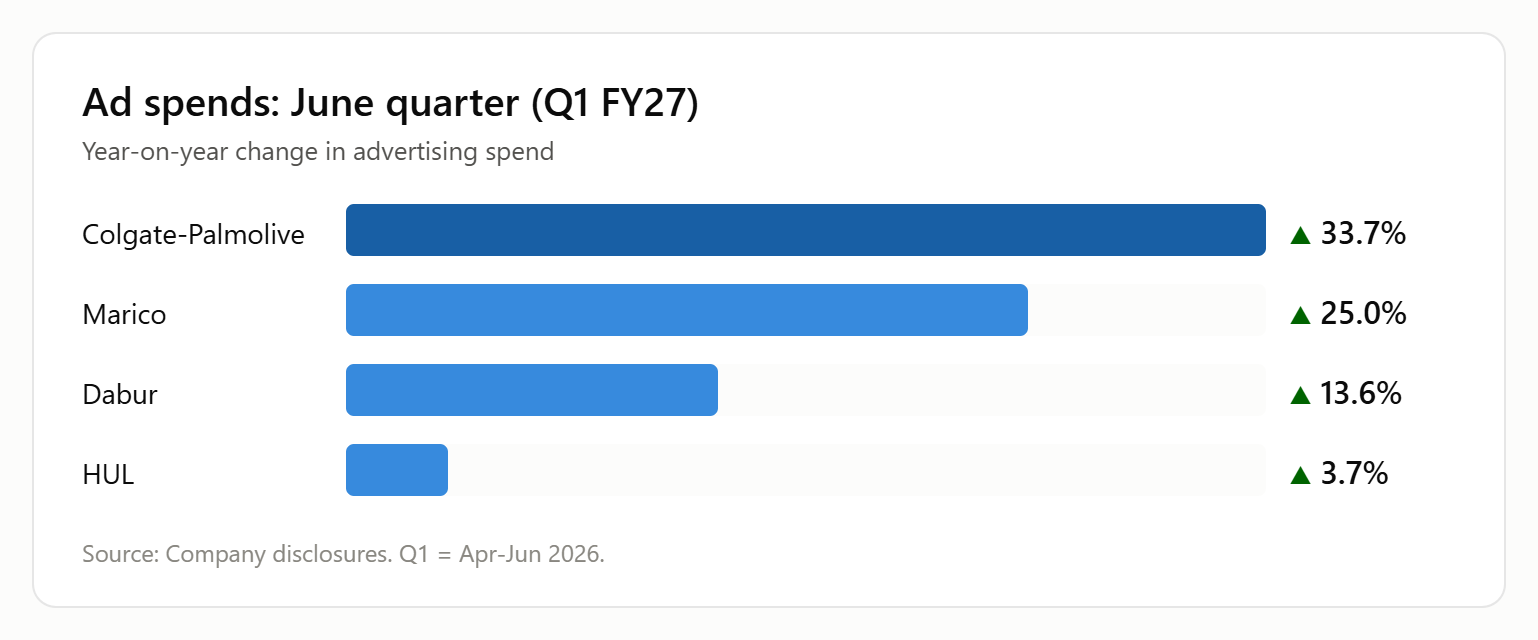
Among the FMCG companies that have reported first-quarter advertising figures, Marico recorded one of the sharper increases. Its advertising and sales promotion expenditure rose 25% year-on-year to ₹327 crore in Q1 FY27, compared with ₹261 crore in the corresponding quarter last year. The outlay accounted for approximately 8.3% of consolidated revenue, against 8.1% a year earlier. Revenue increased 23% to ₹3,957 crore.
Read: Marico hikes ad spends 25% as Q1 revenue climbs 23% to Rs 3,957 crore - Exchange4media
Colgate-Palmolive India increased advertising expenditure by 33.7% to ₹251.9 crore in Q1 FY27, from ₹188.4 crore a year earlier. Net sales grew 12% to ₹1,591 crore during the quarter, indicating that advertising expenditure rose at a faster pace than sales.
Read: Colgate’s ad spends up 34% in Q1FY27 - Exchange4media
Dabur India reported a 13.6% increase in advertising and publicity expenditure to ₹229.46 crore, compared with ₹201.96 crore in Q1 FY26. Consolidated revenue grew 10.6% to ₹3,764.39 crore. The company’s net profit rose 15.3% to ₹586.16 crore.
Read: Dabur’s Q1 ad spend climbs 14% to Rs 229 crore - Exchange4media
Hindustan Unilever, meanwhile, reported a more measured increase. Its advertising and promotion expenditure rose 3.7% year-on-year to ₹1,657 crore in the June quarter.
Read: HUL ad spends up nearly 4% as Q1 profit dips 2% - Exchange4media
Taken together, the disclosures suggest that companies were continuing to fund brand visibility in the first quarter, though the pace of investment varied considerably. The figures also show why aggregate spending growth alone may not tell the whole story: companies differ in their category exposure, sales momentum and the proportion of revenue they allocate to advertising and promotion.
September-quarter spending surge
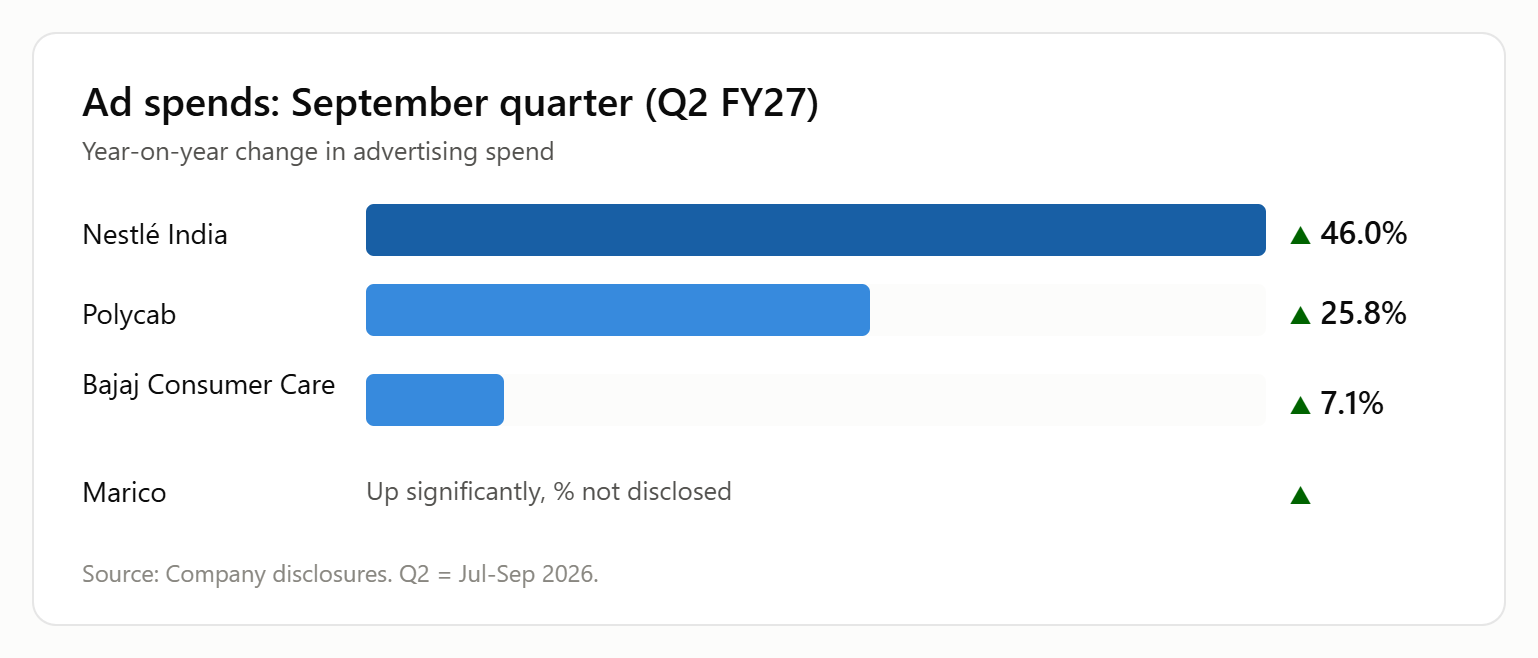
The latest indication comes from Nestlé India, which increased advertising and marketing expenditure by 46% year-on-year in Q2 FY27. Revenue from product sales rose 20.5% to ₹6,782.2 crore, while profit after tax increased 36.3% to ₹1,026.8 crore. The spending increase came alongside growth across several parts of its portfolio, including confectionery, beverages and prepared dishes. The company cited double-digit volume growth and continued investment in innovation, portfolio renovation and distribution.
Read: Nestlé India hikes ad spends 46% in Q2 FY27 - Exchange4media
The gap between advertising growth and sales growth is notable. Nestlé’s marketing expenditure increased at more than twice the rate of revenue from product sales, pointing to a sharper step-up in brand investment during the quarter. The results do not, however, establish how much of the increase was directed towards specific brands, campaigns or media channels.
Marico has also indicated that its spending momentum continued into the September quarter. In its Q2 FY27 business update, the company said advertising and sales promotion investments had “increased significantly”. It has not disclosed the absolute expenditure for the quarter. This follows the 25% year-on-year increase recorded in Q1.
Read: Marico hikes ad spends 25% as Q1 revenue climbs 23% to Rs 3,957 crore - Exchange4media
The update suggests that Marico is continuing to support its brands as it pursues growth across categories. Its India business recorded double-digit underlying volume growth in Q2, while Parachute Coconut Oil reported early-teens volume growth. The company has also reported sustained momentum in value-added hair oils and its foods and premium personal care businesses.
The rise in advertising expenditure comes at a time when consumer goods companies are facing renewed pressure on margins. Higher costs for raw materials, packaging and other inputs have made it more difficult to protect profitability while maintaining sales growth.
Against this backdrop, rising advertising outlays suggest that at least some companies are continuing to prioritise brand support alongside efforts to manage costs. Advertising can be a discretionary expense in the short term, but reducing it also carries potential trade-offs for companies seeking to sustain visibility, introduce products or defend market share.
HUL’s advertising and promotion expenditure rose a modest 3.7% in Q1 FY27, compared with sharper increases at Colgate-Palmolive India and Marico. Differences in campaign timing, category demand and the previous year’s spending levels may partly explain the variation.
The increase extends beyond FMCG
The pattern is not confined to consumer staples. Polycab India increased its consolidated advertising and sales promotion expenditure by 25.8% year-on-year to ₹40.5 crore in Q2 FY27, compared with ₹32.2 crore in the year-ago quarter. Revenue from operations rose 52.8% to ₹9,898.9 crore.
Read: Polycab raises Q2 ad spend 26% to Rs 40.5 crore - Exchange4media
The latest quarterly outlay was also 23.5% higher than the ₹32.8 crore spent in Q1 FY27. For the first half of FY27, advertising and sales promotion expenditure rose 55.3% to ₹73.3 crore, while consolidated revenue grew 46.2% to ₹18,108.6 crore.
Polycab’s business spans wires and cables, fast-moving electrical goods (FMEG), and engineering, procurement and construction. Its FMEG portfolio includes fans, lighting, switches, switchgear and solar products. The segment recorded its highest-ever quarterly revenue of ₹993.1 crore in Q2, more than doubling from ₹443.7 crore a year earlier.
Bajaj Consumer Care offers another variation. The company’s advertising and sales promotion expenditure increased 7.1% year-on-year to ₹41.65 crore in Q2 FY27, while revenue rose 25.4% to ₹332.8 crore. However, its spending was lower than the ₹50.01 crore reported in the June quarter, indicating a sequential moderation despite the year-on-year increase.
A trend to watch as more results arrive
The early FY27 disclosures point to continued advertising investment among several listed companies, even as input costs put pressure on profitability. Nestlé India’s 46% increase in Q2, Marico’s significant step-up in spending, and the first-quarter increases reported by Colgate-Palmolive India and Dabur indicate that brand investment remains a priority for parts of the FMCG sector.
As more September-quarter results become available, the key question will be whether the increases reported so far represent a broader shift in corporate spending or reflect company-specific decisions around launches, campaigns and growth priorities. For now, the disclosures suggest that input-cost pressure has not led all companies to pull back on advertising; however, the scale and intensity of that commitment remain uneven.
Read more news about Marketing News, Advertising News, PR and Corporate Communication News, Digital News, People Movement News
For more updates, be socially connected with us onInstagram, LinkedIn, Twitter, Facebook, YouTube & Google News
