Sugar Squeeze & Regulatory Heat: FMCG marketers brace for double whammy
While sugar prices have surged 30%, rising cost of edible oil, wheat, cocoa adds to margin pressure; packaged food advertisers left to choose between cutting spends or protecting festive visibility
 by
by
Published: Sep 2, 2026 9:24 AM | 7 min read
 Follow Us

- The Indian FMCG sector is facing significant challenges as retail sugar prices have surged 30% in over a month, reaching Rs 65-70 per kg, which is 38% higher than the previous year, impacting companies reliant on sugar for production.
- Major edible oil prices have also risen by 12-15% over the past year, and global wheat and cocoa prices have increased, further straining profit margins for FMCG companies, which are still recovering from a profitability crisis.
- The festive season, crucial for FMCG sales, is prompting companies to reassess their advertising strategies amid rising costs and regulatory scrutiny from the FSSAI, which has issued notices for misleading advertisements to several major brands.
- Analysts predict gross-margin compression and EBITDA pressure for affected companies, leading to potential cuts in advertising spending and a shift in marketing strategies towards more cost-effective channels during the festive period.
The Indian FMCG sector’s sweetest quarter—the festive season—is turning bitter.
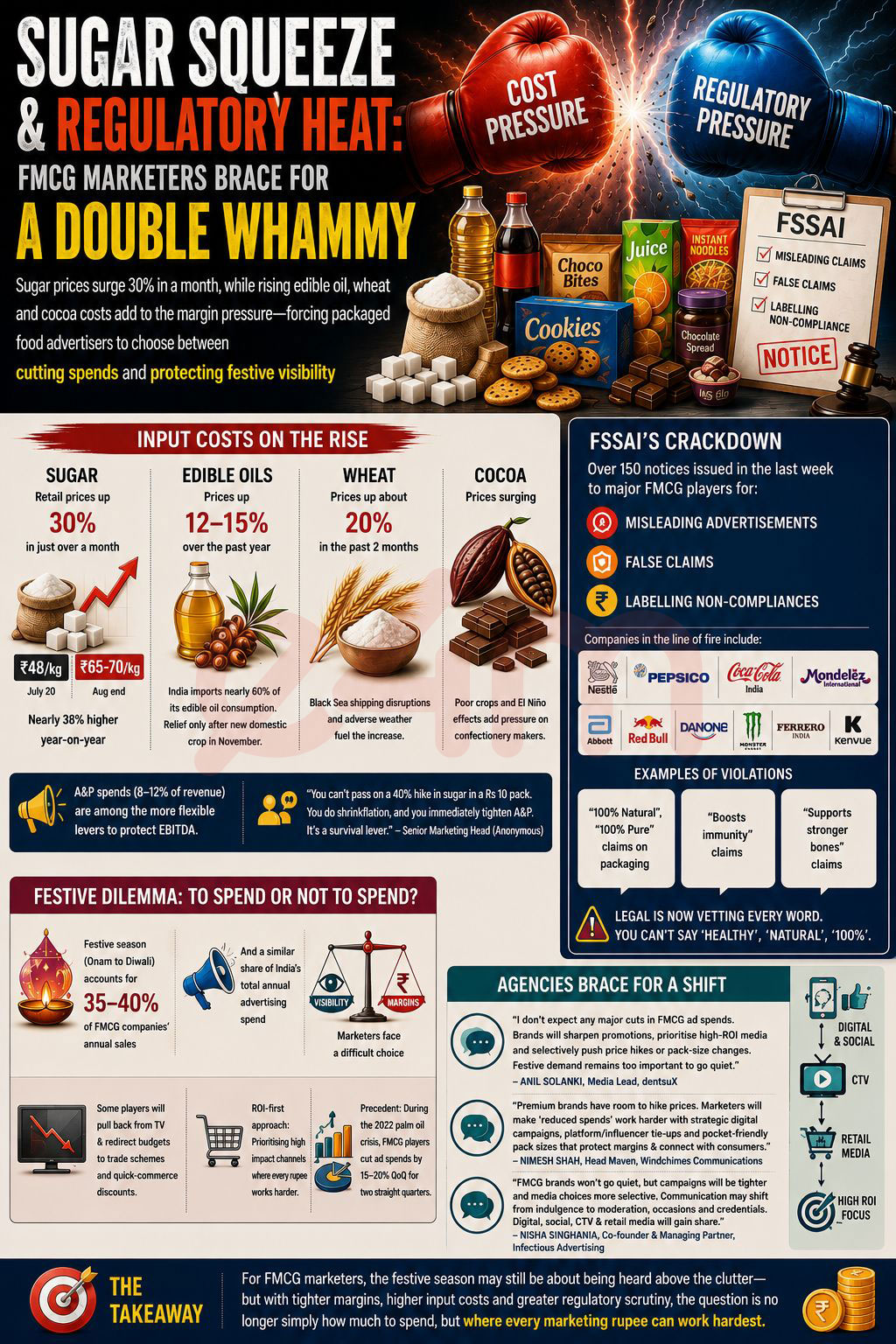
Retail sugar prices have jumped 30% in just over a month, from Rs 48 per kg on July 20 to Rs 65-70 per kg by August end. This is nearly 38% higher than a year ago. For makers of biscuits, confectionery, cakes, fruit juices, carbonated drinks and packaged sweets, where sugar accounts for 25-40% of raw material costs, the timing could not be worse.
Meanwhile, major edible oil prices have risen 12–15% over the past year, driven by firmer global benchmarks, higher freight costs and a weaker rupee. With India importing nearly 60% of its edible oil consumption, prices are unlikely to ease until the new domestic crop hits the market in November. Global wheat prices have also risen about 20% over the past two months amid Black Sea shipping disruptions and adverse weather, while surging cocoa prices, partly linked to poor crops and El Niño effects, are adding to pressure on confectionery makers.
The pressure comes just as the FMCG industry was recovering from its worst profitability crisis in four years. An analysis of seven sugar-exposed companies—including Britannia, Nestle India, Varun Beverages, ITC and Dabur—by Mint found that raw material costs jumped 20% in the June quarter. Their combined operating margin slipped to a four-year low of 22.2%, below even the peak seen during the Russia-Ukraine war, while net profits declined 7%.
Read more on FSSAI crackdown and brands rethinking campaigns
Mayank Shah, Chief Marketing Officer at Parle Products, says, “Following the recent government measures, speculative trading has reduced, hedging has stopped, and pressure from bulk buyers and stock hoarders has eased. Sugar prices have crashed from around Rs 70 to Rs 52-53 per kg in the wholesale market, although they are still higher than before.”
Read more: FMCG giants turn up advertising heat
“We are taking a wait-and-watch approach. Edible oil and wheat prices have also gone up, so we will see where sugar prices settle over the next few weeks. The volatility in edible oil and wheat is relatively lower. To tackle inflation, we are working on improving efficiencies and taking price increases where required. There will also be some rationalisation of advertising spends.”
Whenever input costs shoot up like this, discretionary spends are the first to be looked at, another senior marketing head at a listed company, which makes several biscuit brands, told e4m on the condition of anonymity. “You can’t pass on a 40% hike in sugar in a Rs 10 pack. You do grammage cuts, you push shrinkflation, and you immediately tighten A&P. It’s a survival lever.”
Read more on rise in festive ad spends
The impact, however, extends beyond biscuits and beverages. Industry executives point out that categories such as confectionery, packaged sweets, condensed milk and ice cream are also exposed to higher sugar costs, he pointed out.
Analysts estimate 50-80 bps of gross-margin compression and 20-50 bps of EBITDA pressure for affected companies this quarter. In FMCG P&Ls, advertising and promotions, which account for 8-12% of revenue, are among the more flexible line items that can be adjusted to protect EBITDA, another marketer explained.
Festive Dilemma: To Spend or Not To Spend
The festive season—which typically begins with Onam and runs through Diwali—accounts for 35-40% of FMCG companies’ annual sales and a similar share of India’s total annual advertising spend. FMCG companies, along with automakers, consumer durables, fashion and personal care brands, typically look to go big during this period.
But this year, marketers face a difficult choice: protect visibility or protect margins.
A senior marketer shares, “While we may continue to invest in brand building, the rest of the marketing spends will be assessed more closely. We are also evaluating whether inflation is already beginning to affect consumer demand. Companies tend to spend more when consumers are spending more. The picture should become clearer over the next few weeks. Fingers crossed.”
While some packaged-food players may maintain spending to defend market share, others are likely to quietly pull back from television and redirect budgets towards trade schemes and quick-commerce discounts, where ROI is easier to justify, advertising executives told e4m.
Industry observers point to the palm-oil crisis of 2022 as a possible precedent. “Listed FMCG players had cut ad spends by 15-20% quarter-on-quarter for two straight quarters due to the palm oil shortage. A similar pattern is expected, with publishers, broadcasters and digital platforms feeling the pinch in the ongoing festive window that typically sees heavy confectionery, ice cream, packaged sweets and cold drink advertising,” they said.
FSSAI’s Crackdown
If sugar is the first blow, regulatory scrutiny is adding another layer of uncertainty.
In the last week alone, FSSAI has issued over 150 notices to major FMCG players for misleading advertisements, false claims and labelling non-compliances. The list includes Nestle India, PepsiCo India, Coca-Cola India, Mondelez India (Bournvita), Abbott, Red Bull, Danone, Monster Energy, Ferrero India and Kenvue, among others.
The violations range from “100% Natural” and “100% Pure” claims on packaging to unsubstantiated health claims such as “boosts immunity” and “supports stronger bones”. The heightened scrutiny has added another variable for marketing teams planning their festive campaigns.
“It’s a double whammy, or perhaps even a triple whammy amid the festive season, because the Middle East war has already triggered a crisis around some input and packaging materials,” said a marketer.
“On one side, sugar is squeezing our margins; on the other, our entire health and functional portfolio is under the scanner. Legal is now vetting every word—you can’t say ‘healthy’, you can’t say ‘natural’, you can’t say ‘100%’. So even if you want to step up spending for the festive season, what claim do you make? It creates a lot of uncertainty,” he rued.
Agencies Brace for a Shift
Advertising agencies, meanwhile, are preparing for changes in brands’ communication strategies and media mixes as FMCG companies balance festive visibility with profitability.
Anil Solanki, Media Lead, dentsuX, said, “I don’t expect any major cuts in the FMCG ad spends due to rising input costs. Instead, impacted brands are more likely to sharpen promotions, prioritise high-ROI media and selectively push price hikes or pack-size changes to protect margins. After all, festive demand remains too important for most large FMCG brands to go quiet.”
Echoing the sentiments, Nisha Singhania, Co-founder and Managing Partner, Infectious Advertising, tells e4m, “I don’t think FMCG brands will go quiet during the festive season. But rising input costs and FSSAI scrutiny could lead to tighter campaign scales and more selective media choices. We could also see a shift in communication, from pure indulgence to themes of moderation, occasions and product credentials.”
Singhania believes the messaging and media mix may evolve in response to pressures on the category. “Digital, social, CTV and retail media are likely to gain share, while broad-reach traditional media may see greater scrutiny,” she highlighted.
For FMCG marketers, the festive season may still be about being heard above the clutter—but with tighter margins, higher input costs and greater regulatory scrutiny, the question is no longer simply how much to spend, but where every marketing rupee can work hardest.
Read more news about Internet Advertising India, Marketing News, PR and Corporate Communication News, Digital Media News, Television Media News
For more updates, be socially connected with us onInstagram, LinkedIn, Twitter, Facebook YouTube & Google News