How far can 'edgy' advertising go before it tips into bad judgement?
As brands chase shock value for cut-through, Flipkart's obituary-style sale ad reopens the debate on where provocation ends and poor judgement begins
 by
by
Published: Aug 20, 2026 7:42 AM | 6 min read
 Follow Us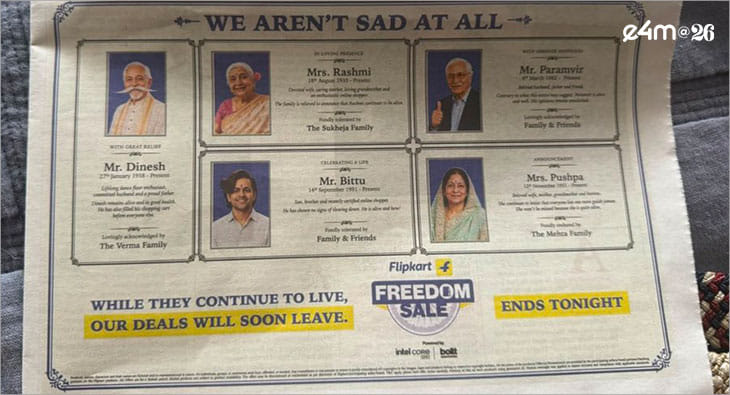

- The Indian advertising industry is facing increased scrutiny, with a 70% rise in complaints and a 102% increase in advertisements under review, primarily due to digital media violations.
- Flipkart's recent obituary-style ad has sparked debate over the fine line between creative provocation and poor judgment, highlighting the challenges brands face in a polarized market.
- Experts suggest that while some brands may take calculated risks for virality, established companies are more cautious due to the potential impact on reputation and trust.
- The industry is shifting towards aligning bold creative ideas with measurable business objectives, emphasizing the need for calculated provocation that resonates with target audiences.
As brands fight for a shrinking sliver of attention in an increasingly noisy feed, provocative humour, shock value and unconventional ideas have become a familiar creative lever. The trouble is that the lever cuts both ways, and the latest obituary-style print advertisement from Flipkart, which drew sharp online criticism, has reopened a debate the Indian advertising industry keeps circling back to: where does creative provocation end and poor judgement begin?
The numbers suggest the industry is operating with far less margin for error than it once had. ASCI's Half-Yearly Complaints Report for 2025-26 recorded a 70% jump in complaints and a 102% surge in advertisements taken up for scrutiny compared to the same period the previous year, with digital media accounting for 97% of all violations. The annual picture tells a similar story. ASCI reviewed 11,581 cases through the year, a 21% rise over the previous year; about 9,841 advertisements, up 37%. Ads promoting harmful products or situations made up 75.4% of the violations logged, ahead of misleading claims at 27.5%. What this points to is not necessarily that brands are getting more reckless, but that the ecosystem meant to catch missteps (spanning consumer vigilance, platform monitoring and self-regulation) has widened considerably, and outrage now travels through the same digital channels where a campaign is placed.
It is against this backdrop that the industry's more cautious instincts are hardening. Dr Sandeep Goyal, Managing Director of Rediffusion, one of India's oldest advertising agencies, frames the retreat as a function of risk appetite as much as creative nerve. “Everyone is playing safe. Trolling can get vicious and not all brands have the stomach for it. Plus, societal interpretations are rapidly getting polarised. And getting caught in any cross-fire doesn't benefit the brand anyway,” Goyal said.
Reading the room in a polarised market
In a market as layered as India's, cut through by regional, religious, linguistic and generational fault lines, what reads as playful in one pocket can read as insensitive in another, and social media compresses the distance between the two to almost nothing. A campaign no longer has the luxury of a slow rollout in which feedback can inform course correction. It is judged, dissected and, in some cases, boycotted within hours of going live. That compression is precisely what makes the debate around the Flipkart ad instructive, not because the ad itself amounts to a crisis, but because it forces a distinction the industry has been sloppy about: the difference between calculated provocation designed to travel and a genuine misjudgement of what an audience will tolerate.
Karthik Srinivasan, a communications consultant who previously headed Social@Ogilvy as its National Lead, argues that lumping the Flipkart ad in with genuine controversy misreads what actually happened. “I wouldn't even call the Flipkart ad either provocative humor or bad judgement. Not a single person is dead in the ad, in fact, it celebrates people when they are alive. This is vastly different from the Poonam Pandey campaign where we were actually made to believe she was dead for 2 full days before they told us that wasn't the case. And this ad is hardly a creative risk in my view; it was a calculated effort in generating online virality because they released it in just one newspaper in one city (Mumbai Mirror alone),” Srinivasan said.
The distinction matters because it separates two very different kinds of risk that are often lumped together in the outrage cycle. One is a controlled bet on virality, engineered for a specific, limited placement and designed to be talked about rather than believed. The other is a genuine misstep in judging what an audience can stomach, the kind that erodes trust rather than building buzz. Srinivasan's read also points to who tends to place these bets in the first place.
“In terms of pressure to stand out and taking risks because of that, yes, that could be possible, and that too by some D2C brands because they operate in a very crowded space. More established brands may not opt for such risks because they have experienced people who know how brand reputation could be affected due to such rash risks,” Srinivasan added.
Why boldness needs a business case
Globally, this caution is measurable in how seriously reputation is now treated as a boardroom risk rather than a marketing footnote. The Global Reputational Risk Readiness Survey for 2024-25 found that 99% of companies now rank reputation among their top ten business risks, a shift that has pushed brand safety conversations out of the marketing department and into risk committees. Indian agencies pitching bold, award-friendly ideas are increasingly aware that this caution sits on the other side of the table, and that creative ambition has to be reconciled with a client's tolerance for exposure long before an idea ever reaches a boardroom.
Megha Marwah, Vice President - Strategy at White Rivers Media, a Mumbai-based digital and social media marketing agency whose client roster spans BFSI, consumer and D2C brands, sees this tension play out at the pitch stage itself. “The disconnect comes from different priorities. Juries often reward originality and bold craft designed for global attention, while brands look for work that delivers measurable outcomes in their specific markets. That difference in the lens is where campaigns sometimes fall short commercially,” Marwah said.
That gap between what wins on a festival stage and what moves a needle in a specific market is precisely where agencies are learning to do their homework before, not after, a bold idea is greenlit. “When we present bold ideas, we always root them in the client's business objectives first. The creative is then shown as a lever to drive visibility, engagement, and ultimately sales. By linking the concept to data, insights, or past examples, we position boldness not as a risk but as a calculated way to break through clutter,” she said.
Provocation stops being a gamble on taste the moment it is backed by a client's own objectives and a body of evidence for why it will work. “It's a simple filter: what matters most to the client's success. Awards are motivating and help build reputation, but they can't replace measurable impact like sales uplift or brand growth. When the team sees how commercial outcomes strengthen relationships and create long-term value, alignment becomes much easier,” Marwah added.
For now, the industry's answer to how far edgy advertising can travel is less about the courage of an idea and more about how deliberately it is built, tested, and defended before it reaches a live audience. Provocation that is calculated, data-backed, and rooted in a clear read of the room continues to find room to breathe. Provocation that mistakes noise for meaning is the kind that gets pulled down within a news cycle, and in a market as watchful and as polarised as India's, that gap is only getting harder to bridge.
Read more news about Internet Advertising India, Marketing News, PR and Corporate Communication News, Digital Media News, Television Media News
For more updates, be socially connected with us onInstagram, LinkedIn, Twitter, Facebook YouTube & Google News
