India has the audience, but is the monetisation catching up?
India generates a fraction of the screen revenue seen in smaller, wealthier economies. Experts say growth will depend on converting audience scale into higher-value consumption & advertising
 by
by
Published: Oct 5, 2026 8:29 AM | 8 min read
 Follow Us

- India, with the world's largest population, has a screen economy valued at $12.4 billion annually, significantly smaller than other countries like China ($88 billion) and the US ($305 billion), despite its vast audience.
- The country's low GDP per capita ($2,703 in 2025) and reliance on affordable media options have created a disparity between audience size and revenue generation in the media and entertainment sector.
- Future growth in India's screen economy, projected to reach $15.4 billion by 2031, will depend on effectively monetizing audiences through innovative formats, improved advertising strategies, and leveraging AI technologies.
- The industry faces challenges in transforming high audience reach into higher revenue, necessitating a shift from a focus on scale to enhancing the value of viewer engagement and content monetization.
India has the world’s largest population and one of its biggest video audiences. Yet its screen economy remains surprisingly small relative to its reach. For the media and entertainment industry, the challenge is no longer simply to attract viewers, but to generate greater economic value from the attention it commands.
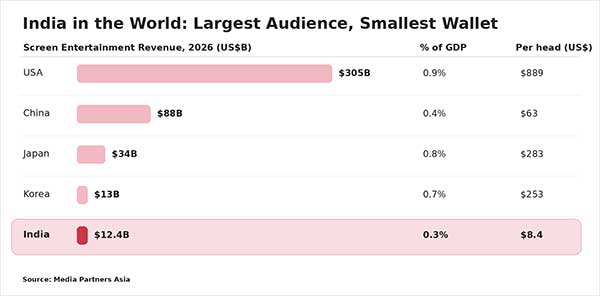
Media Partners Asia (MPA) estimates India’s screen economy at $12.4 billion annually, or $8.4 per capita. China generates $88 billion, equivalent to $63 per person, while South Korea’s $13-billion market translates into $253 per capita. Japan generates $34 billion, or $283 per person, and the US leads with $305 billion, equivalent to $889 per capita. South Korea, with just over 50 million people, thus generates a screen economy comparable in size to India’s, which has roughly 1.46 billion people.
“India has the world’s largest audience, but monetisation has yet to catch up with its scale,” says Vivek Couto, CEO and Executive Director of Media Partners Asia (MPA), speaking at the recent FICCI Frames conference.
The country’s screen economy, estimated at $12.5 billion in 2026, is expected to reach $15.4 billion by 2031, with most incremental growth coming from online video, Couto noted.
He adds the next phase of growth will hinge on monetising audiences more effectively as streaming gains ground, new formats such as microdramas emerge, and screens converge with commerce. AI, meanwhile, is set to reshape the economics of the content value chain, from production and localisation to discovery, marketing and new consumer experiences. Couto noted, “The opportunity now is to monetise that scale more efficiently.”
A Billion-Strong Audience Built on Affordability
India’s income profile explains part of the gap. World Bank figures put the country’s GDP per capita at about $2,703 in 2025, compared with $13,862 in China, $35,951 in Japan and $90,027 in the US. Lower purchasing power constrains direct consumer spending on entertainment.
But affordability is only part of the story. India’s media ecosystem has long relied on free-to-air television, inexpensive cable, low-cost cinema and aggressively priced streaming services. Advertising and telecom distribution have enabled consumption to expand without a corresponding increase in what audiences pay.
Vikram Malhotra, founder and CEO of Abundantia Entertainment, says the industry’s pursuit of scale has helped create this imbalance.
“For decades, players in India, both domestic and foreign, chased and built scale by making entertainment extraordinarily accessible — low-priced cable, free TV, some of the world’s cheapest data, relatively inexpensive cinema tickets and, more recently, very aggressively priced streaming services. All this has been great for consumption, but it has also created an ecosystem in which access and consumption has grown much faster than the revenue generated from that engagement,” Malhotra noted.
MPA estimates India’s screen economy at just 0.3% of GDP, compared with 0.9% in the US, 0.8% in Japan and 0.7% in South Korea. The China comparison also illustrates why scale alone cannot explain monetisation: despite an $88-billion screen economy, its per-capita revenue remains below that of Japan, South Korea and the US.
Consumer behaviour adds another dimension. An EY–Indian Music Industry study in 2026 found that 86% of surveyed smartphone users had paid for video OTT at some point, compared with 38% who had paid for music streaming. The figures suggest a willingness to pay for video, but do not establish how much consumers spend or how regularly they subscribe. Free alternatives and limited differentiation between free and premium offerings remain potential barriers to higher revenue.
A media executive points to the limits of importing established-market economics. “India cannot simply copy global markets. The US model assumes purchasing power India does not yet have, and the Korean one assumes export demand and state coordination at a scale that is hard to replicate quickly. The task is to build a monetisation model for scale rather than replicate mature markets,” the executive said.
“For years, India’s growth playbook centered on affordable data, low-priced subscriptions, telecom bundles and mass-market entertainment. That strategy built reach. The next phase will depend on whether platforms, broadcasters and advertisers can generate more revenue from each viewer without pricing large sections of the audience out of the market,” a TV executive shares.
Digital growth is not enough
The shift in revenue is already visible. According to MPA estimates, television revenue is projected to fall from around $7 billion in 2021 to $4.8 billion in 2026. Online video, meanwhile, has grown from approximately $2 billion to $6 billion over the same period and is expected to approach $10 billion by 2031.
Yet digital expansion does not automatically translate into higher revenue per viewer. A large mobile audience reached through inexpensive plans and bundled subscriptions can generate substantial viewing without delivering commensurate returns.
Pep Figueiredo, COO of PTPL India and a former SonyLIV executive, argues that the industry must move beyond inexpensive access and mass-reach advertising.
“Over ninety percent of that digital reach is still routed through wholesale telco bundles, inexpensive mobile inventory and low yield advertising rather than authenticated, addressable and premium television style monetisation. That is why the next five years must shift from a scale economy to an attention value economy where every viewing hour becomes measurable, targetable and transactable through premium connected television, programmatic and contextual intelligence, retail media convergence, disciplined tiering from daily sachets to annual plans and deeper IP monetisation,” Figueiredo shared.
The advertising opportunity lies in making audiences more valuable, rather than simply larger. Connected television (CTV) combines the big-screen experience associated with traditional television with digital targeting and measurement capabilities. Retail media and commerce-linked advertising can potentially connect exposure to purchase behaviour, while better audience data can help advertisers assess outcomes rather than rely on impressions alone.
Malhotra argues that premium video and screens need to command better advertising yields through improved targeting, measurement and brand integration. The objective, however, is not merely to charge more for inventory, but to demonstrate why it delivers greater value.
A TV channel head sees a parallel opportunity on the supply side: “The next phase may not be about producing more content but about making existing content, audiences and platforms more commercially productive. Sports, premium AVOD, CTV, commerce and data are likely to be central. AI could accelerate the shift by lowering production and localisation costs, improving discovery and retention, and making smaller language markets viable.”
The distinction matters in a market where content investment is not rising uniformly. MPA estimates total content investment at around $5 billion, broadly flat even as online-video investment has reached $2.6 billion, overtaking television. Premium advertising-supported video is estimated at approximately $3 billion, comparable with user-generated content.
The commercial question is whether platforms can improve the returns on content through stronger advertising products, differentiated subscriptions and additional revenue streams, rather than relying on ever-increasing production spending.
Global lessons, Indian economics
The US, Japan, South Korea and China illustrate different routes to monetisation, but none offers a ready-made blueprint for India.
The US built a high-value screen economy on established pay-TV subscriptions, cinema spending and sophisticated advertising. Streaming services have subsequently added advertising-supported tiers, bundling, price increases and measures to convert shared accounts into paying subscriptions.
South Korea’s experience highlights the importance of exportable intellectual property. Institutional support for cultural industries, alongside production and export capabilities, helped Korean content reach international audiences, creating revenue opportunities beyond domestic subscriptions and advertising.
Japan has extracted value through anime, gaming, character licensing and merchandise across multiple distribution formats. China, meanwhile, demonstrates that a vast domestic audience does not automatically deliver high per-capita revenue. Advertising- and commerce-led video can capture considerable attention while direct consumer spending remains comparatively modest.
India’s challenge is to adapt relevant elements to its own economics. Telecom bundles and mobile-first plans have widened access, while cricket has helped platforms attract large audiences and support subscription and advertising models. But low entry prices can also reinforce expectations that premium content should cost very little.
AI could reduce production and localisation costs, improve discovery and make smaller language markets more viable. Stable regulation, credible measurement and effective anti-piracy enforcement could help make returns more predictable. Neither technology nor policy, however, can substitute for products that give consumers and advertisers clear reasons to pay.
The next test: value, not volume
For platforms, the priority is to develop clearer subscription tiers and revenue streams around established properties. For advertisers, it is to connect audience attention with measurable business outcomes through better targeting, CTV and commerce-linked formats. For content owners, it is to extend successful intellectual property across screens, formats and markets.
MPA projects India’s screen economy will reach $15.4 billion by 2031. The trajectory points to continued growth, but the more consequential question is how much revenue that expansion will generate relative to the audience it serves.
India has demonstrated that it can build scale. Its next test is to turn that scale into stronger advertising yields, sustainable content investment and greater consumer spending. The opportunity lies not simply in getting more people to watch, but in building a business model that makes their attention more valuable.
Read more news about Digital Media, Internet Advertising, Marketing News, Television Media, Radio Media
For more updates, be socially connected with us onInstagram, LinkedIn, Twitter, Facebook, YouTube & Google News
