From impressions to attention, marketers rethink what makes an ad work
As consumers move between television, CTV, YouTube, Instagram, mobile and the open web, marketers are questioning whether impressions and reach are still enough to judge advertising effectiveness
 by
by
Published: Aug 25, 2026 12:40 PM | 10 min read
 Follow Us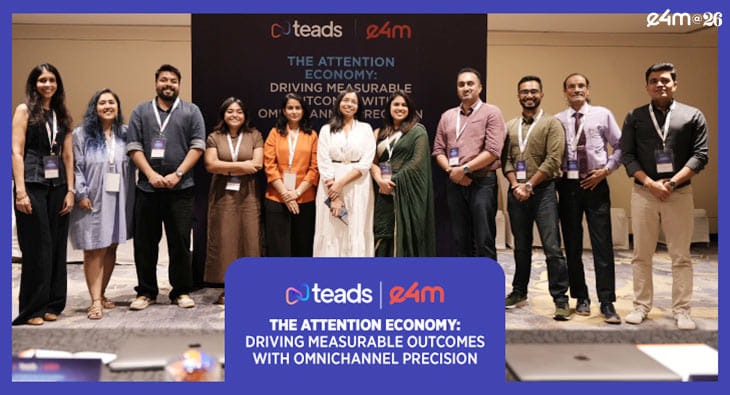

- The advertising industry is shifting focus from mere visibility to understanding consumer engagement and behavior changes, as discussed by marketing leaders at the Teads x e4m event on the attention economy.
- Marketers are increasingly integrating various media channels, recognizing that consumers do not interact with brands through isolated platforms, and emphasizing the importance of context-specific creative content.
- As consumer attention spans decline despite increased screen time, brands face challenges in creating memorable content that breaks through the clutter, necessitating a focus on quality and relevance.
- The discussion highlighted the need for new measurement metrics beyond impressions, emphasizing engagement and consumer behavior to assess the effectiveness of advertising campaigns in a fragmented media landscape.
The advertising industry is moving into a phase where simply being visible is no longer enough, as marketers increasingly want to know whether consumers actually noticed the communication, engaged with it and eventually changed their behaviour because of it. At the Teads x e4m discussion on the attention economy, marketing leaders from Flipkart, Groww, Xiaomi India, Swiggy, Giva and Acer India debated how fragmented media consumption is changing campaign planning and measurement.
The conversation pointed to a fundamental shift in marketing strategy. Instead of treating television, digital, social media and connected television as independent channels, brands are increasingly looking at how each touchpoint contributes to the overall consumer journey, while creative is being developed specifically for the environment in which it will be consumed.
From channel planning to consumer planning
Swapnil Agrahari, Brand Marketing Manager, Flipkart, ex-BoAt said the biggest change is that marketers can no longer think about television and digital as completely separate media choices, because consumers themselves do not experience brands through neatly divided channels. “If I talk about 10 or 12 years ago, people used to plan, say, you do TV, TV gives you ads, you do digital, digital gives you ads. But right now, increasingly, it has become incremental. You cannot choose to do one or the other.”
Agrahari added that the role of a channel is increasingly determined by consumer behaviour and intent rather than by a fixed media hierarchy, because the same consumer can behave very differently when watching YouTube compared with scrolling Instagram. “The same person who watches YouTube has a different intent and behaviour on that channel. And the same person when he or she watches Instagram has a different behaviour and attention span.”
The implication is that simply distributing the same creative across multiple platforms can limit effectiveness, because the context in which an advertisement is consumed changes the level and quality of attention it receives.
Attention is scarce, but screen time is rising
The contradiction facing marketers today is that consumers are spending more time on screens even as their willingness to pay attention to individual pieces of content appears to be shrinking.
Sooraj Balakrishnan, Associate Director and Head of Marketing, Acer India on the panel pointed out that consumers may not have the patience to consume an entire piece of content, but they can still remember an individual Reel, influencer video or unexpected piece of communication if it manages to break through the clutter. “The attention span is going down rapidly. The screen time is increasing a lot, and you do catch up on something that caught your attention eventually, like that one Reel.”
The point is important for advertisers because declining attention does not necessarily mean consumers are becoming impossible to engage. Instead, the threshold for earning attention is becoming higher, making the quality and relevance of content more important.
Ruchita Sharma, Media Manager - Growth Marketing , Xiaomi India on the panel noted that the sheer volume of advertising has also made memorability harder, even marketers struggle to recall which advertisements they have seen recently. “Even when I am trying to keep up with all the trends, there is still nothing in the entire lot. When I look at it, there are a lot of formats, a lot of ads, nothing sticks anymore the way it used to before.”
This creates a new challenge for brands: they are not only competing against rival brands but against an enormous volume of content competing for the same few seconds of consumer attention.
Giva: Content must be built for the platform
For Giva, this shift has meant moving away from television altogether and putting greater emphasis on content and platform-specific creative. Aakanksha, Assistant Vice President, Giva, said the jewellery brand does not use television, a decision that has shaped how it thinks about content and campaign planning. “Funny thing is, we are not on TV at all. We don't do TV, and that has worked for us.”
Rather than producing one central television-led campaign and subsequently adapting it for digital platforms, Giva plans its campaigns according to the requirements of each platform from the beginning. “Whenever we plan campaigns, it has to be according to those platforms. From the get-go, we plan it like that.”
She explained that the approach is deliberately different from retrofitting a piece of content after it has already been created. “It’s not that you’re retrofitting the content as per the platform, but you’re planning for it, and then delivering for it. And that has worked for us.”
For a category such as jewellery, where storytelling, emotion and aspiration have traditionally been important components of advertising, the approach reflects how digital platforms are changing the creative process itself rather than simply changing where the finished advertisement is distributed.
Passive attention versus active attention
The panel also made an important distinction between consumers who are actively looking for a product and those who encounter a brand while consuming unrelated content.
The discussion suggested that active attention, such as when a consumer is searching for a product, requires precise targeting and relevant messaging, while passive attention requires brands to create content capable of interrupting consumers without becoming intrusive.
“When you’re searching about the product, when you’re actually in market, it’s more about reaching the right cohort and ensuring that person sees the right message.” Parinita P Singhi, Associate Director- Brand & Media (Lead), Groww added that passive attention requires a different strategy because consumers have not actively chosen to interact with the brand. “I think that’s important for marketing, where is passive, where is active attention.”
This distinction is becoming particularly important as brands attempt to balance personalisation with consumer expectations around privacy and relevance. The challenge is to make advertising sufficiently contextual without making it feel intrusive or irrelevant.
Swiggy: Not every piece of content needs to sell
For Swiggy, the answer lies in assigning different roles to different platforms rather than expecting every piece of content to generate an immediate commercial response.
Pritam Mondal, Senior Manager, Brand Marketing, Swiggy, said the platform determines how the brand approaches content, with Instagram serving a different purpose from more direct-response environments such as YouTube. “It always depends on which channel, what content you’re using.”
He said Swiggy's Instagram content is designed around what users expect when they open the platform rather than turning every post into a direct sales message. “What are you opening Instagram for? Right? And we’re doing exactly that.”
Even content that may not have an immediate measurable commercial outcome can contribute to brand salience, according to Mondal. “The kind of trigger that it gives onto your mind, it sometimes helps filling the top of mind as well.”
By contrast, the brand uses more direct communication on YouTube, including short-form advertising around offers and other functional messages. “Those are very direct, very meaningful, like what are the offers running? Very direct, very 10-second ads that we run.”
The brand is also experimenting with longer-form storytelling around food and restaurant culture, including content featuring Swiggy CEO Rohit Kapoor and restaurant partners, which Mondal said is less about directly pushing the brand and more about creating associations around food.
Engagement is becoming a proxy for attention
For marketers, the challenge does not end with getting consumers to stop scrolling. They also need to determine whether that attention had enough depth to create an impact.
Mondal said Swiggy increasingly looks beyond simple reach and focuses on the amount of time consumers spend engaging with content.“It’s not about the reach that we’re getting, but what is the kind of engagement that we’re feeling.”
He added: “For me, and I think for all of us, engagement is equal to attention nowadays.”
This is where measurement becomes complicated, because consumer journeys are no longer linear. A consumer might see a brand on television, encounter it again on Instagram, search for it on Google and eventually transact through another platform.
The panel therefore highlighted incremental reach, brand lift and attention measurement as increasingly important tools for understanding whether multiple channels are actually adding value rather than repeatedly exposing the same audience.
Why impressions alone are no longer enough
The industry has traditionally relied heavily on impressions because they provide an easy, scalable number for marketers to report. But the panel argued that impressions increasingly tell only part of the story.
One speaker pointed out that marketers can no longer simply celebrate a large number of impressions without understanding what those exposures actually delivered. “We should start initially about the impression, the needs of the scores. Because when we deliver, impact is more important.”
The argument reflects a wider shift from media delivery to media effectiveness. Brands increasingly want to know whether advertising created attention, whether that attention generated brand lift and whether the campaign ultimately contributed to business performance.
Consumers are doing the research themselves
Another factor making advertising measurement more complex is the increasing sophistication of consumers.
The panel discussed how a consumer may once have seen an advertisement, walked into a store and purchased the product, whereas today's consumer is likely to search online, compare prices, read reviews, check ratings and evaluate product quality before making a decision. “Now people see the ad, wherever they are. They do a Google search, find out what are your ratings, compare it on Amazon.”
For high-value purchases such as cars, laptops and other expensive products, this research journey becomes even more extensive, making it difficult for brands to attribute the eventual purchase to a single advertisement. “If the product is expensive, then it’s more auditing.”
This is pushing marketers towards a broader set of indicators, including brand-search growth and consumer behaviour beyond the initial media exposure.
AI will make brand discovery even harder to measure
AI will make brand discovery even harder to measure
The panel also touched on the implications of artificial intelligence for brand discovery and measurement, with marketers recognising that appearing in AI-generated answers could become another important component of brand visibility.
However, the discussion suggested that AI visibility is likely to be a long-term brand-building exercise rather than a quick performance lever. “AI is a long-term game. Because you have to build a lot of content for the AI engines to start giving up.”
The bigger challenge will be determining whether interactions attributed to AI-led discovery represent genuine consumer interest or automated activity, making traditional metrics such as clicks and impressions increasingly difficult to interpret in isolation.
One possible signal discussed was growth in brand-search volume, which can indicate whether a campaign or broader brand activity is generating genuine interest.
The new advertising currency
The discussion ultimately points to a change in what marketers consider valuable. Reach remains important, but the industry's focus is moving towards the quality of that reach and what happens after an advertisement enters the consumer's field of vision.
For Swapnil Agrahari of Flipkart, that means planning across channels rather than treating them independently. For Aakanksha of Giva, it means creating platform-native content from the beginning. For Pritam Mondal of Swiggy, it means accepting that different platforms can play different roles, from top-of-mind brand building to direct product communication.
The larger lesson is that attention cannot be treated as another standalone media metric. It sits at the intersection of creative quality, platform behaviour, consumer intent and measurement, forcing marketers to connect media exposure with what consumers actually do next.
As advertising becomes increasingly fragmented, the brands that win the attention economy may not necessarily be those buying the most impressions, but those that understand where attention happens, what earns it and how to convert that attention into lasting brand value.
Read more news about Marketing News, Advertising News, PR and Corporate Communication News, Digital News, People Movement News
For more updates, be socially connected with us onInstagram, LinkedIn, Twitter, Facebook, YouTube & Google News
