People are not Googling, they are asking AI what to buy: Mahindra Lifespaces’ Ankur Parmar
Ankur Parmar, CMO of Mahindra Lifespace Developers Ltd, says AI is reshaping search, customer journeys and agency relationships, changing how brands are discovered, built and trusted
 by
by
Published: Jul 14, 2026 8:59 AM | 6 min read
 Follow Us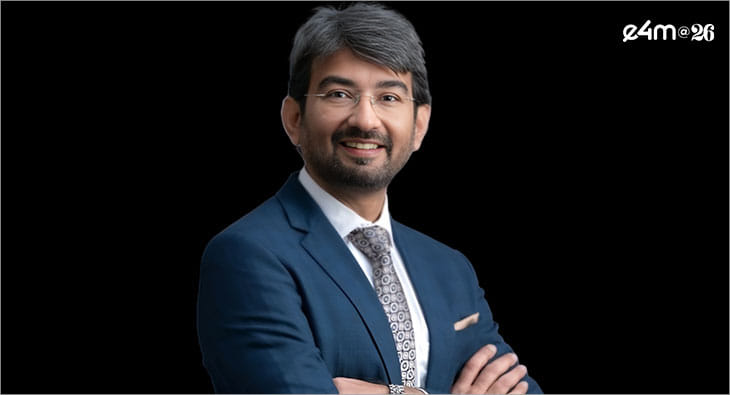

- AI is fundamentally reshaping marketing strategies, challenging long-held assumptions about consumer behavior, search engines, and the marketing funnel.
- Marketers, like Ankur Parmar of Mahindra Lifespace Developers, are shifting focus from traditional SEO to a new approach termed GEO, emphasizing credibility over frequency in search results.
- The buying journey has become omni-channel, with consumers seeking information across various platforms, making the traditional lead-generation model obsolete.
- Despite the rise of AI, traditional media remains relevant, and marketers are advised to maintain a balanced approach that incorporates both digital and traditional channels.
Every marketer has a playbook they rarely question: the funnel, the channel plan, the SEO calendar, the tidy distinction between advertising and everything else.
For years, those frameworks shaped how brands were built and budgets were allocated. But AI isn't simply asking marketers to add another tool to that playbook. It's quietly dismantling the assumptions the playbook was built on. The real challenge isn't learning how to use AI. It's recognising that many of the instincts marketers have relied on for years may no longer hold true.
Ask Ankur Parmar, Chief Marketing Officer at Mahindra Lifespace Developers Ltd, where marketing begins today, and his answer does not start with media plans or creative briefs. He starts with AI, not as another capability in the marketing stack, but as the force reshaping how consumers discover, evaluate and ultimately choose brands.
"People are not Googling, they are talking to AI for what they need to buy," says Parmar. "AI cannot be avoided."
SEO is dead. Long live GEO.
One of the clearest shifts in Parmar's thinking is linguistic as much as strategic: he no longer talks about SEO without also talking about what comes next.
"Google searches can tell me what people are really looking at, and possibly I can, basis that, do the SEO and AIO which is modern nowadays, we can rank ourselves better," he said, describing how Mahindra Lifespaces reads search intent before deciding where information needs to live.
But the bigger shift is already underway inside the organisation.
"We are very much training the GEO! The SEO which we used to do, now is GEO training."
The mechanics behind that shift matter because they overturn a decade of search logic.
"AI is smart enough to say that I have heard more about this, but I have heard this from an authentic source, and that's the reason why, even though it is heard less number of times, it will feature more in my recommendation."
Frequency loses to credibility. That's a different game from the one most SEO teams were trained to play. And for Parmar, that changes where responsibility lies.
"The website remains the most authentic place to get product information in its entirety."
The customer stopped living in one place
If search is fragmenting, it's because the customer is. "The customer is not only in one medium or one space anymore. They have actually become omni-channel," Parmar said. He extended that point while talking about the reality of selling homes. "It's not only about catching the home buyer, but also influencing him in all aspects because he's getting influenced in several ways."
The buying journey no longer begins with Google. It begins with a question.
“Which projects in Pune have the best construction quality?”
That question might go to Gemini or ChatGPT. It could then move to YouTube walkthroughs, Instagram Reels, Reddit discussions, Google searches and, finally, the developer's own website.
For marketers, that means the old obsession with owning a single lead-generation channel no longer applies.
"We are actually not worried about whether they land onto us or not," Parmar said. "We want to inform them correctly about our differentiated features. And it's an omni-channel thing. It is not something which is only limited to one place."
The funnel that once neatly organised this journey doesn't hold up either.
"From awareness to consideration to purchase, it's not as simple with the modern consumer in place," Parmar said. "It goes back and forth."
What replaces sequence, in his view, is consistency.
"At all varied steps, we try to influence customers by giving the right authentic information and consistently across platforms so that trust is developed."
Even then, digital has its limits.
"Digital can optimize the consideration cycle, but from consideration to purchase, it is dependent on trust."
Agencies have to move faster than the marketers who hire them
For years, agencies have defended their relevance against in-house teams, automation and shrinking retainers. AI may be changing that equation.
One of Parmar's more revealing admissions was that his own agencies have adapted to AI faster than he has.
"A lot of things in AI which I want to do, I realise my agency has adapted faster than me. They are doing a good job in terms of using AI more effectively to crunch our requirements, cost and time."
The implication extends well beyond one client-agency relationship. As AI becomes embedded in marketing workflows, agencies are increasingly expected not just to execute campaigns, but to lead clients through technological change.
Parmar is equally clear that AI doesn't diminish creative expertise. Instead, it raises the premium on it.
"A creative guy using AI for a creative output and a layman using AI for a creative output are two different things, because AI responds to the quality of the brief. If you have poor input, it will also give you poor output."
It's also why he doesn't subscribe to the idea that AI will make agencies obsolete. Instead, he believes their role will evolve from execution-led vendors into strategic partners with technological depth.
…but traditional media isn't disappearing
For all his enthusiasm around AI, Parmar isn't arguing for an all-digital marketing strategy. If anything, he's arguing against one.
"We do a lot of print. We do a lot of OOH. Digital is part of our plan too," he said. "We don't invest disproportionately in digital. It commensurates with its share."
His reasoning is straightforward. Consumers may no longer live in one medium, but they haven't abandoned traditional ones either. "We take in new channels, new mediums, but not at the cost of where the brand needs to be built. We do that tactically. We do that very consciously."
Well, this wasn’t really a story about AI adoption. It's about the collapse of assumptions marketers once took for granted: the linear funnel, the dominance of search engines, and the belief that consumers could be reached through a handful of predictable touchpoints.
AI didn't create that shift. It simply made it impossible to ignore.
The marketers who get ahead from here won't necessarily be the ones with the biggest AI budgets. They'll be the ones who recognise that the customer has already rewritten the rules, and stop optimising for a playbook that no longer exists.
Read more news about Digital Media, Internet Advertising, Marketing News, Television Media, Radio Media
For more updates, be socially connected with us onInstagram, LinkedIn, Twitter, Facebook, YouTube & Google News