In two years, AI platforms could account for around 5% of AdEx share: Neil Patel
NP Digital Co-founder says India’s scale, platform adoption and data velocity are turning the country into a global testing ground for next-generation marketing models
 by
by
Published: Feb 28, 2026 8:32 AM | 6 min read
 Follow Us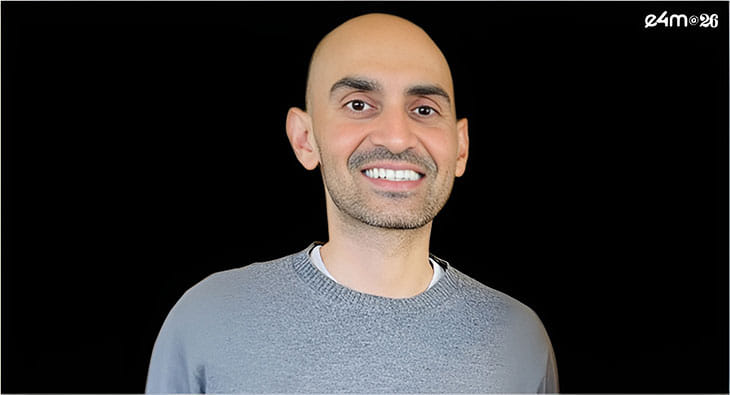

Artificial intelligence may still account for a negligible share of global advertising revenues today, but its commercial inflection point could arrive faster than most marketers anticipate.
“In the next two years, AI platforms could account for maybe 5% of advertising share,” said Neil Patel, co-founder of California-based global performance marketing firm NP Digital, during an exclusive interaction with exchange4media during his one-day visit to India on Friday.
The number may appear modest against the entrenched dominance of platforms such as Google, Meta and Amazon, but Patel argues that even a single-digit shift would signal one of the fastest structural reallocations of advertising spends the industry has witnessed.
“It sounds small, but considering how dominant Google, Meta and Amazon are, that would represent very fast growth,” he noted.
For Patel — whose firm operates across 28 markets — the transition underway is less about new ad formats and more about a fundamental rewiring of how consumers discover brands, how intent is formed, and where marketing interventions occur.
Across categories—from financial services and FMCG to enterprise technology—brands are already beginning to test AI-led optimisation frameworks in content creation, discovery and performance marketing. Patel noted that early adoption is visible among institutions such as mutual funds, fintech platforms and consumer brands experimenting with hybrid human-AI workflows to scale marketing efficiency without compromising brand trust.
India is marketing’s real-time lab
Patel believes India’s strategic importance in this transition stems from an advantage few markets can replicate: scale combined with diversity.
“You have a lot of different regions with a lot of different cultures and languages,” he said. “So you can experiment really quickly with a lot of people because the population is large across different income brackets, and it gives you data very fast.”
Unlike smaller developed markets where experimentation often struggles to achieve statistical relevance, India allows marketers to compress testing cycles dramatically. “With a lot of other countries you can experiment, but there’s not the sample size to get data quickly enough. India is a great place for testing.”
This shift, he added, marks a decisive break from earlier perceptions of India as a lagging technology market.
“If you look at it years ago, you could say India was five years behind. Today there’s no five years behind — not even three or two. Whatever we have in America, they adopt it here in India right away.”
Consumer behaviour, he observed, now mirrors developed economies far more closely than income metrics might suggest. “Consumer adoption is very similar here as it is in the United Kingdom or the United States. The difference is GDP and income, not willingness to adopt technology.”
Reflecting this momentum, Patel expects India to play a far larger role in NP Digital’s global expansion roadmap.
“India is already in our top five markets. Within five to ten years, I believe India will be our second largest market because GDP and technology implementation are growing so rapidly.”
AI abundance raises the premium on human creativity
When asked about shrinking attention spans amid the surge in AI-led content supply, Patel argued—paradoxically—that generative AI may ultimately make human originality more valuable.
He explains, “Before AI, there were already around 4.6 to 4.8 billion pieces of content being created every single day. In two days, there’s enough content for the whole world. With AI, that number will more than double or triple.”
As content supply explodes, differentiation becomes harder — shifting competitive advantage toward expertise and authenticity.
“The content that performs the best is something new that we haven’t seen before. That requires human intervention,” Patel said. “AI can help create content, but you don’t want it to fully create content because it lacks expertise, experience, authority and trust.”
Across markets, brands are increasingly moving toward hybrid models combining automation with human strategic oversight — a trend Patel sees accelerating rather than stabilising.
“At NP Digital, this hybrid approach is already being deployed across clients in financial services and consumer categories,” said Patel. He cited engagements with organisations such as HDFC Mutual Fund and fintech platform Angel One, where AI-assisted workflows are combined with human editorial oversight to improve campaign performance while retaining credibility — an approach he believes will become industry standard.
From search engines to ‘search everywhere’
Perhaps the most significant behavioural shift underway, according to Patel, is the decentralisation of discovery itself.
“Discovery is happening everywhere,” he said. “We look at SEO not as search engine optimisation anymore, but search everywhere optimisation.”
Consumers today encounter brands across social platforms, marketplaces, video ecosystems and increasingly AI interfaces — often long before explicit purchase intent emerges.
“You have to optimize to be found on all platforms before people even know they want to buy,” he added.
Globally, brands across beauty, enterprise software and consumer packaged goods — including companies such as Adobe, L’Oréal and Arm & Hammer — are increasingly investing in what Patel describes as “search everywhere optimisation”, ensuring visibility not just on traditional search engines but across AI interfaces, social discovery environments and knowledge platforms.
In India, similar strategies are now being extended to legacy conglomerates and digital-first enterprises alike, with companies such as Dabur and Tata Communications focusing on improving structured brand visibility across AI-led recommendation ecosystems, he noted.
As connected environments expand, advertising will increasingly move beyond screens altogether. “You’re no longer just going to advertise on a cell phone or computer,” Patel said. “Marketing will be everywhere — from cars to home devices — because everything is turning digital.”
The shift is already visible in large-format connected environments such as airports, retail infrastructure and live sporting ecosystems, where emerging AI platforms have begun appearing alongside traditional advertisers — signalling how discovery-led marketing is expanding beyond conventional digital screens, Patel noted.
It takes time to penetrate India market
Despite rapid technological convergence reshaping India’s media and marketing ecosystems, Patel pointed to a far more fundamental and enduring distinction when asked about his biggest challenge in India—the nature of doing business itself.
“India is very relationship driven,” he said. “It takes time to penetrate the market, build trust and relationships. In the US, business is more transactional.”
His observation underscores a structural reality for global companies entering India: scale alone rarely guarantees success. Market entry often hinges on long-term credibility, local partnerships and sustained on-ground engagement—factors that slow expansion timelines but ultimately deepen brand resilience in one of the world’s most complex and relationship-oriented business environments.
For global firms, he suggested, success in India will depend as much on long-term ecosystem integration as technological capability — a dynamic that may ultimately strengthen partnerships as India assumes a larger role in shaping future marketing models.
Read more news about Digital Media, Internet Advertising, Marketing News, Television Media, Radio Media
For more updates, be socially connected with us onInstagram, LinkedIn, Twitter, Facebook, YouTube & Google News