Imperial Blue’s Because, Men Will Be Men: ‘The humour has to feel current & not nostalgic’
Tilaknagar’s Ishwindar Singh and ad Director Roopali Singhal on bringing back the lift, putting women in on the joke and evolving an iconic franchise
 by
by
Published: Oct 9, 2026 9:19 AM | 10 min read
 Follow Us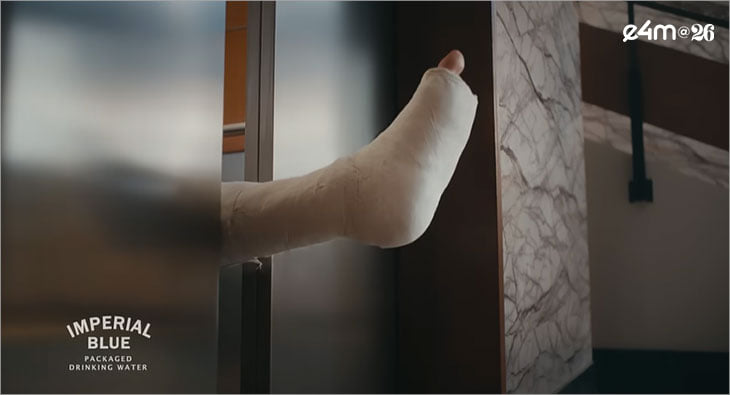

- Imperial Blue Packaged Drinking Water, now owned by Tilaknagar Industries, has revived its advertising campaign "Because, Men Will Be Men" with a new film directed by Roopali Singhal, marking a shift in perspective by featuring a woman as an active participant in the humor.
- The film, produced by 82.5 Grey and DejaVu Films, showcases a humorous scenario in a lift involving two men and a woman, emphasizing chivalry while avoiding outdated or objectifying portrayals.
- The campaign aims to leverage the established brand equity of Imperial Blue while making the humor relevant to contemporary audiences, focusing on relatable male behaviors without falling into nostalgia.
- As the bottled water market in India is projected to grow significantly, the brand seeks to differentiate itself through memorable advertising rather than functional claims, expanding its distribution and presence across more states.
Few advertising spots in India have aged as well as Imperial Blue's 'Because, Men Will Be Men', and fewer still get a second life in an entirely different category. Imperial Blue Packaged Drinking Water, now under Tilaknagar Industries (TI), the liquor maker that took over the Imperial Blue brand from Pernod Ricard India, has revived the franchise with a film that returns to its most recognisable creative cue, the lift. What has changed is who holds the camera and who gets to laugh.
Roopali Singhal, who the brand says is the first woman to direct a film for the platform, helmed the new outing for newly appointed creative partner 82.5 Grey, with DejaVu Films as the production house.
The film places two friends and a young woman in a lift, with chivalry as the trigger for the humour. One of the men, pushing his friend's wheelchair, gets so busy impressing the woman that he forgets his friend at the door, and it is the woman who points it out. The cast includes Aaron Kaul, Kaveri Seth and Anant Joshi.
e4m spoke to Ishwindar Singh, Senior Vice President, Marketing, TI, and Singhal about what it takes to evolve an advertising icon without letting it curdle into a nostalgia play.
Inheriting equity, not rewriting it
The decision to return to the platform rather than invent a new one was as much a business call as a creative one. This is the brand's first big-ticket push under TI, and the equity on offer is not just recall but a distinct brand of humour built over close to three decades. Ahmed Rahimtoola, Chief Marketing Officer, TI, framed it in those terms in a statement. "For us at TI, this is a critical step in unlocking the potential of Imperial Blue Packaged Drinking Water's established brand equity and accelerating its growth story," he said.
Singh, who has worked on Imperial Blue earlier in his career, says the diagnosis was straightforward. The platform runs on exaggerated but relatable humour drawn from observation, and that was never going to be tampered with. "We had inherited the platform itself as a strong source of brand equity. It was an observation of men's quirks. Men are wired in a certain manner. There are male idiosyncrasies, which we all see around us. We all know somebody in our group who has, sometime or the other, behaved in a manner which we say, 'you know what? That's a Because, Men Will Be Men ad,'" he said.
The brief that followed was less about fixing and more about tuning. Singh adds that the job was to enhance what already worked rather than bring in something untested. "That's the greatest strength of equity which we really got, and we said, look, we've got to enhance it and make it relevant to the current audience. That's been the clear focus on the ground," he said.
A new lens on the lift
For Singhal, taking on a platform of this stature came with its own set of guardrails. A franchise this recognisable leaves little room for missteps, and the humour has to land without veering into territory that feels dated. "'Because, Men Will Be Men' is iconic, and this particular campaign came with a lot of responsibility. One is to still stay true to the DNA of the brand, which means the humour has to work, but at the same time being very careful about what could be borderline objectifying or offensive," she said.
She also read the brand's willingness to take the assignment as a statement in itself. "What was really nice is that there are still brands willing to take some amount of risk or continue to be authentic to what old-school advertising has always been," Singhal said. Her method on set was to put herself in the situation and ask what would feel enduring, and the script was already built around chivalry. "There is still some amount of respect for this woman who comes in. The script in itself was very strong and very clear about how the woman is portrayed and what is her role in the film," she said.
The director's lens is what Singh credits most for the film's finish. Writing in a franchise that has a quarter-century of male-led treatments behind it, he argues the instinct had always been to look at male behaviour from the inside. "For the first time, we had Roopali who basically looked at it from a very different lens. We might think that when two men are talking or looking at something, they see it in a certain light. She looked at it from a very different lens, and therefore you see the nuances between the characters," he said.
That perspective came with a tough creative constraint. The film is largely wordless, and Singh does not underplay the challenge. "Imagine getting a script and saying you're not allowed to use words. It's a 27-year heritage, and you've got to beat all benchmarks," he said.
Women move from spectators to participants
The biggest structural change in the new film is who the humour belongs to. In the earlier lift films, women were largely the audience to the ‘Mennisms’. Here the woman is a participant who is in on the joke, and that changes the casting brief as much as the script. Singhal says the performers had to feel real. "These characters are very real. The male characters are enduring; they're sweet, they're acting out of chivalry. The woman as well, the way we portrayed her, she's a self-assured, confident young woman of today," she said.
It also changes the comedy construct. Instead of a single target for the joke, the film leans on a small web of reactions between three people. "It's a lot more about the situation. It's situational comedy. There isn't a particular butt of the joke. Once the girl comes in, she becomes a part of the joke, a part of the situation. She's actually the one who first points out that the friend left the guy in the wheelchair at the door," Singhal said. The friend in the wheelchair could be read as a prop, she adds, but even his mood shifts when the woman walks in. "The joke is in the situation itself."
Singh describes the same dynamic from the brand's side, and says the warmth is the point. "It's a beautiful moment of interaction between three people which elevates the humour. It's so nice because it's absolutely harmless, it's absolutely enduring," he said.
The film's most talked-about beat was not even on the script. The moment where the friend gets left at the door emerged on set, and Singhal says it has become one of the film's memorable moments. Singh recalls the time pressure behind it. "That was not even in the plan. I was getting worried because there was a certain time slot. I think what the magic they created in that half an hour, that's where Roopali really elevated the film," he said. It is the kind of gut-over-script call that Singh is quick to put in perspective. "It's a subjective world at the end of it. There's no formula for it."
A franchise that refuses to be called nostalgia
Revivals of old advertising properties often tip into nostalgia or fatigue, and both speakers are keen to steer clear of that label. Singh frames the lift not as a throwback but as a recurring device in a franchise that now has three entries. "The way Mission Impossible has a franchise, Imperial Blue and the lift now have a franchise. There is a sense of nostalgia in the lift, but the whole piece is so different. It is so in the times," he said.
He rejects the word outright. "I think the word nostalgia is a bit overstated here. It's a platform. It's not a script which is being rerun 27 times. It is a celebration of men's idiosyncrasies in the cultural context of those times," Singh said. The shift is visible in the way characters behave around each other, with the other person in the lift no longer overawed by who walks in. "There's respect. It is very much in line with the times. It's a lot more inclusive and a lot more contemporary," he said.
That is also where he sees the platform's longevity. The original film was contemporary for its time, which makes contemporaneity the real brand code and the lift only its setting. "The humour has to feel current and not nostalgic, and I think that's why this platform is timeless, because even in 2050 you can make a men will be men commercial which will be in line with the times now. We need to continuously push the boundary of acceptability of how men show up in these commercials, and that's the challenge we take very, very seriously as a brand," he said.
Singhal credits the client for giving her room to work within that brief. "It's always a two-way street. The kind of freedom that I had on the project, it's a dream for a director, because there is a legacy, there is a DNA of the brand, there is a lot that is at stake when you're coming back after so many years. But there was still so much freedom, and honestly, I just had fun. Every day a new idea would come to my mind, a new ending of the film, when should the music come, when you see the girl, what's the interaction like, and all of them really entertained each and every idea of mine," she said.
Playing a different game in a low-involvement category
The creative swing also has to work in a category where purchase is typically driven by price and availability. The category is not small either. According to MarkNtel Advisors, India's bottled water market was valued at around $3.73 billion in 2025 and is projected to rise from $4.25 billion in 2026 to $9.23 billion by 2032, a CAGR of 13.82%, with packaged drinking water holding about 89% of the category. In a growing but crowded field, the question for a new entrant under a new owner is how to stand out without outspending the incumbents.
Singh answers that functional claims are off the table. In his view, every category gets commoditised to a point, and what separates brands is what the consumer remembers beyond usage. "The minute you have a distinctive brand platform which gives the consumer the reason to notice, to recognise the brand and remember it beyond its functional use is when people will go and buy the brand," he said. Taking on the bigger names, he adds, calls for a different play. "The only way to really take them on is not to play the game the way they play but to change the rules of the game. We are not talking functional at all. It is for a person who is looking at humour a bit and going beyond the functional benefit to create memorability in the mind of the consumer," Singh said.
Distribution is the second lever, and the creative has a role there as well. Singh says the brand has already moved from its earlier footprint to three times the number of states and plans to push further. "One of the areas of unlock which we are doing on the brand is expanding our territories aggressively for water. So it's important that we show up in a certain manner that more and more partners want to partner with us as we expand our franchise nationally," he said.
He was also categorical on the question of following any liquor-owned brand into a non-alcohol category. "There's no surrogate advertising. This is a legitimate brand extension, and we clearly meet all the norms," Singh said, referring to the framework laid out by the Ministry of Consumer Affairs.
If the film works, it will be because the brand resisted the easy path of repeating itself while holding on to the codes people remember. As Singh put it in the launch note, "Mennism is back, the lift is back, and everyone is on the joke."
Read more news about Internet Advertising India, Marketing News, PR and Corporate Communication News, Digital Media News, Television Media News
For more updates, be socially connected with us onInstagram, LinkedIn, Twitter, Facebook YouTube & Google News
