The microdrama opportunity: How brands are finding the winning formula?
Industry players say the format is beginning to attract investment in content, production and commercial partnerships
 by
Published: Nov 23, 2026 9:41 AM | 11 min read
 Follow Us


- Microdramas are evolving from short videos to episodic content, allowing brands to integrate their messaging into narratives rather than just placing ads, thus enhancing viewer engagement and brand recall.
- The format is attracting significant investment in content and production, with platforms seeing increased viewer engagement, as audiences are now watching multiple episodes in a single sitting.
- Advertisers face the challenge of ensuring that brand integrations feel relevant to the story, as merely inserting products may not lead to effective brand recall or viewer engagement beyond the initial viewing.
- The growth of microdramas indicates a shift in audience preferences towards accessible and engaging storytelling, prompting platforms to explore new formats and production models to sustain viewer interest and create commercial opportunities.
Microdramas are no longer just short videos with a dramatic ending designed to make viewers scroll to the next episode. The format is increasingly being packaged as episodic entertainment, with platforms building discovery, sequential viewing and monetisation features around stories that can run for dozens of episodes.
For advertisers, that changes the proposition. Instead of competing for a few seconds of attention between videos, brands have an opportunity to become part of the story itself. But the challenge is not simply finding space inside a drama. It is making the brand's presence feel relevant enough to the narrative that viewers do not experience it as another interruption.
The format is beginning to attract investment in content, production and commercial partnerships. Yet as microdramas scale, the more consequential question for the advertising industry is whether the attention they command can translate into repeat engagement, meaningful brand recall and a business model that works beyond novelty.
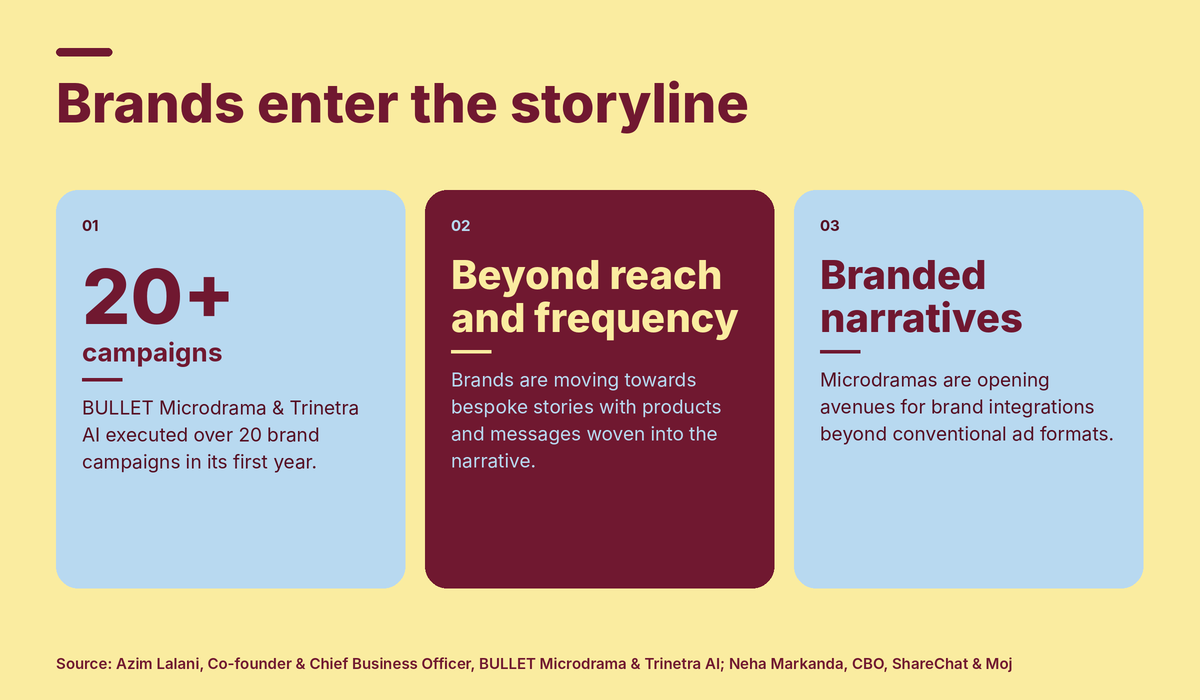
Neha Markanda, CBO, ShareChat & Moj, said the format was opening up opportunities beyond viewership, particularly through advertising and brand integrations. She pointed to brands experimenting with bespoke stories instead of simply using microdramas to drive reach and frequency.
“The surge in microdramas indicates a larger shift in how audiences are choosing to consume content. It is not necessarily a move away from long-form entertainment, but a growing preference for storytelling that is accessible, engaging and fits naturally into everyday viewing routines. What makes microdramas particularly interesting is their ability to combine the brevity of short-form video with the narrative depth of episodic content, giving audiences a reason to keep coming back for the next episode.”
Brands want a place in the plot
The shift is already visible in how platforms and advertisers are approaching integrations. Rather than treating microdramas as another avenue to distribute promotional messages, brands are beginning to experiment with storylines where the product or brand becomes part of the narrative.
The commercial distinction, Markanda suggested, lies in the opportunity to build the brand into that reason for returning, rather than simply placing it in front of an audience.
“We believe this momentum also signals an evolution in mobile-first storytelling, where discovery, entertainment and engagement come together seamlessly. For the content ecosystem, it opens up opportunities beyond viewership, particularly in advertising and brand integrations.
“We are already seeing brands such as Glow & Lovely (HUL), with Saas, Bahu aur Magic, and Level Infinite, with The Misfits, move from simply leveraging microdramas for reach and frequency to developing bespoke stories, where products and brand messages are organically woven into the narrative. As the format matures, its opportunity lies in bringing together sustained audience engagement, culturally relevant storytelling and sustainable monetisation, making it a distinct and increasingly important part of the digital entertainment landscape.”
The examples also point to two different ways of approaching branded storytelling. One is to adapt an existing content property around a brand's messaging, while the other is to create a story from the outset with the brand playing a role in the narrative. The latter could offer greater creative control, but it also demands a stronger understanding of what audiences would watch even without the commercial association.
The monetisation question remains
The viewing behaviour around microdramas is increasingly resembling appointment-like entertainment, even when consumption happens on a phone and in fragmented pockets of time. An industry report found that 56% of viewers watched six to ten episodes in a sitting, while 49% spent 15–30 minutes per session. The format may be vertically packaged and short in duration, but the overall viewing occasion is not necessarily fleeting.
Markanda said the engagement being observed on ShareChat, Moj and Quick TV was also pointing towards a deeper investment in episodic content. “Together, ShareChat, Moj and Quick TV reach over 75 million monthly active users and deliver over 1 billion daily episode views across the ecosystem, up 6.5x in the last 12 months. Users now spend an average of about 55 minutes a day watching microdramas, with nearly 80 viewing sessions a month.”
“More significantly, the average number of episodes watched per user per day has grown from 20 to over 80 in the last year, indicating a deeper investment in serialised storytelling. Our research with Kantar also indicates that 86% of viewers watch microdramas for more than 15 minutes a day, and 54% return for repeat viewing sessions. Microdramas are no longer just a quick-consumption format; they’re becoming a regular part of how audiences are entertained,” she added. The Kantar figures have been shared exclusively with e4m.
The numbers make a case for the viewing time available to advertisers, but they do not automatically establish how brands should value that time. The opportunity to integrate a product into an episode is only one part of the equation. The other is whether audiences remember the brand, associate it with the story and respond to it beyond the viewing experience.
That distinction will become particularly important as brands move from experimenting with integrations to allocating repeat budgets. The format may be capable of delivering longer engagement than a single short-video placement, but advertisers will still need to establish what that engagement delivers for awareness, consideration or action.
The branded storytelling opportunity
The format's commercial potential is also bringing more creators and production partners into the ecosystem.
Azim Lalani, Co-founder and Chief Business Officer, BULLET Microdrama & Trinetra AI, said the growth was creating opportunities beyond the audience side, with production partners and talent also benefiting from the expansion.
“This growing demand is also creating more opportunities across the production ecosystem. We're seeing more creators, actors and production houses actively working in this space, with some production partners now able to take on three to five times the volume of work they were doing last year. This is helping the format expand while creating more opportunities for talent and production partners.”
With microdramas requiring a steady pipeline of episodes, production models are being built around volume, speed and the ability to keep audiences invested across story arcs.
“There is a similar opportunity on the business side, particularly in how brands engage with audiences. Rather than relying only on conventional ad formats, brands can be integrated into the content through brand integrations and branded narratives. We've already executed over 20 brand campaigns in our first year. Ultimately, the momentum reflects the growth of an entertainment format that is creating value across the ecosystem, from audiences and creators to production partners and advertisers,” Lalani added.
The growing volume of production could make branded microdramas easier to commission and execute, but volume alone will not make the format commercially effective, industry observers shared. A brand appearing repeatedly across episodes is not necessarily a brand being remembered. The creative challenge is to ensure that the integration adds to the story rather than slowing it down or turning a dramatic moment into a disguised advertisement.
The battle for repeat viewing
For platforms, keeping audiences coming back is central to building a category that can sustain a regular content pipeline. For brands, repeat viewing potentially offers multiple opportunities to become familiar with the audience without having to rely on a single exposure. But the commercial value of that repetition depends on the story itself holding up.
Ambuj Kashyap, EVP – Micro Content, JioStar, said the growth was being driven by audiences investing in characters and stories rather than simply consuming short videos to fill time.
“The growth of microdramas tells us that there is a strong appetite for stories that are designed differently for mobile viewing. Short-form consumption has always existed, but the fact that audiences are watching six to ten episodes in one sitting shows that the format is doing more than filling a few spare minutes. People are getting invested in the characters and stories, and that is what is driving them to watch more.”
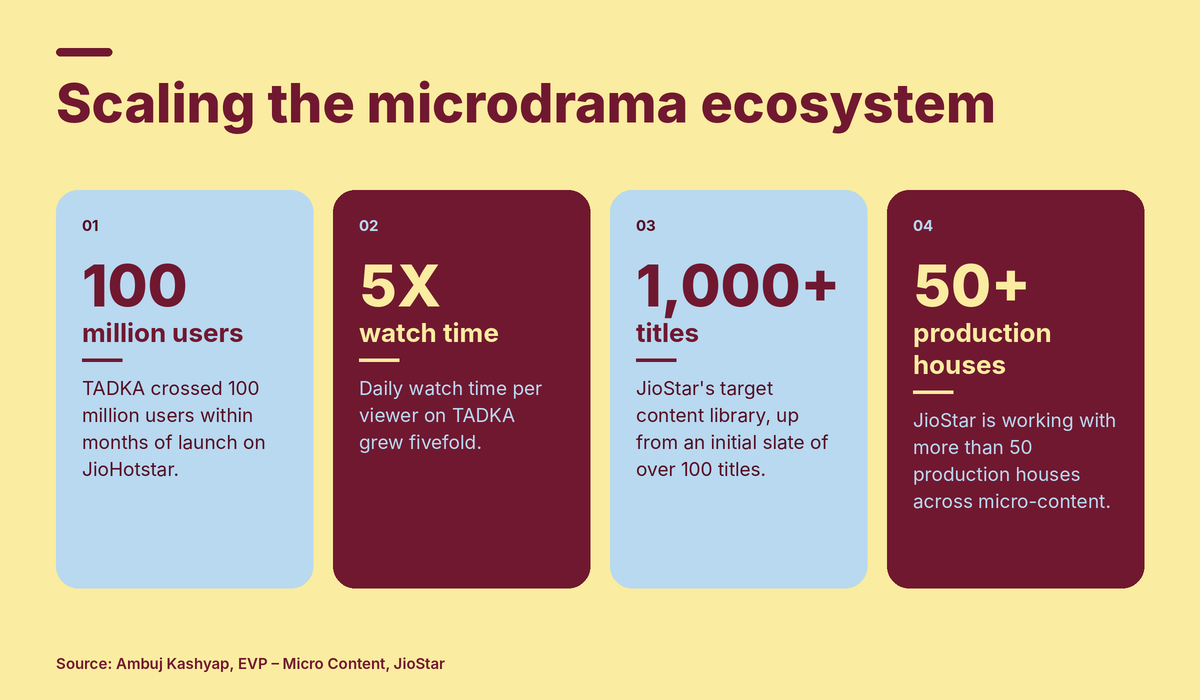
“We are seeing this play out with TADKA on JioHotstar, which has crossed 100 million users within months of launch, with daily watch time per viewer growing 5X. The response has also been encouraging across different audience segments, with over 42% of viewership coming from audiences under 24 and strong consumption across metros, Tier 2 markets and beyond,” he added.
The scale of the audience is creating room for platforms to build larger content libraries and experiment with formats beyond scripted fiction. Kashyap said JioStar had begun with more than 100 titles and was working towards 1,000-plus by the end of the year.
“Alongside scripted stories, we are introducing formats such as vertical reality with Rizzmaster and AI-powered storytelling with Game On! The ₹4000 Cr Empire, Dilli 3200, and more. We are also working with over 50 production houses, giving more creators the opportunity to experiment with this space. The commercial opportunity is certainly there, particularly as viewing habits become more established. But the real opportunity today is to build a category that audiences return to consistently.”
That distinction between building scale and building habit may determine how the advertising opportunity evolves. A growing library can create more inventory, while repeat viewing can make episodic storytelling attractive to brands looking for sustained association. Yet both depend on whether platforms can consistently deliver stories that audiences actively choose to continue watching. For brands, the format's promise may not lie in the number of episodes a campaign can occupy, but in whether the storyline creates an association worth carrying beyond the screen.
The next episode economy
The infrastructure around microdramas is changing alongside the content. YouTube, in its October 2026 Culture & Trends blog, noted how creators across Asia-Pacific were adapting the pace and visual language of Shorts into multi-part dramas, with stories unfolding through fast-paced, vertical episodes rather than standalone skits.
The platform is also introducing ways to organise Shorts into seasons and episodes, with custom thumbnails and sequential playback, making it easier for viewers to discover a series and continue watching. The shift is significant for advertisers because episodic storytelling creates a different kind of viewing relationship. A viewer who returns for a character or storyline presents a different opportunity from someone who encounters a video once while scrolling.
YouTube's creator examples also point towards the commercial possibilities. Japan's GOKKO CLUB has explored bespoke branded short dramas, integrating brand messages into narratives, while India's Shorts Break has leaned into relatable humour, family dynamics, twists and audience participation.
The platform reported 6.5 billion microdrama views on YouTube in the first half of 2026, with watch time growing more than 50% year-on-year. In APAC markets, views grew more than 70%. The numbers point to growing consumption, but the more interesting development for brands is how the format is being packaged to encourage audiences to stay with a story.
That is where microdramas begin to move away from conventional short-form advertising and towards a more deliberate content proposition.
The real test for brands
The underlying audience shift, according to Lalani, is not simply a preference for shorter content, but a change in when and how people consume entertainment.
“What we're seeing with this surge is a shift in how audiences are choosing to consume stories. But I don't think this is simply about shorter attention spans or microdramas replacing long-form entertainment. They serve a different viewing occasion. Microdramas offer a more immediate viewing experience, where every episode is designed to hold attention and deliver something within a short span of time. The fact that audiences follow stories across 60-100 episodes shows that they are willing to invest time in a format when the content holds their interest and gives them a reason to keep watching.”
That willingness to follow a story across dozens of episodes is what makes the format commercially interesting. However, it also raises the bar for branded content. A product cannot merely be inserted into a story because the format offers multiple episodes. Its presence has to make sense within the characters, setting or plot, while giving the advertiser a reason to invest in storytelling rather than conventional media placements.
The opportunity is developing, but so is the question of effectiveness. More viewing time, higher episode consumption and a growing content pipeline are indicators of a format gaining traction. They are not, on their own, evidence that branded microdramas deliver better returns than other advertising formats.
For the industry, the next phase will be about establishing that distinction. Microdramas have demonstrated that short-form video can sustain longer narrative engagement. The advertising business now has to establish whether brands can earn a place in those stories without compromising the entertainment that brought viewers there in the first place.
As Kashyap put it, “Micro-content is showing that a story doesn't need a longer runtime to hold attention. It needs to give audiences a reason to watch the next episode.”
That may also be the principle brands will have to follow. Being part of the episode is one thing. Giving the audience a reason to remember the brand after it ends is the bigger challenge.
Read more news about Digital Media, Internet Advertising, Marketing News, Television Media, Radio Media
For more updates, be socially connected with us onInstagram, LinkedIn, Twitter, Facebook, YouTube & Google News