Agitations amid festivals: Why Gen Z attention is becoming a catch-22 for brands & media
India’s most powerful consumer cohort is generating enormous attention through its protests, but the media and advertisers that need that attention most are constrained from embracing it
 by
by
Published: Oct 9, 2026 8:23 AM | 5 min read
 Follow Us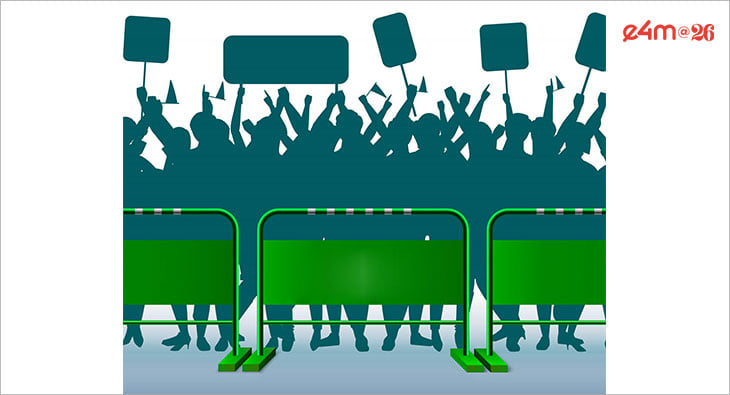

- In India, recent mass protests led by Gen Z on issues like women's safety and voter lists have created significant attention moments, with participants actively documenting and sharing these events on social media.
- Despite the large influence of Gen Z, which accounts for 43% of consumer spending, mainstream media and brands are hesitant to engage with the protests due to concerns over political sensitivity and brand safety.
- The reliance of news media on government advertising revenue complicates coverage of politically charged events, as it risks alienating advertisers who prefer not to associate with contentious issues.
- As the festive advertising season approaches, brands face the challenge of capturing consumer attention without being linked to the protests, which could affect their marketing strategies amid economic pressures.
There is a strange contradiction playing out in India’s attention economy.
The country’s most commercially powerful consumer cohort has been generating some of its biggest attention moments on the streets of Mumbai, Delhi and across India in recent weeks, with mass demonstrations around issues ranging from paper leaks and women’s safety to voter lists.
Gen Z is not just participating in the protests; it is filming them, interviewing fellow protesters, creating memes, documenting placards, making Reels and deciding which moments travel. Millions may be on the ground, while millions more, including millennials and older generations, are consuming these moments remotely, turning street protests into mass attention events that extend far beyond those physically present.
The scale of the opportunity is difficult to ignore. According to BCG-Snap, India’s roughly 377 million Gen Z consumers already influence 43% of consumer spending, equivalent to about $860 billion.
Despite the scale of that attention, mainstream media have largely remained cautious about giving the protests sustained coverage, even as they have traditionally monetised mass audiences through advertising.
Brands, too, cannot afford to ignore a consumer cohort they increasingly need to win. The hesitation, therefore, is not about Gen Z attention itself, but about the context in which that attention is being generated. Neither media nor marketers necessarily want to be commercially associated with the contentious moments commanding that audience’s attention.
Said Acer India’s Head of Marketing, Sooraj Balakrishnan, “I would be cautious about categorising protests as another attention or engagement platform for brands. Brands need to recognise the sensitivity of these moments rather than viewing them purely through the lens of reach, impressions or cultural relevance. I feel responsible marketing is not just about knowing when to participate in a conversation, but equally about knowing when to stay away.”
This creates a conflict between audience engagement and commercial interests, particularly for news media dependent on government advertising revenue.
“It’s a catch-22 situation for both media and marketers. After all, government advertising remains a significant source of revenue for news media, with industry estimates putting the government contribution at 50–80% of advertising revenue for some news organisations. The dependence is particularly relevant for regional and smaller publications and broadcasters, where alternative revenue pools can be narrower. That makes politically sensitive coverage a difficult commercial terrain,” said a media executive.
For news television, the situation is further complicated by private advertisers, who are equally concerned about brand safety. “If protest coverage takes up more airtime, we risk losing commercial advertising, as brands would not want their campaigns appearing alongside footage of anti-government slogans or police action on protesters,” said a news channel executive.
“On the other hand, if traditional media do not provide adequate coverage, consumers’ eyeballs inevitably shift elsewhere, potentially impacting brands’ festive marketing objectives,” industry experts noted.
And the timing could hardly be more consequential. Festive advertising begins to peak from October 11 with Navratri and builds towards Diwali, when brands typically put some of their biggest campaigns behind television, print, digital and other media. Industry estimates put this year’s festive advertising market at around ₹60,000 crore.
Notably, the festive season in India drives 40-50% of total ad spend for most advertisers. For consumer companies, the period is particularly important as they seek to convert heightened consumer attention into demand.
The challenge becomes more acute at a time when businesses are already grappling with economic pressures, including inflation, a monsoon deficit and concerns over weakening consumer demand. Large advertisers in the FMCG, auto, consumer durables and travel sectors are increasingly shifting their ad spends towards digital.
Also Read: Offline Audience: Are marketers missing millions of GenZ women in India?
How last week’s protests hit campaign economics
A Brand-Safety Problem
The stirs, though led by non-political groups, carry political overtones that make the dilemma particularly revealing.
A witty placard can become a meme. A protester’s interview can become a Reel. A song, dance or humorous moment can travel independently of the larger event. A creator with a smartphone can reach an audience that a traditional news crew may take hours to reach.
But attention and advertising suitability are not the same thing. That distinction is emerging clearly from conversations with marketers.
“A brand can’t take sides, so we are not tapping protests or protesters in any way,” FMCG marketers told e4m.
“For a brand, the problem is not that Gen Z is watching. It is that a brand may be seen next to what Gen Z is watching. A campaign appearing alongside footage of a protest can create an unintended association with a political position, a contentious issue or a negative event,” said an agency head.
As the media and advertising industry waits for the standoff to ease and the festive season to gather momentum, the protests could be intensifying instead. Various youth groups, farmers and political parties have announced plans to step up their stir from October 10, leaving brands and media to navigate an increasingly difficult question:
How do you monetise attention when you cannot afford to be associated with what is commanding it?
Read more news about Marketing News, Advertising News, PR and Corporate Communication News, Digital News, People Movement News
For more updates, be socially connected with us onInstagram, LinkedIn, Twitter, Facebook, YouTube & Google News
