#e4mXplains: Google is giving advertisers more control over ad budgets. But how much?
Google’s new tools offer advertisers more flexibility in budget allocation, but non-binding limits, bundled channels and automated decisions raise questions about how much control they really gain
 by
by
Published: Oct 17, 2026 8:37 AM | 5 min read
 Follow Us

- Google has introduced new advertising features, including channel prioritization and budget allocation controls, allowing advertisers to influence spending across its platforms, starting from October 15, 2023.
- Advertisers can classify channels as "High priority" or "Low priority," enabling Google’s algorithms to prioritize spending on preferred channels while still allowing flexibility in budget distribution.
- The budget allocation feature allows advertisers to specify a percentage of their daily budget for low-priority channels, but this is not a strict limit, as actual spending can exceed the set percentage.
- Despite these updates, advertisers still have limited control over individual placements, and Google's algorithms retain significant discretion in optimizing ad placements based on performance targets.
For years, Google has asked advertisers to trust its algorithms to decide where ads should appear, when they should run and which users are most likely to convert. Advertisers, meanwhile, have continued asking a less futuristic question: where, exactly, is the money going?
Google’s latest advertising update attempts to bridge that gap. On October 14, the company announced channel prioritisation and budget allocation controls that allow marketers to influence how spending is distributed across Google-owned properties and partner networks. The rollout began on October 15 and will continue over the coming months.
Read On: Google is putting Search on the front page as AI starts selling ads of its own
The operative word, however, is influence. Google is offering advertisers more ways to guide its automated campaigns, not unrestricted control over individual placements or a guarantee that every channel will receive precisely the budget specified.
What has changed?
Under channel prioritisation, advertisers can classify eligible channels as either “High priority” or “Low priority”. Google’s systems then aim to spend on the preferred channels first, within the advertiser’s bidding objectives, before directing available funds to lower-priority inventory.
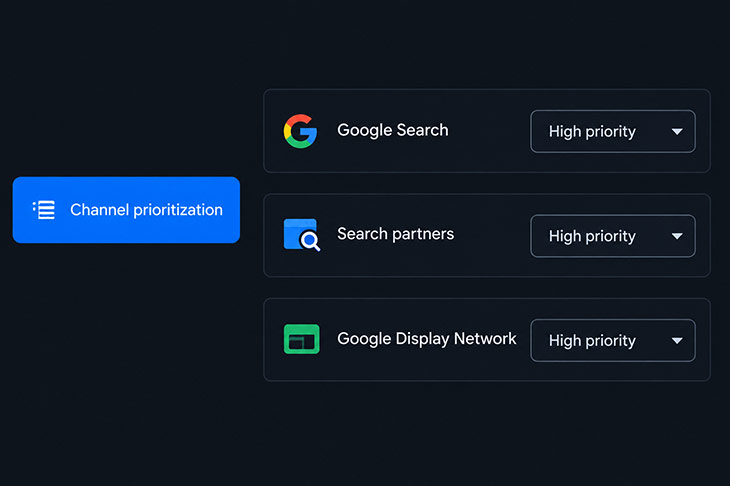
Consider a retailer running Search ads. It might prefer ads on Google Search, while treating Search partners (after all, other sites and services carrying search ads) or the Google Display Network as secondary. Previously, choosing whether to include certain networks could be more of an on-or-off decision. Now the retailer can retain them at lower priority rather than necessarily excluding them.
The second feature, budget allocation, allows marketers to specify a percentage of their average daily campaign budget for a low-priority channel. On a campaign with a ₹1 lakh daily budget, a 10% allocation would tell the system to aim for no more than ₹10,000 a day on that channel.
Read On: What does an ad look like inside AI? ChatGPT and Google are starting to answer
But this is not a hard ceiling. Google says the allocation works on a “best-effort” basis; daily spending can exceed the percentage set. The amount is calculated against the average daily budget, not actual expenditure, and the allocation resets daily. A stated 10% is therefore a spending preference, not an enforceable daily accounting limit.
Where does advertiser control stop?
The controls are also considerably less granular than the words “channel prioritisation” might suggest.
In Performance Max, which automatically places advertising across Google’s ecosystem, Search, YouTube, Maps, Gmail and Discover remain grouped under “Google channels”. Advertisers can prioritise that bundle relative to Search partners and the Display Network, but cannot use this new feature to allocate separate budgets to each Google property within Performance Max. Demand Gen similarly groups Google properties.
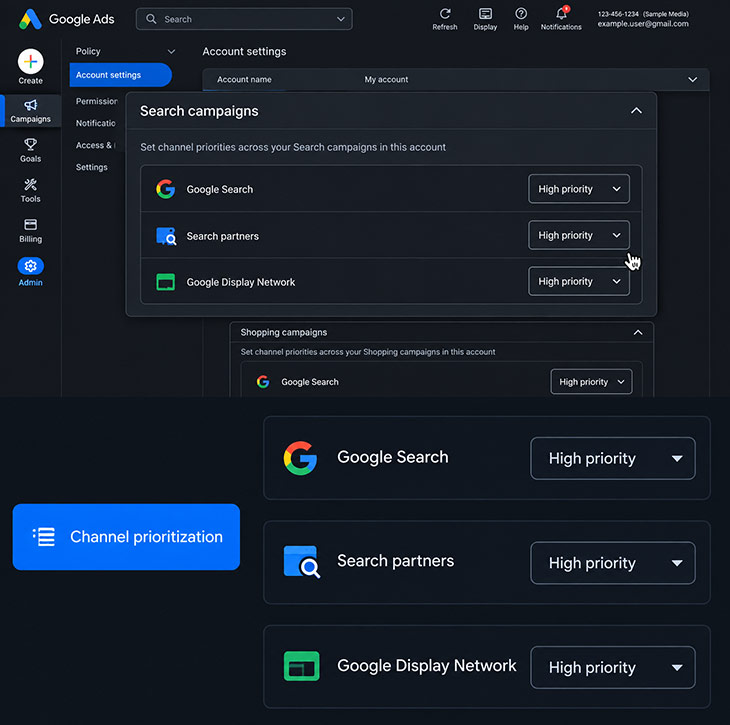
There are differences across campaign types. Search advertisers can set priorities across Google Search, Search partners and Display, while Shopping supports Search and Search partners. Demand Gen gets prioritisation, but not the new percentage-based budget allocation. The controls are therefore not a universal dashboard for carving up spending across every Google surface.
Read On: Adios Google: Being seen vs Being visited
Importantly, priority settings may have little effect when a campaign is not constrained by budget. For campaigns using target cost-per-acquisition or return-on-ad-spend bidding, Google says its systems will continue optimising across channels against those performance targets. A low-priority budget allocation can still apply, but changing a channel’s label alone may not move much money.
In short, advertisers can indicate preference, and they can still opt out of eligible networks. The algorithm retains considerable discretion over how the participating channels are used.
Why introduce the change now?
The announcement belongs to a longer, gradual retreat from the opacity of automated advertising. Google introduced channel performance reporting for Performance Max in 2025, making those reports available across all Performance Max campaigns by November. In January 2026 it expanded channel-level reporting through its Ads API. Better visibility has been followed by more tools to act on that information.
There is also a commercial incentive. In announcing the controls, Google explicitly encouraged advertisers who had opted out of Search partners or the Display Network to consider testing them again, now with more limited exposure. That could help advertisers discover profitable inventory. It could equally direct additional spending towards networks they had previously considered unsuitable. The controls alone establish neither outcome.
Read On: Google wants AI to become marketers' strategist. Is the industry ready?
What should marketers watch?
One immediate consequence arrives in February 2027. Search campaigns currently using Display Expansion will migrate to the new model, and Google warns that spending patterns could change. Its suggested approximation of the old setup is to mark the Display Network as low priority with a 50% daily allocation, which is itself subject to the best-effort caveat.
For Indian advertisers balancing large platforms, retail media and performance objectives, the useful question is not whether more settings have appeared in Google Ads. It is whether channel-level performance improves without sacrificing predictability.
The change gives marketers a more nuanced alternative to switching networks off entirely. It does not settle the older argument over automated advertising: how much control should a platform retain when it is both selling the inventory and deciding where the advertiser’s money goes?
Read more news about Digital Media, Internet Advertising, Marketing News, Television Media, Radio Media
For more updates, be socially connected with us onInstagram, LinkedIn, Twitter, Facebook, YouTube & Google News
