We are enablers, not regulators: MIB's Senthil Rajan on India’s $100B media ambition
Joint Secretary says government’s role is to remove policy bottlenecks, ease doing business and help the media and entertainment industry tap global markets
 by
by
Published: Oct 16, 2026 4:02 PM | 4 min read
 Follow Us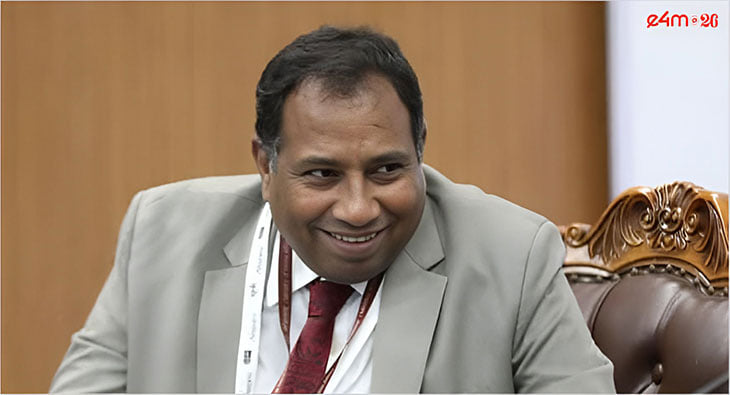

- The Ministry of Information and Broadcasting (MIB) aims to support India's media and entertainment industry by removing policy barriers and facilitating new business models, rather than acting as a regulator, according to Joint Secretary Senthil Rajan.
- Rajan highlighted the removal of the 12-minute-per-hour advertising restriction for linear television as an example of adapting regulations to market changes, allowing broadcasters more flexibility in monetizing their advertising inventory.
- The ministry is also working to streamline permissions for live events and film production through initiatives like the Live Events Development Cell and the India Cine Hub, which aim to simplify the approval process and enhance operational efficiency.
- Emphasizing the need for global ambition, Rajan urged the industry to develop content that appeals to international markets, advocating for the creation of intellectual property that can succeed beyond the Indian diaspora.
The Ministry of Information and Broadcasting (MIB) sees itself as an enabler of India’s media and entertainment industry rather than a regulator, with a focus on removing policy bottlenecks, facilitating new business models and creating an environment for the sector to achieve its $100 billion growth ambition, said Senthil Rajan, Joint Secretary at the ministry.
Speaking at CII Big Picture Summit 2026, Rajan said the media and entertainment sector had been driven predominantly by private enterprise, and the government’s role was to ensure that regulations did not impede its growth as platforms, consumption patterns and revenue models evolved.
“The industry looks at it as a predictive facilitator. Our job is to remove any stumbling blocks,” Rajan said, outlining the ministry’s approach to supporting the sector.
He said there was no single intervention that could unlock the industry’s growth potential. Instead, the government was pursuing incremental, sector-specific measures to improve the ease of doing business and address emerging challenges.
“There is no magic bullet or magic solution to it. There cannot be one single solution; there will be multiple steps that we all need to take,” he said.
Rajan pointed to the removal of the 12-minute-per-hour advertising restriction for linear television channels as an example of the government adapting policy to changing market realities. With advertising spending increasingly migrating to digital platforms, the move gives broadcasters greater flexibility to monetise their advertising inventory.
“There was a regulation limiting your advertising time to 12 minutes in linear TV. We have removed that. Now the entire advertising real estate is available to every TV channel,” he said.
He added that the ministry was examining issues across different segments of the industry to ensure that existing policy frameworks did not become obstacles to growth.
Government shifts focus to facilitation
Rajan said the ministry was also working to make it easier for companies to organise live events and secure permissions for film production.
The second phase of the Live Events Development Cell is being developed, with the ministry engaging state governments to streamline approvals. Several states have joined a live events portal through which organisers can apply for permissions.
He said live events have an economic impact extending beyond entertainment, generating activity across hospitality, tourism, transport and other sectors.
The ministry has also established India Cine Hub, a single-window portal intended to simplify permissions for film shoots and facilitate related production activities, including foreign collaborations.
These initiatives reflect the ministry’s approach of addressing operational hurdles through facilitation rather than treating regulation as an end in itself, Rajan indicated.
Skilling to support next phase of growth
The ministry is also addressing the need for specialised talent in emerging creative industries. Rajan highlighted the establishment of the Institute of Creative Technologies following the WAVES summit, in partnership with industry stakeholders, to train professionals in gaming, animation, visual effects and related fields.
Rajan pointed out that IICT facilities include virtual reality and extended reality infrastructure, a projection theatre and a gaming laboratory. Rajan encouraged industry participants to use these capabilities to develop skills and strengthen India's creative technology ecosystem.
Industry must look beyond the Indian market
While the government works to improve the business environment, Rajan said the industry must also broaden its ambitions beyond domestic consumption and the Indian diaspora.
“Our industry should be looking at not just the Indian market but the global market. Make products for the world. Our IPs have to be planned in such a way that they travel the world,” he said.
He recalled how Indian filmmakers once considered the ₹100 crore box-office milestone a major achievement, before setting their sights on the ₹1,000 crore mark. The subsequent success of Baahubali demonstrated the potential of setting more ambitious commercial goals, he said.
Rajan argued that Indian content creators, producers and distributors needed to develop intellectual property that could travel internationally, rather than relying primarily on overseas audiences of Indian origin.
“We need to have the entire value chain reach the global market and see that at least every year there are three or four Indian content products which are globally successful beyond the diaspora market,” he said.
His remarks place the onus on both government and industry: the former must enable growth by removing policy and operational barriers, while the latter must develop globally competitive content and business models.
As India works towards its $100 billion media and entertainment ambition, Rajan said the ministry would continue to pursue sector-specific interventions and ensure that policy frameworks supported, rather than constrained, the industry's expansion.
Read more news about Television Media, Digital Media, Advertising India, Marketing News, PR and Corporate Communication News
For more updates, be socially connected with us onInstagram, LinkedIn, Twitter, Facebook YouTube & Google News
