Microdrama boom needs a new script: Nikhil Mirchandani, Hoop
After producing more than 30 shows, Hoop Entertainment Founder Nikhil Mirchandani sees a market ready to expand beyond ‘hidden billionaires’ and ‘revenge romances’
 by
by
Published: Oct 14, 2026 8:59 AM | 7 min read
 Follow Us

- India's microdrama market is projected to grow from $260 million in 2025 to over $1 billion by FY30, according to a report by Meta and Ormax presented at FICCI Frames.
- Consumers are spending a median of 3.5 hours weekly on microdramas, indicating a shift towards habitual mobile viewing, though the industry faces challenges of creative fatigue from repetitive storytelling tropes.
- Nikhil Mirchandani, Founder of Hoop Entertainment, emphasizes the need for innovative storytelling and diversification of monetization models beyond subscriptions to sustain growth in the microdrama sector.
- The report highlights the importance of engaging viewers on smartphones, with social media serving as both a competitor and a discovery tool, while also pointing to the potential for genre experimentation and the development of original intellectual property.
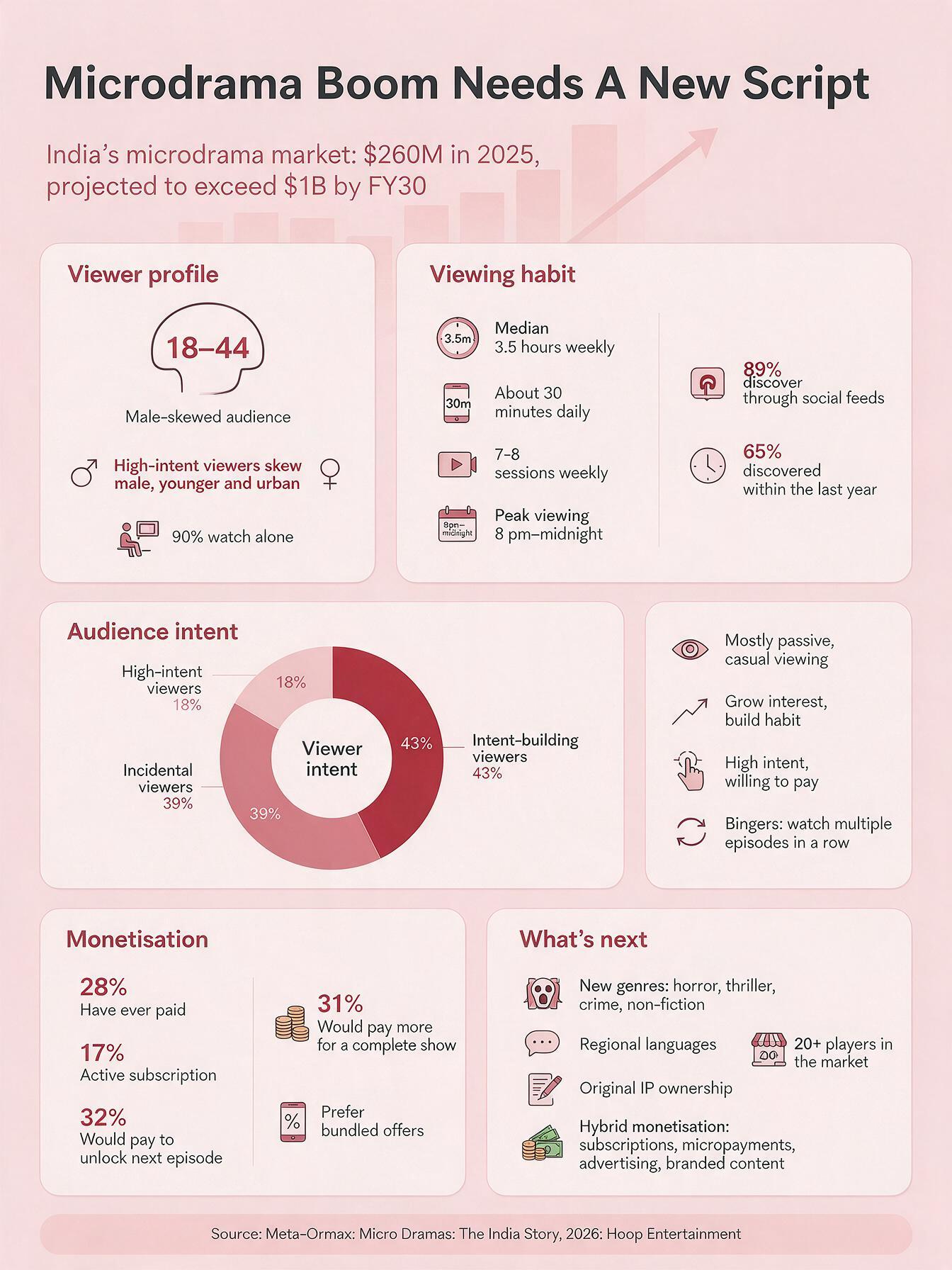
India’s microdrama market hits $260M in 2025 and is projected to exceed $1B by FY30, as per a recent report by Meta and Ormax titled “Meta solutions playbook for Micro Drama 2026” released at the FICCI Frames earlier this month. The report also revealed that consumers spent a median of 3.5 hours per week watching microdramas, roughly 30 minutes daily, indicating that microdramas are becoming a recurring mobile viewing habit, not just an occasional diversion.
But its next phase may be harder than its first. The formulas that helped the format find an audience, such as hidden billionaires, revenge romances and stories of humiliation followed by dramatic reversals, are also creating a risk of creative fatigue.
For Nikhil Mirchandani, Founder of Hoop Entertainment, this is where the industry’s next opportunity lies. Having worked on more than 30 microdrama shows across platforms, he believes microdramas are establishing themselves as a distinct entertainment format, with their own storytelling grammar, production economics and distribution models.
“Amongst all the gloom and doom of TV and other media that we keep hearing about, Microdrama is the one undisputable growth area from an industry point of view. But growth alone will not determine which businesses endure. Producers must find new stories, platforms must diversify their offerings, and monetisation models must evolve beyond a dependence on subscriptions or views,” says Nikhil Mirchandani, Founder of Hoop Entertainment.
Mirchandani also points out that the battle for microdrama's next audience is increasingly being fought on the smartphone screen, where episodic storytelling competes with the endless scroll of social media.
“Yet social media is both a rival for attention and a discovery engine. Over 89% of viewers, in the study by Meta and Ormax, said they discovered microdramas through social feeds and recommendations. For producers, the challenge is not merely to attract viewers, but to persuade them to stop scrolling and stick to the microdrama platform for the next episodes,” shares Mirchandani, the former Managing Director of National Geographic Channel and Executive Vice President at Star India.
Diminishing returns of a winning formula
Microdramas are built around immediate engagement. With episodes sometimes lasting less than a minute, writers must establish conflict quickly and give audiences a reason to keep watching.
“You have to write a hook point every 45 seconds or one minute so that the audience does not scroll up and stick to the show,” Mirchandani says. “It is not an extension of OTT. Neither is it just television or a movie cut short. The grammar of microdrama writing is completely different. The hook, the pace, it is not the same,” he says.
Nikhil attributes the global popularity of hidden-billionaire stories to the interplay of aspiration, escapism and dramatic anticipation. “The audience knows that the character is a billionaire, while the other characters do not. They may even anticipate what will happen next, but they still want to see the moment of revelation,” he explains. However, he cautions that the repeated use of such tropes could eventually dilute their appeal.
That is prompting producers and microdrama platforms experimentation with other genres, including horror, thrillers, crime and non-fiction. Hoop has itself experimented with horror, while true crime presents an interesting test of the format's storytelling limits: the narrative must remain faithful to real events while delivering frequent hooks.
For Mirchandani, the opportunity lies in balancing familiar storytelling structures with new subject matter. A fresh genre may initially attract fewer viewers than an established hit formula, but experimentation is necessary to discover the next category of demand.
From commissioned shows to owning IP
Mirchandani is now looking beyond commissioned shows to building intellectual property (IP) that Hoop can own and license across platforms. Lower production costs and shorter development cycles make microdramas a relatively low-risk space for creative experimentation.
“With a microdrama, I can have a story written, produced and published within weeks. With long-form content, pre-production, post-production and release take months,” he says.
What determines the success of a microdrama? Mirchandani quips, “Views alone do not tell the complete commercial story.” Mirchandani believes a new genre should also be assessed on how long viewers stay with it, rather than being judged exclusively against established, formula-driven successes. “If there are 100 people who came to view it, how long have they stayed with the show? What was the reach of the show? How many people came to see it? How long did they stay?” he says.
That thinking is informing Hoop's next move: developing original intellectual property rather than relying entirely on commissioned productions. Mirchandani is currently speaking to writers to develop original stories that Hoop can own, giving the company greater creative control and the potential to monetise the same IP across multiple platforms.
“When you own the IP, you can move faster. You decide the story and take it forward, provided you can make the investment and recoup the costs,” he says, explaining the rationale behind the move. The strategy offers producers greater creative control and the possibility of monetising the same IP across multiple distribution partners. It also transfers more financial risk to the producer, who must invest without the certainty of a commission, he says.
Monetisation must follow the content
On monetisation, the Meta-Ormax study finds that 28% of viewers have ever paid for micro-drama content, but only 17% currently hold an active subscription, an important distinction between payment experience and ongoing subscribers.
Among viewers who have paid, 32% say they would pay a small amount to unlock the next episode, while 31% would pay slightly more for a complete show; these percentages apply to paying viewers, not the entire audience. “Together, the figures point to a sizable habit-building audience but a smaller paying core, with scope for both flexible payments and advertising-led monetisation,” Mirchandani noted.
Subscriptions, freemium access and episode-level micropayments are among the monetisation models used by microdrama platforms. Mirchandani expects advertising and branded content to play a bigger role as the market matures, leading to a hybrid model.
Though he cautions that overt brand placements can disrupt the narrative and alienate viewers. Drawing on his experience in the television industry, Mirchandani argues that content must establish an audience before brands can derive value from it. “Success gets you brands, so you better have your content working first. In the end, brands also want numbers. If your show itself does not work, how many people have seen it?”
Genre has tremendous scope
Over the next three years, he expects more genres, regional-language content, non-fiction and new distribution models. He also sees scope for consolidation where platforms and content owners bring complementary strengths to the table.
For an industry still experimenting with its business models, the opportunity is considerable. But its next phase will depend on moving beyond sheer output and finding stories that audiences want to return to. As Mirchandani puts it, microdramas are a fast-moving growth area but sustaining that growth will require the industry to keep reinventing what happens after the next hook.
With more than 20 players already in the market, Mirchandani believes the microdrama ecosystem still has significant headroom, given its young audience and growing reach across Tier 1 and Tier 2 cities. He would not be surprised to see consolidation, with OTT platforms acquiring or investing in microdrama players, such as ZEE5 has done with Bullet, as the battle for audiences and intellectual property intensifies.
Read more news about Digital Media, Internet Advertising, Marketing News, Television Media, Radio Media
For more updates, be socially connected with us onInstagram, LinkedIn, Twitter, Facebook, YouTube & Google News
