India is a key subscription market for Bloomberg: Christine Cook
Bloomberg Media’s Global Chief Commercial Officer discusses India’s appetite for trusted journalism, opportunities for Indian brands, and the commercial potential of live events and video
 by
by
Published: Oct 14, 2026 9:15 AM | 5 min read
 Follow Us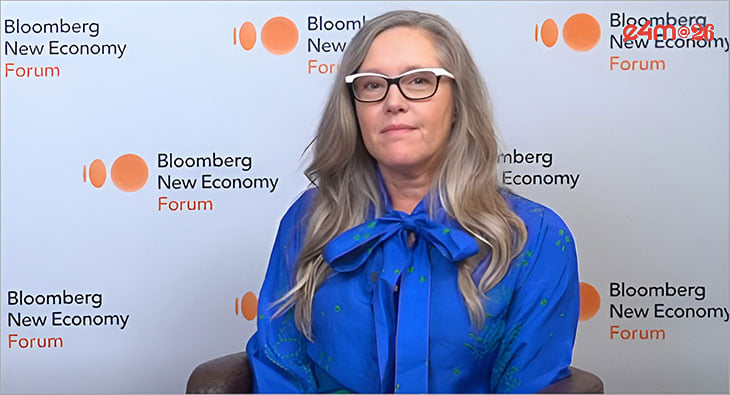

- Christine Cook, Global Chief Commercial Officer at Bloomberg Media, emphasizes India's significance to the company, highlighting its 30-year presence and focus on innovation and trade.
- Bloomberg Media distinguishes itself in a competitive Indian advertising market by targeting global business leaders and facilitating connections through live events and curated discussions.
- The company sees strong commercial opportunities in live convenings and video content, with India being the second-largest market for Bloomberg's digital consumption and paid subscriptions outside the U.S.
- Bloomberg is adapting its offerings with a dedicated homepage for India, enhanced video capabilities, and machine learning technology for targeted advertising, while continuing to evolve its media presence across multiple platforms.
Christine Cook, Global Chief Commercial Officer at Bloomberg Media, leads its global advertising business across platforms. In a conversation with Ruhail Amin at the Bloomberg New Economy Forum, she discusses India’s importance to the company, the relationship between subscriptions and advertising, and how Bloomberg is adapting its content and commercial offerings.
Edited excerpts:
How important is India to Bloomberg Media’s overall growth?
We have been in India for 30 years, and India is very important to us.
We are a focused global media company covering the evolution of innovation and trade. India represents both of those things in a significant way.
India has strong domestic media brands competing for advertising. How does Bloomberg distinguish itself?
We focus on serving global business leaders, people who work in multinational companies and require a connection to news as it happens. We are on nine different platforms, including live events.
Creating opportunities to connect global business leaders in dynamic places such as India, here at the Bloomberg New Economy Forum, allows us to bring local and regional Indian business leaders together with global leaders.
For example, the opening plenary will have the leader of Blackstone and the leader of Tata in conversation with the former head of commerce from the US. Curating and convening these conversations is something Bloomberg does particularly well.
As Indian brands go global, do you see an opportunity to help them tell their stories?
Absolutely. We have been working with many Indian companies. Tata has been a partner of Bloomberg New Economy for eight years.
We are very happy to be working with Tata, Suzlon and Infosys. These brands work with us for live convening opportunities, but they also often use Bloomberg Media Studio to create videos or articles that communicate their thought leadership to our global audiences.
Across your platforms, where do you see the strongest commercial opportunity in India?
One of the areas where we are at our strongest is live: live convening, as we are doing here today, and live video.
Because we have journalists around the world, business leaders trust us. They know that when something happens, regardless of the market, we are there to provide context.
I think the combination of live convenings and video will be what many Indian companies come to us for.
There is a perception that Western media sometimes covers India through a particular lens. How do you respond to that?
As I mentioned, I see Bloomberg Media as a truly global media company. We tell stories about global business and global trade that are backed by data.
That is what builds trust in our journalism and in the communities we convene: telling stories backed by data, and looking at how policies, the positioning of companies and opportunities will grow the global economy.
AI is changing news discovery. Is it making things easier or more complicated for publishers?
AI is another tool. In our careers, we have seen many new tools emerge, and reporting and conversations will continue to evolve.
I think it is a tool that publishers will embrace and deploy. Journalism is still an important contributor in that process.
India’s media business remains heavily dependent on advertising. Do you see subscriptions becoming another strong pillar?
I can tell you a couple of things about the Indian market within Bloomberg Media.
India is the second-largest market for Bloomberg’s digital consumption, behind the United States. It is also the second-largest paid subscription market outside the United States.
This signals to me, not just specifically about the Indian market, that business leaders are willing to pay, and want to pay, for trusted, quality information. Bloomberg represents that.
I believe subscriptions will continue to exist in partnership with advertising.
What new offerings are you introducing for the market?
We have recently launched a specific homepage for India, both to reflect the local market and to give audiences access to our global coverage.
Beyond India specifically, video growth has been tremendous for us. We relaunched a section of our website that houses live video from television, Bloomberg Originals and our series. It can now also accommodate social video in portrait format.
This discoverability has increased viewership by 44 per cent. I expect continued growth in video advertising, not only from the Indian market but globally.
Last year, we also launched technology that allows live contextual video targeting. Often, advertisers can target a television show or a particular placement on a website.
We use machine learning to understand who the hosts are and what they are talking about, along with relevant information in the stock ticker. We combine those elements, and if the context matches the positioning a client wants, the next advertisement will be that client’s advertisement.
This opens up much more inventory across our offering, as opposed to placing a client against a particular show.
I think we will continue to evolve that product.
Mainstream media’s relevance is frequently questioned, even as it reinvents itself. Where do you see traditional media heading?
It is a curious question because, as I mentioned, Bloomberg is on nine platforms. Forty years ago, we were not on nine platforms.
Wherever consumers want access to content, and however they want to access it, I expect us to continue investing in delivering what we have to those places.
Looking at the next two to three years, what is Bloomberg Media’s growth path in India?
People want opportunities to meet face-to-face, understand who they are doing business with and learn, especially executives.
There is so much for them to process and learn to stay current with business trends. I want Bloomberg to continue to be a place that provides education, perspective and current relevance on macroeconomic trends.
In this market particularly, I see us expanding some of our core franchises, such as Bloomberg Invest, where we convene in industry-specific ways to address relevant questions of industry growth.
Read more news about Digital Media, Television Media, Out of Home Advertising, Print Media, Latest Advertising India
For more updates, be socially connected with us onInstagram, LinkedIn, Twitter, Facebook, YouTube & Google News
