The price of patient acquisition: Inside healthcare marketing economics
With no clear metric to track every rupee spent, healthcare marketers face a measurement blind spot. Stakeholders across radio, OOH and digital explain what drives media choices
 by
by
Published: Oct 14, 2026 9:26 AM | 10 min read
 Follow Us

- Healthcare advertising is increasingly prevalent across various media channels, including TV, radio, and social media, with a notable rise in digital spending, particularly in the pharmaceutical sector, which saw a 41% increase in digital advertising expenditure from 2024 to 2025.
- Marketers face challenges in measuring the effectiveness of healthcare advertising, as traditional metrics like cost per lead (CPL) do not accurately reflect patient acquisition, necessitating more nuanced approaches to track the journey from inquiry to consultation or treatment.
- Local advertising remains crucial for hospitals, with radio and outdoor advertising being effective for reaching geographically defined audiences, while digital platforms are gaining traction for service promotion and patient acquisition.
- Trust and credibility are vital in healthcare marketing, as patients often make decisions based on familiarity and reliability, highlighting the importance of building long-term relationships rather than solely focusing on immediate conversions.
TV is one place where we spot hospitals advertising their services and new facilities. Radio feels more local, often announcing a new hospital or healthcare centre opening in the neighbourhood. Instagram is a different rabbit hole altogether, with doctors building their own clout, hospitals showcasing AI-enabled machines and aesthetic clinics running before-and-after ads.
The advertising is visible across channels, but what does it take to win a patient’s attention, and more importantly, turn it into a consultation, prescription or admission? Healthcare, after all, is a sensitive category to advertise in, and unlike many consumer businesses, measuring the returns on that spending is far from straightforward.
Read On: The role of content and consumer education in healthcare marketing
According to figures from the Dentsu report, pharmaceutical digital advertising expenditure rose from ₹2,367 crore in 2024 to ₹3,328 crore in 2025, an increase of about 41%. Digital’s share of pharma’s media budget climbed from 54% to 67% over the same period.
But pharma is only one part of the healthcare advertising market. Hospitals, diagnostic chains, fertility clinics, over-the-counter (OTC) products, wellness brands and health-tech businesses have different audiences, objectives and conversion cycles. Their spending spans search and social media, television, radio and outdoor advertising, with no single metric capturing returns across the sector.
Yasin Hamidani, Director, Media Care Brand Solutions, said, “We are increasingly seeing healthcare move towards a full-funnel media approach. Television, print, video and other mass-reach platforms remain important for credibility and brand building, but search, social, YouTube and hyperlocal digital are attracting greater investment when the objective is service promotion or patient acquisition.”
For marketers, the challenge is no longer just generating attention. It is establishing whether that attention leads to a qualified enquiry, a consultation, an admission or a purchase.
Read On: AI Overviews drive up healthcare Search acquisition costs, organic CPCs jump 45%
What it takes to acquire a patient
In performance marketing, cost per lead (CPL) is often used to assess campaign efficiency. But an enquiry does not necessarily translate into a patient showing up for an appointment, undergoing a procedure or getting admitted. Healthcare decisions can involve weeks of research, comparisons between providers, family discussions and consultations with doctors. The channel that first introduces a consumer to a brand may not be the one through which the eventual appointment or purchase is recorded.
Vikas Chawla, Co-Founder, Social Beat and Influencer.in, said, “Last-click ROAS undercounts health brands. People research for weeks, then buy on Amazon, Blinkit or a pharmacy app. Serious advertisers now use brand lift, search lift, geo tests and Marketing Mix Modelling.”
For hospitals, the relevant conversion could be an outpatient consultation, an admission or a procedure. For diagnostic chains, it may be a completed test, while consumer healthcare brands may track sales through pharmacies and online marketplaces.
Read On: Beyond prescriptions: Why pharma is adopting the FMCG playbook
“In healthcare, a low CPL by itself means very little. Agencies increasingly need to measure the journey from enquiry to qualified lead, appointment, show-up, consultation and ultimately treatment or admission. Cost per qualified enquiry and patient acquisition cost are consequently becoming more meaningful measures of performance,” said Hamidani.
A campaign generating inexpensive enquiries may prove less valuable than one bringing in fewer, better-qualified prospects. Attribution adds another complication: search may capture an existing need, while television, radio or outdoor advertising may have helped establish familiarity before a consumer began actively looking for care.
Hamidani said, “Hospitals also require a different strategy from consumer healthcare brands because their catchments are often geographically defined. Regional media, local search, Maps, OOH and performance campaigns therefore become extremely relevant.”
That geographical focus helps explain why traditional media continues to find a place in hospital marketing, even as digital advertising expands.
Why hospitals still buy local reach
Radio Aircheck data shared by Chandan Das, Vice President and Business Director at Mirchi, shows how local radio serves medical-services advertisers.
Hospitals and multi-speciality advertisers recorded 19.1 million seconds of free commercial time (FCT) in FY2024-25, rising to 21.2 million seconds in FY2025-26, an increase of 11.1%.
Across medical services, FCT declined from 40.2 million seconds in FY2024-25 to 38.8 million seconds in FY2025-26, a fall of 3.3%. The decline, however, masks differences between advertisers. Jeena Sikho Lifecare, an Ayurveda clinic chain, reduced its advertising, with FCT falling from 5.9 million seconds to 4.2 million seconds. Excluding the advertiser, medical-services FCT rose 1.3% in FY2025-26.
The latest figures point to stronger activity. Between April and September 2026, hospital and multi-speciality FCT rose 30% year on year. Medical-services FCT increased 13%, rising about 25% after excluding Jeena Sikho Lifecare.
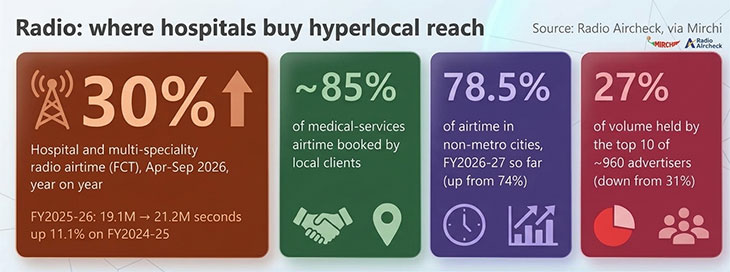
The category is also fragmented. About 960 advertisers were active in medical services in FY2025-26, with the top 10 accounting for 27% of volume, down from 31% the previous year. Around 85% of medical-services FCT was booked by local clients, and the typical advertiser operated in just one city.
Read On: Q3FY26 reflects radio’s digital and non-FCT transformation
Non-metro cities accounted for 74% of medical-services FCT in both FY2024-25 and FY2025-26, rising to 78.5% in FY2026-27 so far. Gujarat, Madhya Pradesh and Chhattisgarh, and Rajasthan together represented 39% of FY2025-26 volume.
“Hospitals are buying hyperlocal reach rather than national brand-building. Radio works for them because they can buy a city, a catchment and a daypart. Only a handful of chains (Apollo, Narayana, Fortis, Manipal, Care) run multi-city plans,” Chandan said.
Spot advertising is only part of the picture. Doctor interviews and radio jockey-led reels allow hospitals to showcase facilities and explain specialities to more specific audiences. Chandan said, “A specialist explaining a symptom, a procedure or a preventive check-up in their own voice carries credibility that a conventional commercial cannot.”
These formats are not captured in Radio Aircheck's FCT data. The airtime figures therefore reflect only part of healthcare's radio activity, leaving doctor-led content and facility walkthroughs outside the measured totals.
Outdoor’s role in patient acquisition
Outdoor advertising serves different purposes across healthcare categories. Hospitals and clinics need to reach people within their catchments, while diagnostic chains, OTC brands and larger healthcare businesses may seek broader awareness.
Yuvrraj Agarwaal, Chief Strategy Officer, Laqshya Media Group, said, “Hyperlocal is where hospitals, diagnostics, fertility and dental clinics put most of their money. Nobody crosses a city for a blood test or an OPD visit, and in an emergency people go to the nearest hospital they trust.”
Hoardings on arterial roads, bus shelters and pole kiosks can reinforce awareness among people who regularly travel past a facility. Agarwaal pointed to Apollo Hospitals’ “Stroke Awareness Corridor” in Chennai, a cluster of billboards along a high-traffic route carrying the 1066 emergency number, as an example of outdoor advertising connecting public awareness with a specific service.
Read On: Apollo Hospitals Chennai creates unified 5-hoarding stroke awareness corridor
Other categories have different priorities. Diagnostics brands may need to communicate availability or a rebrand, while OTC brands use the outdoors to build consumer awareness. Airports can help hospital chains reach medical-tourism audiences and promote premium healthcare offerings.
“Healthcare is not one category on outdoor. It is five or six small ones, and each goes outdoors for a different reason: trust, proximity, a rebrand, a medical-tourism patient or a brand-new therapy,” Agarwaal said.
His assessment also points to newer activity around weight-loss treatments. “The GLP-1 launches have created something healthcare outdoors has not had before: national, premium, airport-led launch activity tied to a therapy area. It also sits under the closest regulatory watch, so the brands in it have to be disciplined about what they say and where they say it,” he added.
Yet putting a figure on the sector's total outdoor investment remains difficult. Agarwaal said there was no credible published figure for healthcare OOH expenditure for FY2024-25 or FY2025-26. The industry estimates he cited differ in scope and methodology, and do not break out healthcare as a standalone category.
The cost of building trust
Acquisition in healthcare cannot be separated entirely from credibility. A consumer may click an advertisement or respond to a promotion, but choosing a provider or treatment involves a different level of consideration from many routine purchases.
Regulatory and ethical restrictions also shape what advertisers can communicate, particularly around prescription medicines, treatment claims and the promotion of medical services.
Read On: The Future of Marketing: AI, brand building & consumer trust in focus at Pitch CMO Summit
Agarwaal said, “When you cannot make claims, you have to be clever.” He cited campaigns by Hamdard's Safi and Star Health Insurance that used the reverse side of billboards to deliver their messages. In these executions, the medium became part of the creative idea. But Agarwaal cautioned against treating the attention generated by such work as audited outdoor reach, arguing that these ideas should be judged as earned media and priced as content rather than as conventional OOH inventory.
The distinction matters because visibility and conversion are not interchangeable. A campaign may generate conversation and improve recall without producing an immediately measurable patient enquiry. Conversely, a targeted performance campaign may generate enquiries without necessarily building the familiarity that influences future decisions.
Meanwhile, consumer healthcare brands are following interest in specific outcomes, including sleep, stress, gut health and women's health. Chawla also pointed to the growing role of YouTube, connected TV, marketplaces and quick-commerce advertising alongside search and social media.
Search still accounts for close to 40% of media spending across the brands Chawla works with, followed by social, video and display. He said YouTube and connected TV were moving into core plans, while marketplace and quick-commerce advertising were gaining ground because that is where consumers increasingly buy supplements.
For hospitals, the outcome can be different. Chawla said advertisers may look at sales for consumer brands and inpatient admissions for hospitals, making measurement across the funnel important.
Hamidani said, “The strongest healthcare strategies today are therefore combining four things: reach, intent, attribution and credibility.”
Measuring what the money delivers
Healthcare advertising does not have a single acquisition benchmark. A hospital needs to track the progression from enquiry to appointment and admission; a diagnostics chain may measure completed tests, while a consumer healthcare brand may look at sales across pharmacies and online platforms.
The challenge is connecting these outcomes to the media that influenced them. A low CPL does not establish whether a campaign brought in qualified patients, just as a high-reach campaign may build familiarity without generating immediate enquiries.
The available figures offer a view of individual parts of the market, from the growth of pharmaceutical digital advertising to the concentration of hospital radio activity in local markets. They do not provide a consolidated estimate of healthcare marketing expenditure or a common patient-acquisition cost across the sector.
For hospital marketers, acquiring a customer is not quite like selling a phone or a pair of shoes. The product is healthcare, the customer is a patient, and the decision often comes at a moment of vulnerability, urgency or fear. Yet hospitals, too, are under pressure to make every marketing rupee work harder. An ad can generate a lead, a call can produce an appointment, and a campaign can fill a dashboard with numbers. But if the patient never walks through the hospital’s doors, the money spent on acquisition has delivered little beyond the illusion of performance.
In healthcare, however, acquisition cannot begin and end with a conversion metric. As the industry grapples with misinformation on social media, trust becomes as important as reach.
A hospital’s presence is public, accountable and enduring. As Agarwaal puts it, “Nobody shortlists a hospital at two in the morning. They go to the one they already remember and already trust.” The challenge, then, is not simply to acquire patients when the need arises, but to build that trust before it does, without reducing a deeply personal healthcare decision to another lead-generation target.
Read more news about Marketing News, Advertising News, PR and Corporate Communication News, Digital News, People Movement News
For more updates, be socially connected with us onInstagram, LinkedIn, Twitter, Facebook, YouTube & Google News
