Festive media bets shift upstream as brands chase intent before Diwali ad inflation
The shift was a key theme at “The Festive Surge: Winning India’s Billion Shoppers,” an exclusive closed-door leadership roundtable hosted by e4m with Branch Discovery
 by
by
Published: Sep 17, 2026 11:12 AM | 10 min read
 Follow Us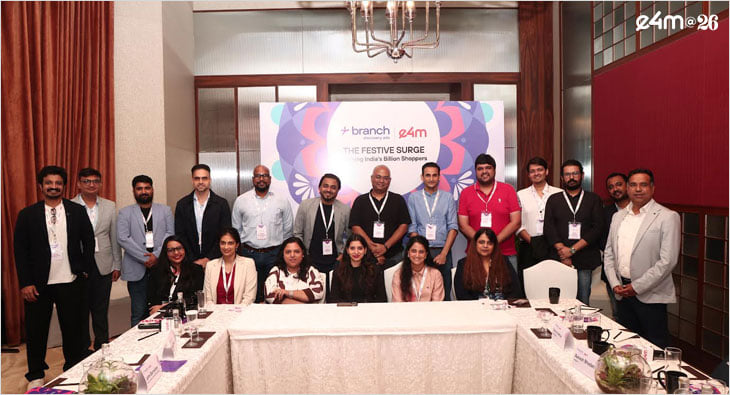

- As the 2026 festive season nears, brands are shifting focus from traditional Diwali media bursts to early consumer engagement, aiming to identify audience intent well before peak shopping periods.
- The discussion at the roundtable hosted by exchange4media emphasized the importance of building audience cohorts ahead of festive auctions, utilizing early intent signals across various digital platforms, including mobile and connected TV (CTV).
- Marketers are encouraged to leverage existing consumer behavior patterns rather than creating new cohorts, as festive shopping amplifies year-long habits, with significant increases in app activity observed during this period.
- The evolving media strategy highlights the need for cross-platform consistency and early intent mapping, with brands aiming to connect consumer interactions across multiple screens and environments to enhance engagement and drive conversions.
As the 2026 festive season approaches, brands are moving beyond the traditional Diwali media burst and looking to identify consumers earlier in the purchase journey. The focus is shifting towards building audience cohorts before festive auctions intensify, using early intent signals across OEM surfaces, mobile, connected TV (CTV) and other digital touchpoints.
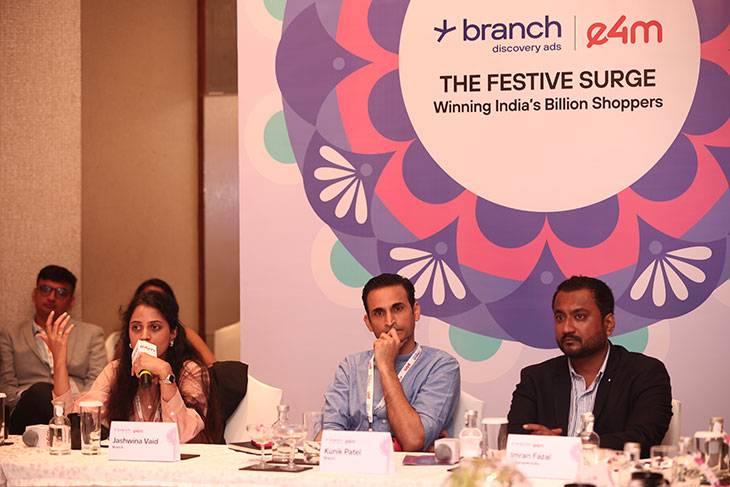
The shift was a key theme at “The Festive Surge: Winning India’s Billion Shoppers,” an exclusive closed-door leadership roundtable hosted by exchange4media in association with Branch Discovery Ads on September 8 in Mumbai. The discussion brought together marketers and media leaders from retail, financial services, real estate, beauty, home improvement and consumer goods to examine how changing consumer behaviour and rising media competition are reshaping festive planning.
The central question through the discussion was no longer simply where brands should buy festive inventory, but when they should enter the consumer journey.
Brands look to get ahead of the festive auction
For marketers, the pressure begins before consumers actually start shopping. Consumer journeys can start weeks or months before the transaction, while competition for inventory rises sharply closer to Diwali.
For Madison, this early audience-building approach is becoming important as festive CPMs rise.
Vivek Das, Chief Digital Officer, Madison, said brands need to start building audiences before consumers enter the peak shopping window.
"In India, the same festival is celebrated in ten different ways, which means granular planning must translate into granular execution. The real battle is capturing consumer attention weeks before they start active shopping, when CPMs on traditional walled gardens skyrocket. By leveraging deterministic data sources like Branch early on, we can establish frequency control and seed our cohorts effectively before peak festive bid-inflation hits."
Das said shopping journeys can begin two to three months before the festive season, creating a window for marketers to establish attention before the cost of reaching consumers increases.
The strategy, he said, is to have audience cohorts substantially built before the peak campaign begins rather than attempting to construct them when the auction is already crowded.
Kunik Patel, Director & Head of Advertising Sales, APAC, Branch Discovery Ads, said the platform currently reaches around 450 million monthly active users, with 79% of festive-engaged audiences comprising Gen Z and millennials. He also pointed to the growing role of smaller cities, with 62% of the audience coming from Tier 2 and Tier 3 markets.
The scale also reflects how fragmented festive discovery has become.
Festive does not create a new consumer, it amplifies an existing one
The discussion also challenged the idea that festive audiences should be built entirely from scratch.
Sonal Jadhav, Managing Partner - West, Havas Media, said consumer behaviour during Diwali is largely an amplification of patterns that exist throughout the year.
"Diwali and festive periods don't fundamentally change core consumer behavior; they simply amplify year-long habits. Festive planning shouldn't rely on creating entirely new cohorts from scratch, but on layering and refining existing year-long consumer journeys to match this heightened, effervescent period of intent."
The data shared at the roundtable indicates how this amplification plays out across digital behaviour.
Jashwina Vaid Director, Branch Discovery Revenue Growth, revealed that the shopping and social apps see close to an 80% increase in activity during the festive period compared with normal behaviour. Finance, travel, ride-hailing, transaction and utility apps also see increased activity as consumers move from discovery to transactions.
This creates multiple intent signals around a single festive purchase. A consumer may discover a product on one surface, research it on another, transact through a financial app and eventually visit a physical store.
The geographic distribution of this activity is also changing. While the top states account for 53% of smartphone reach, she highlighted Patna, Lucknow and Jaipur as cities contributing to growth, pointing to the increasing role of Tier 2 markets in festive discovery.
OEM surfaces move into the pre-shopping window
This is where OEM inventory is becoming part of the consideration-stage media mix.
Lock screens, app drawers, global search and app stores can give brands access to consumers before they enter a retailer, marketplace or social platform. According to Kunik, OEM presence provides access to more than 20 touchpoints, alongside in-app, mobile web and CTV environments.
For high-consideration categories, the timing of that first interaction can be significant.
Sarika Nadkarni, Assistant Vice President Marketing, Birla Opus, said festive intent for home improvement begins before the consumer reaches the store.
"For high-involvement home improvement decisions like paints, festive intent begins long before the actual purchase or store visit. Capturing early signals on OEM surfaces and lock screens before a user even opens an e-commerce or utility app gives us a competitive edge in building top-of-mind recall during key renovation windows."
The same logic applies to real estate, where the purchase journey is longer and the final transaction can be separated from the initial digital signal by several weeks or months.
Rajeeb Dash, Head of Department - Sales & Marketing, Adani Realty, said, "High-value sectors like real estate require continuous intent mapping rather than last-minute festive impulse targeting. Reaching consumers early in their digital journeys, using deterministic demographic and geo-location signals before they enter transactional environments, is critical for driving high-quality lead generation."
Financial services face a different challenge because the product itself may not be the starting point of the consumer journey.
Nikita Dilip Gupta, Assistant Vice President - Marketing, Tata Capital, said consumers typically do not begin their festive journey by actively looking for a financial product. The opportunity, therefore, lies in identifying signals around an impending purchase.
"Unlike retail shoppers, consumers rarely wake up actively wanting to apply for financial products. The festive marketing challenge for financial services is identifying contextual indicators of buying intent early on, ensuring our credit offerings are present before the final transaction occurs."
Shwetha Iyer, SVP & Head of Marketing, Kissht, similarly pointed to the increase in financial activity around festive purchases, including credit and instant payments.
CTV moves from reach to cross-screen sequencing
The other major theme at the roundtable was the role of CTV in connecting the early mobile interaction with the household screen.
Jashwina reported India has around 60-65 million CTV-ready households, while its own CTV reach is around 37-38 million. Its household-sync capability allows brands to connect mobile and CTV exposures where a household match is available.
Saif Shaikh, Head of Biddable & Non-Biddable and Planning, WPP Media, said the growth of CTV is creating an opportunity to link big-screen exposure with mobile re-engagement.
"Connected TV has reached a major inflection point in India, growing to over 200 million viewers across 60+ million households. The opportunity during festive season lies in managing co-viewing household impact and bridging CTV big-screen attention seamlessly with deterministic mobile re-engagement to drive true cross-device outcomes."
The focus is also moving from household reach to measurable business outcomes.
Somnath Mukherjee, Head of Programmatic, Vibrant (Reliance Retail), said omnichannel retail requires brands to connect media exposure with actions beyond a digital impression.
"Omnichannel retail requires moving past basic reach metrics toward real-world outcomes and footfall attribution. With programmatic capabilities tapping into OEM device hardware and household Wi-Fi sync, we can link big-screen CTV exposures directly to online orders and physical store visits."
The presentation cited by Branch Discovery Ads gave a sample of around 14 million households with visibility across devices connected to Wi-Fi routers. It said an average Indian household has about four devices connected to a Wi-Fi router, allowing the technology to create a household-level identity for cross-device targeting.
This makes CTV part of a broader sequence rather than an isolated reach channel. A consumer can first encounter a brand on mobile, receive a subsequent CTV exposure and later be re-engaged on mobile or directed towards a physical store.
The festive funnel gets shorter for some categories
The requirement for early intent does not look the same across categories.
For impulse-led businesses, the relevant signal may emerge much closer to the transaction. Branch Discovery Ads cited its work with Havmor, where it used deterministic signals to identify 18-25-year-old consumers in metros actively engaging with quick-commerce and UPI apps. The audience was then reached through lock-screen push notifications and in-app interstitials, generating a reported 2% CTR.
Aakash Bhadani, Assistant General Manager (Marketing), Havmor, said, "Impulse categories like ice creams and impulse treats thrive on real-time relevance and quick-commerce delivery. By mapping 18–25 year-old cohorts actively engaging with quick-commerce and delivery apps using OEM push surfaces, we can trigger instant cravings and drive direct conversions during peak festive moments."
For beauty and personal care, the discovery process is more closely linked to social and video behaviour.
Varun Kothari, Head of Social Media & Influencer Marketing, Galderma, said brands are moving from broad impressions towards more specific appographic and lifestyle cohorts to identify consumers at the point of product discovery.
Premium categories, meanwhile, are looking at the entire cross-screen journey.
John Barnabas, GM & Head - Digital & Customer Experience, Novel Jewels, Aditya Birla Group, said luxury and jewellery purchases are planned decisions, requiring brands to create consistent experiences across connected screens rather than relying on fragmented app journeys.
From media metrics to business outcomes
The shift upstream is also changing what marketers want from media platforms.
The discussion moved repeatedly from reach and clicks towards frequency control, incrementality, footfall and other business outcomes. Branch said its platform is increasingly focused on full-funnel measurement and real-world attribution rather than campaign delivery alone.
For Das, three considerations are becoming important when marketers evaluate new media environments: mitigating CPM inflation, reaching consumers before peak shopping behaviour and establishing incrementality.
He said a platform capable of reaching a large audience before the major walled-garden auctions become crowded can help marketers address both price and frequency pressures.
"The second is starting to grab that attention before the peak behaviour happens, the search happens, the AI search happens, the Amazon search happens," Das said.
The roundtable also brought in examples of how intent-based targeting can extend beyond festive retail. Branch cited a campaign with ChatGPT during the IPL where appographic signals were used to identify users active on JioHotstar and competing AI applications such as Gemini before reaching them through interstitial and video formats.
For Flipkart, the focus was re-engagement across categories including quick commerce, groceries and lifestyle. Branch said its OEM display campaigns were driving more than 1.2 million orders a month and approximately ₹720 crore in GMB, according to the case study presented at the roundtable.
The festive media window is getting longer
The broader takeaway from the discussion was that festive media planning is becoming less about a single Diwali burst and more about sequencing consumer interactions.
For some categories, that means identifying intent months ahead. For others, it means recognising a purchase signal closer to the transaction. Across both, marketers are looking to connect discovery, consideration and conversion across multiple screens and environments.
Suruchi Kore, Head of Digital & Social Strategies, Group Communication, Bajaj Group, said the fragmentation of attention across mobile, CTV and physical spaces makes consistency across platforms increasingly important.
"Consumer attention is increasingly fluid, shifting continuously between mobile devices, CTV screens, and physical spaces. Building unified, cross-platform brand narratives during festive periods requires deterministic identity resolution that ensures consistent messaging without ad fatigue."
With competition for festive inventory expected to intensify as Diwali approaches, the media battle is consequently moving further upstream. Brands are looking to identify consumers before they enter peak shopping environments, establish audiences before auction pressure rises and then connect those consumers across mobile, OEM surfaces, CTV and physical retail.
The festive media question, therefore, is increasingly moving from how much reach a brand can buy during Diwali to how early it can identify intent and how effectively it can carry that intent through to the eventual transaction.
Read more news about Marketing News, Advertising News, PR and Corporate Communication News, Digital News, People Movement News
For more updates, be socially connected with us onInstagram, LinkedIn, Twitter, Facebook, YouTube & Google News