#e4mExclusive: Sports rights in flux: Prasar Bharati CEO Gaurav Dwivedi on the big-ticket bidding war
Dwivedi confirmed that Prasar Bharati is developing the D2M Broadcasting RFP, with preparations advancing for its release in October. e4m reported the development on Wednesday
 by
by
Published: Sep 30, 2026 2:29 PM | 7 min read
 Follow Us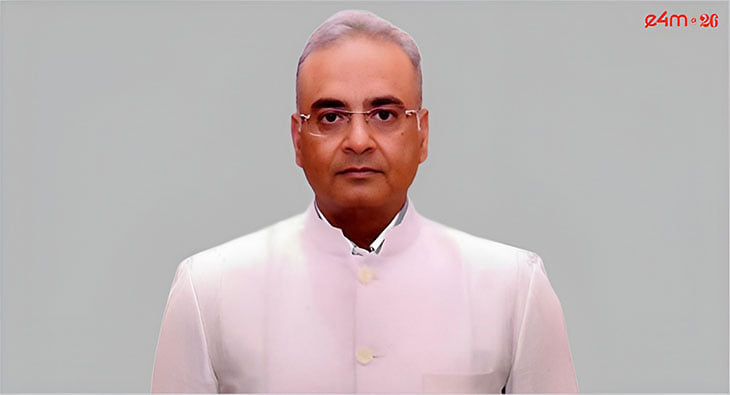

- Prasar Bharati is pursuing multiple roles as a public service broadcaster, OTT operator, spectrum custodian, and sports network amidst evolving media landscapes influenced by connected TV, FAST channels, and AI technologies.
- The organization has issued an Expression of Interest to expand its WAVES OTT platform globally, targeting the Indian diaspora, with plans for international distribution strategies and partnerships.
- The rollout of the Direct-to-Mobile (D2M) service has faced delays, but Prasar Bharati is finalizing a Detailed Project Report and preparing to issue a Request for Proposals by the end of October, intending to operate D2M as a public-private partnership.
- Prasar Bharati is exploring collaborations with TV manufacturers for connected TV growth and has engaged in AI technology, including the use of AI anchors in its programming, while also seeking to enhance its content strategy and sports rights acquisition amidst changing market dynamics.
Prasar Bharati is trying to be a public service broadcaster, an OTT operator, a spectrum custodian and a sports network at once, while the media industry around it is being rewritten by connected TV, FAST channels and AI. In this interview, Chief Executive Officer Gaurav Dwivedi talks about taking WAVES OTT abroad, the long-delayed Direct-to-Mobile (D2M) rollout, sports rights and why the broadcaster's creator outreach has not yet worked.
Prasar Bharati has issued an Expression of Interest (EoI) to take WAVES OTT global for the Indian diaspora. What exactly is the strategy?
International distribution is a completely different kind of operation from domestic distribution. Some of the platforms growing fastest in India are global players for whom India came later in their journey. At the same time, several Indian platforms have gone global. To realise WAVES' full potential, we need a strategy that lets audiences interested in Indian content know that it exists and access it.
We can't do that sitting in India. That is why we have invited partners from other countries to come in with proposals. We want to evolve a strategy that lets us reach other markets.
When do you expect to close this and launch globally?
It will take a few months because it is a complex exercise. We have issued the first paper, and I expect a fair amount of activity over the next two to three months.
D2M has been delayed. The RFP hasn't been issued and deadlines have been missed. What is the status?
There were concerns about the device ecosystem and about how devices receiving D2M signals would perform. Through demonstrations and a consultative process involving all stakeholders, we ran multiple tests in both live and test environments. Those queries have been satisfactorily resolved.
A key ecosystem question was whether D2M would be a mandate or a choice. We have made it clear that device manufacturers are under no obligation to carry D2M signals or make D2M-capable devices. It is entirely voluntary. Some manufacturers have already prototyped and built devices that can receive D2M signals. If demand grows, others will follow.
With that settled, the next steps are the Detailed Project Report (DPR) and then the RFP. The DPR work is almost complete, and the draft has been submitted to us. The RFP is being prepared, and we can float it by the end of October.
How will the commercial rollout work?
We propose to run D2M as a public-private partnership. Prasar Bharati will offer its infrastructure and the spectrum allocated to it. The private partner will bring the transmission equipment and technology, and will make the necessary tie-ups with content owners and channels. Prasar Bharati will receive a share of the revenues. The final details of the RFP are being worked out, and we should be able to release it in a month or so.
Will it follow the 60:40 revenue-share model offered on WAVES OTT?
No. The revenue model will be discovered through the bidding process.
What are the key recommendations in the roadmap prepared by EY, which Prasar Bharati appointed?
The draft DPR has been submitted and is under final evaluation, so it wouldn't be appropriate to comment on a draft. Once it is finalised, it will come into the public domain and you will have your answers.
TV sets with built-in tuners are making an antenna-free, dish-free experience possible. How does that help Prasar Bharati?
Connecting a linear set-top box is an additional purchase when you buy a TV. Parts of the linear broadcast industry have underperformed recently, partly because audiences are questioning whether they want to pay for linear content. In that landscape, DD Free Dish has still shown growth.
The pay set-top ecosystem has its place. But for audiences who don't want to be part of the linear pay system, the cord-cutters, there is now an option. Every TV manufactured and sold in India has an unencrypted satellite tuner built in. When you buy a new TV, you just connect a dish and it will play Free Dish signals.
Our role as a public service broadcaster is to give access to content that is barrier-free and hindrance-free, and building the satellite tuner into the TV reinterprets that role.
Are you looking at integrating more AI anchors?
We have already done it. DD Kisan has carried AI anchors, and we ran experiments almost two years ago. The technology has moved on a great deal since then. During the ongoing Asian Games coverage, we have two AI anchors on DD Sports presenting the day's coverage every day. If you haven't seen DD Sports lately, do watch it today.
Is Prasar Bharati collaborating with TV makers (OEMs) for connected TV growth?
We have reached out to all of them, and several are in conversation with us. Some OEMs use Android-based TVs, and the WAVES app is already available on the Android app store, so you can download it on your TV. We are also talking to individual manufacturers about turning some of our more prominent channels into FAST channels.
Everybody is grappling with the same question: what is the most appropriate way to reach audiences on a platform that fits their viewing preferences? It isn't just Prasar Bharati. All channels are trying to answer it, and we will see how it unfolds over the next few months or years.
You've said DD News's primetime show is second only to one channel. That growth came after a marquee anchor was brought onto your network. Does Prasar Bharati need similar investments elsewhere?
Content evolves very rapidly, in news and outside it. What works at one point may not work at another or in a different context. But we have had very good results from this experiment, and we are spending a lot of time devising a strategy to improve performance in other time bands. What form it takes, you will know in a few weeks, because it is still under consideration.
Beyond mandatory sports sharing, will Prasar Bharati invest in acquiring sports rights?
Sports rights are in a fair amount of flux. Major broadcasters, in India and globally, have felt that certain sports properties are overvalued and that valuations need to be rationalised. We saw that with FIFA, where some of the country's largest broadcasters went back and forth before one finally acquired the rights.
There are two points here. First, mandatory sharing lets us take a property to audiences who don't subscribe to the rights-holder's channels, whichever broadcaster holds the rights. Second, given how the largest properties are valued, it is a challenge for us to enter that bidding game and take an entire property for ourselves.
Fortunately, far more sports events are now happening across the country. Small leagues have sprung up everywhere and are growing very rapidly, not only in cricket but in other sports too. We are offering our platform to these programmes and continuing to function as a sports channel rather than just a cricket channel.
Prasar Bharati floated a tender for creators and influencers to make a reality-style show, but received no response. Was the money offered too low?
We are engaging with creators, and several are already working with us. The modern creator ecosystem works very differently from the traditional way content was sourced. We do have some influencers and creators working with us, but we are still working out the right way to engage more of them. That effort will continue. We will find the best-fit approach and then use it to bring more creators on board.
Read more news about Digital Media, Television Media, Out of Home Advertising, Print Media, Latest Advertising India
For more updates, be socially connected with us onInstagram, LinkedIn, Twitter, Facebook, YouTube & Google News
