An overdue mandate for accessible TV
Guest Column: Brij Kothari, Adjunct Professor, IIT-Delhi, School of Public Policy, writes how TV accessibility standards is now about broadcast infrastructure upgradation
 by
by
Published: Sep 29, 2026 2:11 PM | 4 min read
 Follow Us

- The Ministry of Information and Broadcasting (MIB) established the 'Accessibility Standards for Persons with Disabilities in Television Programmes, 2019,' mandating that by 2025, 50% of General Entertainment Content (GEC) on TV should include Same Language Captions (SLC) or Indian Sign Language (ISL). Currently, only 120 programs feature SLC, with overall compliance below 10%.
- Other countries, including the US, UK, Australia, Canada, and the EU, have implemented similar mandates for TV captioning, highlighting the need for regulatory support in India to enhance accessibility for persons with disabilities (PwDs).
- The article emphasizes that further delays in enforcing the 2019 standards would undermine the Rights of Persons with Disabilities Act, 2016, and suggests that advancements in AI can facilitate the cost-effective scaling of SLC across all programming without needing extensive infrastructure upgrades.
- It advocates for a decoupled regulatory approach, allowing for immediate implementation of SLC while setting phased targets for other accessibility features like Audio Description (AD) and ISL, to effectively improve media access for all viewers.
Seven years ago, the Ministry of Information and Broadcasting (MIB) took a giant leap for accessible TV in India by framing the ‘Accessibility Standards for Persons with Disabilities in Television Programmes, 2019.’ Formally issued as an advisory, it stipulated that half of all General Entertainment Content (GEC) on TV should have Same Language Captions (SLC) or Indian Sign Language (ISL), by 2025.
As a result, 120 TV programmes are currently telecast with SLC. The Billion Readers (BIRD) initiative maintains a list of active programmes with SLC at: https://billionreaders.org/sls-for-tv/. Although overall compliance is still less than ten percent, it demonstrates policy commitment to disability rights and proves that India’s multilingual TV networks are more than capable of implementing SLC on television with the existing infrastructure.
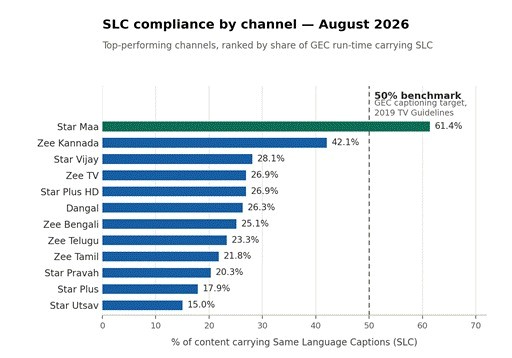
TV channels that have made good progress on SLC integration
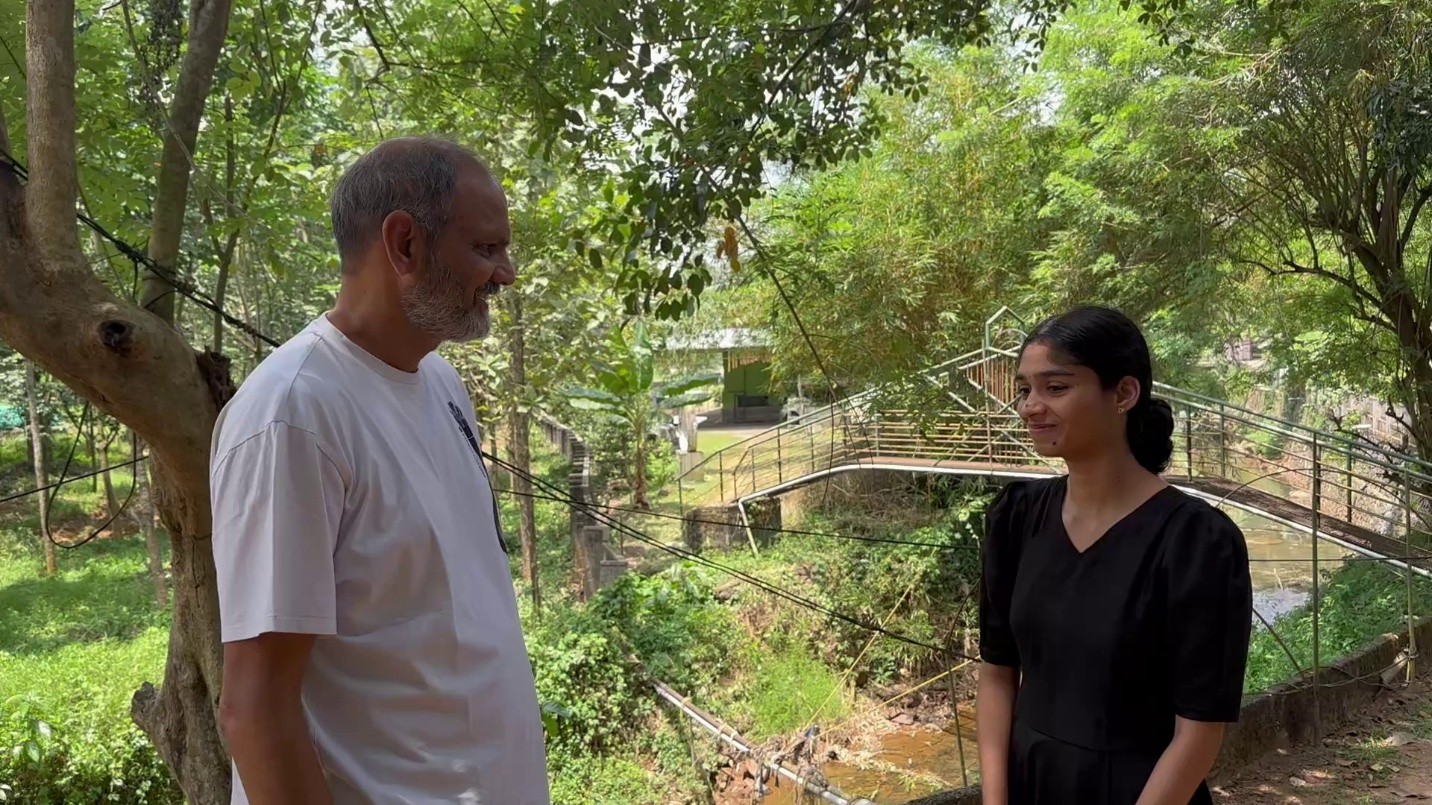
Seethal Kumar in conversation with the author on why SLC is important for language & literacy at population scale.
A public good in need of regulation
No country has implemented captions on TV without a mandate. The US requires nearly 100 percent of English and Spanish broadcast programming to be captioned, under legislation like the Americans with Disabilities Act (ADA). In the UK, regulators require all major TV channels to carry captions, supported by their Equality Act. Australia, Canada and the European Union too enforce captions on nearly all TV programming. With AI advances in Indian languages, India too can consider all TV programming to include SLC, moving us gradually toward an ‘All content born accessible’ entertainment ecosystem.
India’s Rights of Persons with Disabilities (RPwD) Act, 2016 requires TV channels to “ensure that persons with hearing impairment can have access to television programmes with sign language interpretation or sub-titles.” Importantly, any rules on accessibility notified by MIB must be implemented “within a period of two years.” By not notifying the 2019 TV standards, MIB has already given the industry a long rope – seven years – to ramp up its TV accessibility provisions. A further extension would therefore privilege TV industry interests over the rights of PwDs.
Building on progress
The conversation on the notification of the TV accessibility standards and their implementation in a phase-wise manner during 2019-2025, now seems to be veering toward broadcast infrastructure upgradation as a pre-condition. Rather than back pedaling, we should be building on the progress made by the implementation of SLC on 120 TV programmes using existing infrastructure. AI advances allow us to not only scale SLC cost-efficiently on all programming, the availability of an accurate and time-coded transcript makes it possible to layer onto it, search, translation, dubbing and other accessibility features like Audio Description (AD) and Indian Sign Language (ISL). Longer timelines than the seven years that have already elapsed since the TV standards were framed, would be a disservice to PwDs in violation of the RPwD Act, 2016.
A decoupled strategy
Policy makers and the TV industry need to appreciate that SLC in India has the power to contribute, besides media access, to a few more national goals at scale – reading literacy language learning and language conservation. All one billion TV viewers stand to benefit. A rejigging of set top boxes and other broadcast hardware, as implied here, can take their course but need not be a pre-condition for the universalization of SLC. A number of TV networks are already implementing SLC in major languages. The challenge is to scale the implementation and improve the quality of SLC for readability using universal design principles.
Canada, the UK, and the US are widely considered the global pioneers in AD for television. Canada requires AD across all prime-time programming. The UK mandates established broadcasters to provide AD for at least 10 percent programming. In the US, TV networks must provide an average seven hours of AD content per week. To maximize time with family and minimize the isolation of PwDs, MIB could consider specifying a minimum quantum of AD hours in prime time to begin with.
Lumping SLC, AD and ISL under a single implementation timeline only provides the industry with a convenient rationale to delay progress altogether. True systemic change in media accessibility requires a decoupled regulatory strategy. By demanding the immediate and universal expansion of SLC, which is cost-efficient with AI, while setting phased quality implementation targets for AD and ISL, MIB can systematically chip away at the barriers to media access. Treating accessibility as a composite challenge only preserves the status quo. Treating accessibility as a suite of actionable solutions, with their unique set of conditions for implementation, is a pragmatic way toward inclusive TV for all.
Disclaimer: The views expressed here are solely those of the author and do not in any way represent the views of exchange4media.com.
Read more news about Television Media, Digital Media, Advertising India, Marketing News, PR and Corporate Communication News
For more updates, be socially connected with us onInstagram, LinkedIn, Twitter, Facebook YouTube & Google News
