Q-commerce advertising faces accountability test as brands question media wastage
As ad budgets swell, brands say stock-outs and serviceability gaps are breaking the link between paid attention and actual purchase
 by
Published: Nov 13, 2026 9:08 AM | 7 min read
 Follow Us


- Advertisers in quick commerce are facing challenges when consumers express interest in products but cannot complete purchases due to inventory or delivery constraints, raising questions about accountability for lost sales opportunities.
- Industry experts emphasize the need for a shift in measuring advertising effectiveness from impressions and clicks to actual conversions, as the gap between consumer interest and completed transactions becomes more pronounced.
- Founders of beauty brands advocate for shared accountability between brands and platforms, suggesting that both parties should define the scope of work and responsibilities regarding product availability and fulfillment.
- Proposed solutions include implementing credits or make-good options for brands when logistical issues arise, as well as enhancing transparency and data sharing between platforms and advertisers to better understand consumer drop-off points.
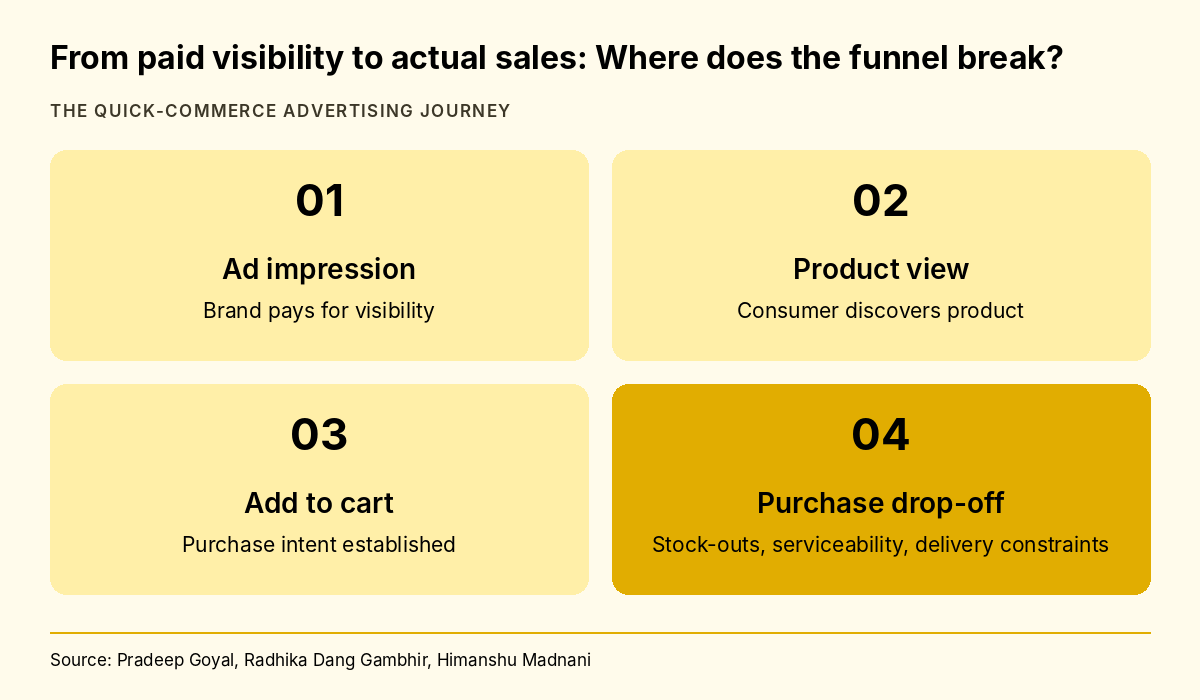
A consumer spots a beauty product on a quick-commerce platform, clicks on its sponsored listing, perhaps even adds it to the cart, but eventually drops off because the product is unavailable in their location or delivery is restricted. For the brand, the advertising impression has been delivered, but the transaction it was meant to generate has not materialised.
This raises an increasingly important question for advertisers investing in quick commerce: when brands pay for visibility but platform-level operational constraints prevent consumers from completing purchases, who bears the cost of that lost opportunity?
With quick-commerce platforms becoming an important discovery and purchase channel, the gap between consumer interest and actual sales is becoming harder to ignore. Brands are now questioning whether advertising effectiveness can continue to be measured through impressions and clicks when the consumer's ability to buy remains dependent on inventory, geographical serviceability and delivery capacity.
The concern is not limited to campaign measurement. It also brings the commercial relationship between brands and platforms under scrutiny, particularly around accountability, media compensation and the conditions under which advertising inventory is sold.
For Himanshu Madnani, Director at Shryoan Cosmetics, the problem starts with what an ad budget is understood to buy. “It is implied that with the paid placement by a brand, the product would be visible, accessible, and buyable. The paid investment would fail to deliver value to the brand when there is no option to buy due to stock-outs, delivery constraints, and other similar factors that impact availability,” he said.
The scale of the money involved sharpens the point. Madnani put numbers on it: “The rapid growth of quick commerce ads in the festive season of 2026 is likely to touch the mark of ₹2,200 crore, which implies an increase of 50% year-on-year.”
Festivals compress the problem. Pradeep Goyal, Co-founder of Glam21, pointed to the season’s double pressure on brands and platforms alike. “During festive occasions, consumer demand is generally high, along with the competition for visibility. Seamless fulfilment is thus extremely important during such times,” he said.
Radhika Dang Gambhir, Founder & CEO of Wildflower Naturals, argued the yardstick itself needs to change. “It should not be forgotten, though, that advertising effectiveness can be evaluated not through visibility, impressions, and clicks but through conversion to purchases,” she said.
Shared accountability, undefined split
The founders converge on one idea: neither side can walk away clean. How the burden divides is where the detail gets thin.
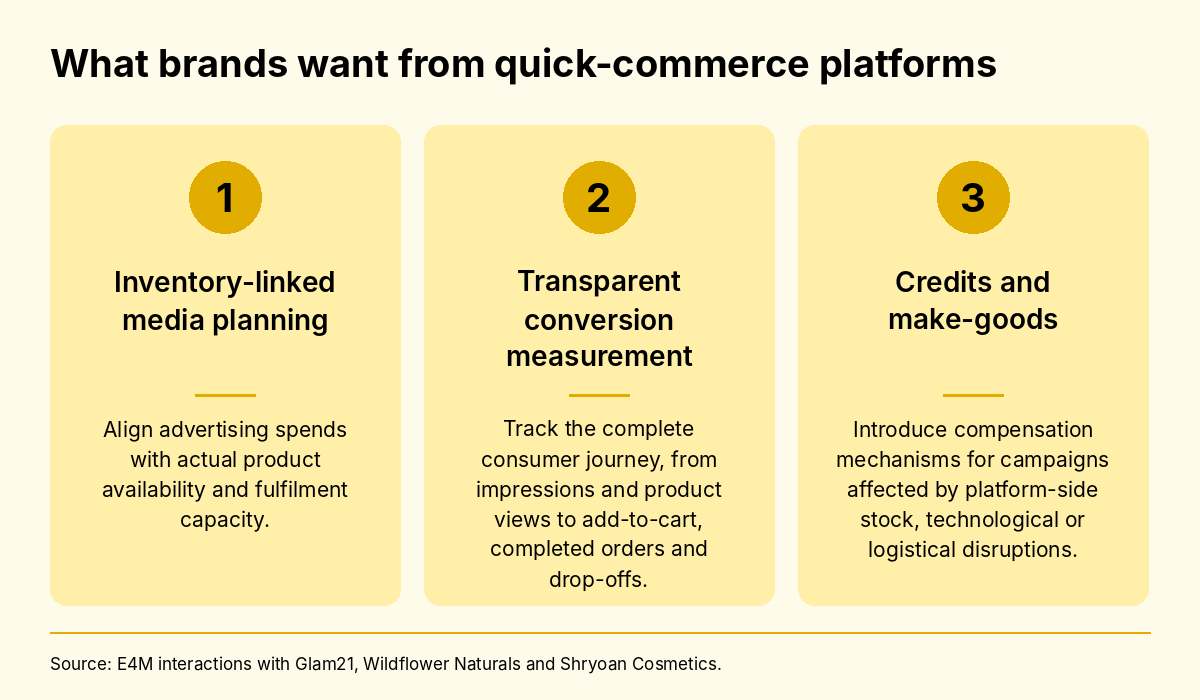
Goyal ties the question to how campaigns are set up in the first place. “There needs to be accountability shared by the brand and the platform, with a well-defined scope of work in the beginning,” he said. He also placed a specific obligation on the platform. “Brands have been spending money on visibility to generate demand, but there is a need for the platform to be certain that there is an adequate supply of the products and the capacity to deliver those goods to customers.”
Gambhir’s answer keeps the brand on the hook as well. “When consumers interact with the paid placements and do not make purchases because of platform-side inventory, geographical, or logistical issues, accountability is required from both sides. Although the brands should assure supply, the platforms should also share some responsibility,” she said.
That last clause matters. A stock-out can originate with the platform’s inventory or with a brand’s supply, and the two cases carry very different claims on responsibility. None of the three described a specific incident or named a platform, so where the line sits in practice remains untested. This is the gap Goyal’s call for a defined scope of work is meant to close.
Where interest turns into drop-off
If accountability is contested, the point of failure is less so. Goyal described what Glam21 treats as the real measure of a campaign. “We strongly feel that it is important to measure the success of our campaigns not only in terms of impressions and clicks but also product views, number of adds to cart, conversion rate, and the percentage of orders completed successfully,” he said.
Gambhir identified the break in that chain. “The major problem in this ecosystem is the disparity between consumer interest and transactions,” she said. Her next step is a work in progress. “Moving forward, we will aim to put more focus on analyzing the entire consumer journey, starting from view through to click, to add to cart, conversion, and drop-offs due to availability or fulfillment issues.”
Madnani described the moment of failure from the shopper’s side. “The moment consumers come to know about or click on a product but then realize that it is out of stock, lacks adequate delivery locations or incurs some additional charges, there arises a chasm between engagement and purchase,” he said.
Taken together, the three describe the same funnel from different ends. Glam21 names the metrics, Wildflower Naturals commits to tracing the full journey and Shryoan Cosmetics points to where shoppers fall out of it.
Numbers that did not come from the funnel
The question put to the founders also asked for data: traffic, product views, click-throughs and conversions during the festive window, along with estimated media spend and revenue lost. None of them supplied those figures.
Madnani offered industry-level numbers instead. “According to industry figures, about 70% of all festival shoppers have ended up making impulse buys in the Navratri-Diwali season, while almost 30% relied on quick commerce for their festival requirements,” he said. He did not name the source. The figures indicate how large the festive opportunity is, not how much of it leaked at checkout.
Gambhir argued that brands cannot produce the missing numbers alone. “More transparency and granular attribution on the part of the platforms will assist advertisers in gauging the influence of such disruptions, including media wastage and lost revenue opportunities,” she said. If advertisers cannot see where shoppers dropped off, they cannot size a claim for compensation either.
From credits to a new test for media spend
On remedies, the founders are closer to each other than on anything else. Credits, make-goods and re-billing came up in all three responses. Goyal linked the remedy to the underlying spend. “There should be an alignment between media spend and actual inventory and fulfilment capabilities of the platform. There should be credit or make-good options offered to the brands due to technological or logistical reasons,” he said.
Madnani framed it as a billing mechanism rather than a goodwill gesture. “In such instances, the platforms need to have systems like credits or re-billing based on such constraints,” he said.
Gambhir extended the idea to how brands plan campaigns. “At Wildflower Naturals, we believe media investments must be evaluated against actual purchase opportunities, factoring in product availability, serviceable pin codes, fulfilment and successful conversions, not just visibility,” she said.
The unsettled bill
The founders want a quick-commerce ad to be judged by whether it produces a sale, yet the sale depends on stock and delivery that brands and platforms handle jointly. Credits and re-billing are easy to ask for and hard to price without shared data on where shoppers drop out. The harder question may be whether availability becomes part of what an ad is understood to sell, written into campaign terms rather than assumed. Until someone puts a number on the leak, the cost of an empty shelf will keep landing wherever the contract is silent.
Read more news about Digital Media, Internet Advertising, Marketing News, Television Media, Radio Media
For more updates, be socially connected with us onInstagram, LinkedIn, Twitter, Facebook, YouTube & Google News
