Digital keeps growing, but newspapers aren't surrendering: What ABC 2026 reveals
Publishers are investing in journalism, reader engagement and distribution, while advertisers say newspapers continue to offer credibility, regional reach and influence
 by
Published: Nov 12, 2026 8:57 AM | 14 min read
 Follow Us


- Despite the ongoing shift to digital media, recent circulation figures show that several major Indian newspapers, such as Dainik Jagran and Divya Bhaskar, have experienced growth in print circulation, indicating a degree of resilience in the print industry.
- Advertising expenditure in print has seen modest growth, with a 3% increase in 2025, suggesting that advertisers still value newspapers for their credibility and regional reach, although digital media continues to capture a larger share of advertising budgets.
- The performance of individual publications varies significantly, with some experiencing declines in circulation, highlighting that growth is not uniform across the industry and is increasingly publication-specific.
- Advertisers are becoming more selective, focusing on audience relevance and measurable outcomes rather than circulation numbers alone, which poses a challenge for publishers to demonstrate the commercial value of their readership.
The obituary for print was written long ago. As advertising budgets shifted towards digital, smartphones became an inseparable part of everyday life and audiences acquired more screens than ever before, newspapers were repeatedly confronted with questions about their future. Yet, the latest circulation figures suggest that print is not going anywhere anytime soon.
Some of India's largest newspapers are still adding copies. Advertisers continue to see value in their credibility, geographic reach and ability to influence purchase decisions. Publishers, meanwhile, are investing in everything from journalism and reader engagement to printing infrastructure and last-mile distribution.
But is this evidence of print's resilience, or are a handful of established newspapers managing to hold their ground in an otherwise challenging market? And with digital commanding an increasing share of advertising expenditure, what is persuading brands to continue investing in newspapers?
The latest Audit Bureau of Circulations (ABC) data for January–June 2026, accessed by exchange4media, provides an interesting starting point.
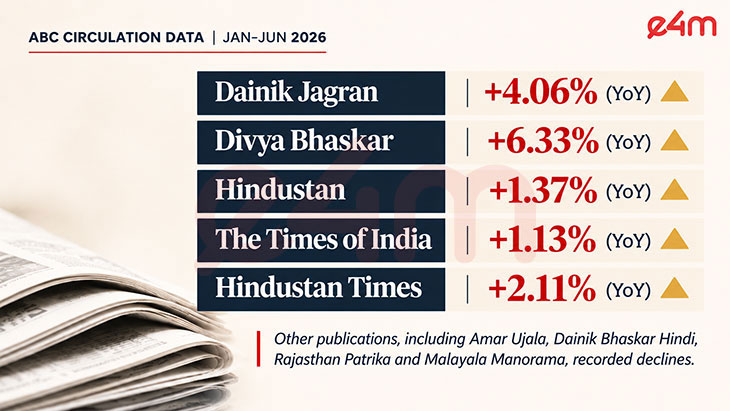
A year-on-year comparison with January–June 2025 shows Dainik Jagran recording an increase of 95,678 copies, or 4.06%, taking its average qualifying sales from 23,53,778 to 24,49,456 copies.
Gujarati daily Divya Bhaskar registered growth of 6.33%, increasing from 4,60,989 copies to 4,90,155 copies. Hindustan, the Hindi daily published by HT Media, grew 1.37%, from 14,63,341 to 14,83,381 copies.
Among English newspapers, The Times of India recorded a 1.13% year-on-year increase in average qualifying sales, from 16,40,418 copies in January–June 2025 to 16,58,970 copies in January–June 2026, based on the audited publication figures.
Hindustan Times registered growth of 2.11%, from 6,19,280 to 6,32,321 copies, although circulation movements varied across individual editions.
The Economic Times recorded a 1.97% decline, from 2,55,567 to 2,50,528 copies, on the comparable-edition figures used in the analysis. This comparison should not be interpreted as including editions without corresponding data for both periods.
The analysis is based on ABC-certified average qualifying sales for the publications and editions covered in the available audit data. Where year-on-year comparisons are made, the figures refer to the audited circulation reported for January–June 2026 and the corresponding period of 2025. Edition coverage is relevant when interpreting individual publication totals, particularly where editions have been added, discontinued or lack comparable data across both periods.
Coming back to numbers, the gains, however, were not universal. Amar Ujala's circulation declined 1.53% year-on-year, while Dainik Bhaskar Hindi recorded a marginal decline of 0.58%. Rajasthan Patrika fell 2.61%, The Economic Times declined 1.97%, and Malayala Manorama recorded a sharper reduction of 6.42%.
The figures reveal a market where circulation growth is increasingly publication-specific rather than uniform across the industry. But they also challenge the assumption that newspaper circulation is moving in only one direction.
What, then, is keeping readers engaged? And does the ability to retain or grow circulation still translate into advertising value?
Behind the numbers: The business of retaining readers
For publishers, sustaining newspaper circulation requires continuous investment in both the product and the ecosystem that delivers it.
Girish Agarwal, Promoter Director, Dainik Bhaskar Group, says the group's circulation strategy is built around maintaining its relationship with readers.
"At Dainik Bhaskar Group, our primary focus has always been the reader. Therefore, growing circulation and reaching the right readers are of paramount importance to us. This is equally important for our advertisers, who want to connect with the right target audience in their markets.”
Agarwal points to the group's circulation leadership and the investments required to sustain it.
"Maintaining this leadership requires continuous investment in acquiring new readers while nurturing and retaining our existing reader base,” he said.
According to the latest figures, the Dainik Bhaskar Group recorded average qualifying sales of 35,26,989 copies across its Hindi, Gujarati and Marathi publications in January–June 2026.
Within the portfolio, performance varied. Dainik Bhaskar Hindi recorded average qualifying sales of 30,23,109 copies, compared with 30,40,724 copies a year earlier, a marginal decline of 0.58%. Divya Bhaskar, however, grew 6.33% year-on-year.
The contrasting movements illustrate why even large publishing groups cannot be assessed through a single publication's performance.
Agarwal says the group's circulation strategy is built on three areas.
"First and foremost, we focus on delivering credible, relevant and high-quality editorial content. Our emphasis on strong journalism and stories that matter to our readers ensures the newspaper remains an integral part of their everyday lives,” he said.
Beyond editorial content, the group is also investing in initiatives intended to maintain reader participation and loyalty.
Agarwal also highlighted the group's focus on reader engagement through initiatives which offer prizes to readers and are aimed at encouraging participation and strengthening loyalty, particularly in key markets such as Rajasthan, Gujarat and Madhya Pradesh.
The physical distribution network remains another important component of the strategy.
"Third, and equally important, is our distribution ecosystem. We continuously invest in strengthening our printing and distribution infrastructure through new printing centres and distribution points closer to our markets,” he added.
According to Agarwal, the group’s continued investments in content, technology, reader engagement and distribution are aimed at strengthening relationships with readers and creating greater value for its partners and advertisers.
The question is whether these investments can continue to deliver sufficient returns as media consumption habits evolve.
Circulation matters, but does it guarantee influence?
For advertisers, the latest ABC figures are an important indicator of newspaper distribution. However, they are not necessarily a direct measure of advertising effectiveness.
Rajiv Dubey, Head of Media at Dabur India, believes that the medium's commercial future will depend on the quality and relevance of the audiences it reaches.
"Circulation is a measure of distribution; it is not, by itself, a measure of influence or advertising effectiveness. The future of print will be determined by how effectively it delivers the right audience, in the right market, at the right cost,” he said.
For brands operating across India's diverse consumer markets, newspapers continue to offer advantages that extend beyond circulation.
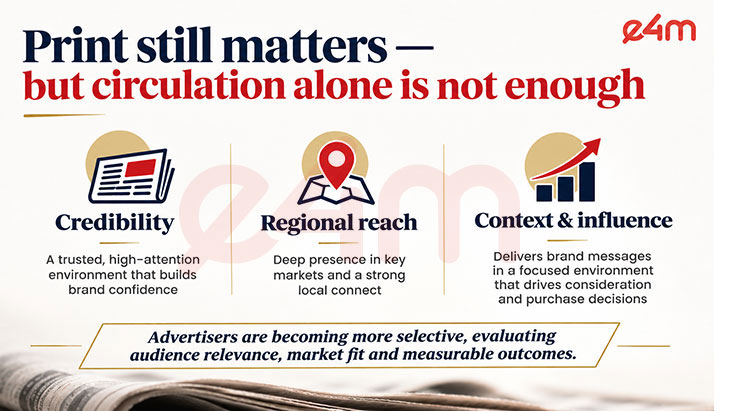
"Print continues to play an important role in our media mix, offering credibility, consumer trust and strong regional reach. While television delivers scale and digital provides precision and measurability, print brings attention, context and market-level relevance. For brands like Dabur, these strengths remain valuable, particularly in a diverse market like India,” Dubey added.
Yet, the ability to deliver those advantages does not mean print automatically receives advertising investment.
"ABC numbers are an important planning input, but circulation alone cannot determine advertising investment. We look at effective readership, audience profile, market relevance, brand affinity and cost efficiency. A decline in circulation does not necessarily mean a decline in influence. Our approach in 2026 is to be more selective and market-specific, focusing on effective reach and return on media investment rather than just copies sold. Ultimately, what matters is not how many copies a publication circulates, but how effectively it reaches and influences the consumers we want to connect with,” he added.
Dubey's assessment raises an important question for publishers. If circulation is no longer sufficient to determine advertising value, how effectively can newspapers demonstrate the quality of their readership and the business outcomes they deliver?
For advertisers, the answer increasingly appears to depend on the category, market and objective of a campaign.
Why print still matters for considered purchases
For brands selling products that involve significant consumer research and consideration, newspapers continue to offer an environment for detailed communication.
Ullas Vijay, CMO, Duroflex Ltd., says print's ability to provide context and depth remains particularly relevant for such categories.
"For brands, the value of print lies in its ability to influence informed purchase decisions through credible, detailed and high-impact communication. It offers an opportunity to engage with urban consumers, professionals and decision-makers, while giving brands the space to communicate the distinct value of their offerings. For considered purchases such as mattresses and furniture, where consumers evaluate product features, design, technology and long-term value, this depth of communication becomes particularly relevant,” he said.
However, Vijay does not see print and digital as competing for identical roles.
"We see print and digital playing complementary roles in the media mix. Digital enables precision and real-time engagement, while print brings context, visibility and depth to brand communication. The strength of a media strategy lies in understanding the role each channel can play in reaching the right audience and achieving the campaign objective,” he added.
The company's World Sleep Day campaign provides an example of how newspapers can support a broader brand-building objective.
For World Sleep Day, Duroflex undertook a national campaign to bring greater attention to sleep and its impact on overall health and wellbeing.
"At Duroflex, our World Sleep Day campaign demonstrated how print can amplify a larger brand conversation. By taking the message around sleep and its impact on health and wellbeing to a wider readership, print helped extend the campaign's reach beyond our immediate consumer touchpoints and gave greater visibility to a subject that deserves more public attention,” Vijay added.
The example highlights print's potential role in building awareness and communicating complex propositions. However, such campaigns also underline the need for advertisers to evaluate outcomes beyond visibility alone.
Where is the advertising money going?
The latest ABC circulation figures provide a view of newspaper distribution, while advertising expenditure data offers a separate perspective on the medium's commercial performance.
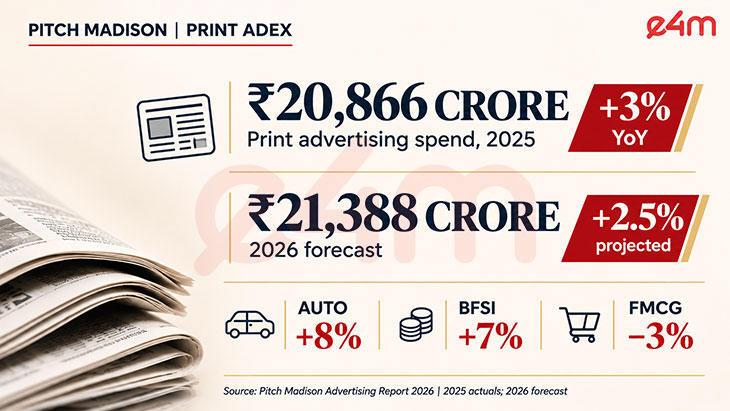
According to the Pitch Madison Advertising Report 2026, print advertising expenditure grew 3% in 2025, from ₹20,272 crore to ₹20,866 crore. Advertising volumes increased by approximately 1%, suggesting that improved yields and premium inventory contributed to revenue growth.
English newspaper advertising volumes rose 6%, increasing their share of print advertising volumes from 28% to 30%.
The report also projects print advertising expenditure of ₹21,388 crore in 2026, representing growth of 2.5%.
These numbers suggest that advertisers continue to allocate substantial budgets to newspapers. But they also indicate that print's revenue growth is modest, particularly when compared with the expansion of digital advertising.
Vijay says the trend reflects increasingly selective media investment.
"Media investments are becoming increasingly selective, with brands evaluating channels based on audience relevance, campaign objectives and the quality of engagement they can deliver. While digital continues to account for a growing share of advertising investment, print remains relevant for campaigns that require strong visibility, credibility and deeper communication,” he said.
Category-level spending provides further context.
According to Pitch Madison, automobile advertising expenditure in print increased 8% in 2025 to ₹3,036 crore. BFSI spending grew 7%, retail rose 4%, and real estate increased 3%.
However, FMCG print expenditure declined 3%, while education spending fell 2%.
The differences suggest that print's commercial relevance is becoming increasingly category-specific rather than being driven by uniform growth across advertisers.
Automobiles, dealerships and the importance of local reach
For automobile manufacturers, newspapers continue to offer a way to connect brand communication with local dealership requirements.
Vinay Dholakia, Head - Digital Marketing & Media, Tata Motors Commercial Vehicles, explains why print remains relevant despite growing investment in digital platforms.
"From an automotive OEM perspective, print continues to have relevance because dealers need enquiries at a local level. Print works in that space because advertisements can be aligned with specific editions, relevant dealerships and locations. One of the biggest draws is the belief that print helps drive footfalls to dealerships. Print also elevates a brand in the consumer's mind. When consumers see an advertisement in print, there is a perception that it is a big brand undertaking a big campaign. That sense of scale and impact associated with a large advertising activity continues to be reinforced through print,” he said.
His comments point to two advantages: the ability to target specific markets through editions and the perception of scale associated with newspaper advertising.
However, Dholakia also acknowledges that the medium presents challenges.
"Having said that, we have our own set of reservations and have been cautious about investing in print. Buying a vehicle is a high-involvement decision. After buying a house, it is probably one of the biggest investments a consumer makes. From that perspective, print helps brands reach middle management and well-read younger consumers who are more involved in the purchase decision. English print continues to be important for automotive brands. It is an important part of Tata Motors' media strategy. In the passenger vehicle category, brands are advertising in print, and you cannot afford to be left behind. You need to maintain a certain level of presence,” Dholakia explained.
The distinction is significant. A brand maintaining visibility in newspapers does not necessarily mean it is increasing its print budget. Competitive considerations, local market requirements and brand positioning can all influence advertising decisions.
For FMCG companies, print's relevance is similarly linked to specific markets and campaign objectives.
An Emami spokesperson said, "Our media strategy is guided by brand objectives, target audience and market relevance. While digital has grown significantly post-pandemic, print continues to be an effective medium for mass outreach, new launches, credibility-building and reaching consumer segments and markets where newspaper readership remains strong.”
The spokesperson adds, "ABC circulation data is an important input as it helps evaluate reach and media efficiency. However, our advertising decisions are based on a broader assessment that includes audience relevance, brand fit, market importance and expected ROI. Consequently, while circulation trends are considered, media investments are ultimately determined by the ability of a platform to deliver campaign objectives and business outcomes.”
These perspectives indicate that print's continued place in advertising plans is not unconditional. Brands still see value in newspapers, but increasingly expect that value to be demonstrated through audience relevance, market performance and returns.
Publishers see year-on-year growth as an important indicator
An earlier exchange4media analysis of ABC circulation data had also examined performance against the immediately preceding six-month period, July–December 2025, revealing a different picture. While Dainik Jagran, Amar Ujala and Hindustan recorded sequential gains, The Times of India and Hindustan Times saw declines of 9.73% and 14.79%, respectively, despite registering year-on-year growth. Divya Bhaskar followed a similar pattern, growing 6.33% year-on-year but declining 2.36% sequentially. The contrasting trends raise an important question about how circulation performance should be assessed across audit periods.
READ MORE: ABC Circulation Data 2026: Who gained, who lost in India’s newspaper market?
For newspaper publishers, comparing circulation across corresponding audit periods provides a more consistent view of performance.
Indra Narayan Das, the national circulation head at HT Media Group says seasonal factors can significantly influence newspaper circulation.
"Circulation is subject to significant seasonal variations. Hence the correct way to compare circulation growth is by using identical time periods from the two years. Comparisons are always done January-June to January-June and July-December to July-December. Growth in both HT and HH circulation numbers, results from our continued focus on being a reader centric credible newspaper and improved channel efficiencies,” he said.
The latest ABC figures show Hindustan Times recording 2.11% year-on-year growth, while Hindustan Hindi registered an increase of 1.37%.
Das added, "We also continue to be the preferred print partner for our clients and agencies due to our consistent circulation numbers.”
The year-on-year figures support the observation that both publications expanded their average qualifying sales compared with January–June 2025.
At the same time, circulation growth across individual publications should not be confused with an industry-wide recovery. The latest figures also show declines at several established newspapers, underlining the differences in performance across language markets and publishing businesses.
Print's future: More selective, but far from irrelevant
The latest ABC numbers challenge the idea that newspaper circulation is uniformly declining.
Dainik Jagran, Divya Bhaskar, Hindustan, The Times of India and Hindustan Times all recorded year-on-year gains in January–June 2026, even as other major publications lost ground.
The advertiser responses suggest that newspapers continue to serve distinct purposes in media planning, from credibility and detailed communication to local market activation and high-impact brand visibility.
But there is a qualification.
Circulation growth does not automatically translate into higher advertising revenue. Nor does continued advertising investment necessarily indicate that print is gaining share in the broader media market.
The Pitch Madison figures show that while print advertising expenditure continues to grow modestly, digital is expanding much faster. Advertisers are also becoming more selective, increasingly evaluating newspapers on audience relevance, cost efficiency and measurable outcomes rather than circulation alone.
For publishers, the challenge is to sustain reader relationships through journalism, engagement and distribution while demonstrating that those readers remain commercially valuable to advertisers.
For brands, print's future appears less about choosing newspapers over digital and more about identifying where newspapers can deliver something distinctive within a wider media strategy.
The obituary for print may have been written long ago, but the latest ABC data suggests that the medium is not ready to disappear.
Whether newspapers can turn that resilience into sustained growth is another question.
For now, print continues to make a case for its place in India's advertising market.
Read more news about Print Media, TV Media, Advertising India, Digital Media, Marketing
For more updates, be socially connected with us onInstagram, LinkedIn, Twitter, Facebook, YouTube & Google News
