The End of “Who You Know”
Guest Column: Rahul Khurana, Founder, ScaleMind Media and Few Found, writes trust is being unbundled. AI is moving it from relationships to proof that anyone, or anything, can check
 by
Published: Nov 3, 2026 3:04 PM | 9 min read
 Follow Us


- The traditional reliance on personal relationships and trust in Indian media is being challenged by advancements in AI, which can now evaluate and verify potential partners without human introductions.
- A significant majority (66%) of agency owners still rely on referrals from existing clients for new business, but this method may soon become less effective as AI tools begin to shortlist and assess partners based on verifiable data.
- Trust is evolving from personal endorsements to independent verification, with agencies needing to adapt by providing measurable outcomes and transparent metrics to remain competitive.
- The future of agency relationships will hinge on the ability to provide verifiable proof of effectiveness, as AI-driven evaluations become the norm in partner selection, potentially diminishing the value of personal connections.
Every growth playbook in Indian media rests on one assumption: trust travels through people. The AOR vouches, the CMO’s network checks, the right introduction opens the door. That assumption is about to break. AI has made self-made proof worthless, and AI is starting to shortlist, compare and even buy before anyone makes an introduction. Trust is being unbundled: from who vouches for you, to what can be verified about you. My prediction: relationship-led selling, the backbone of this industry, has about three years left as our main growth engine.
THE NUMBER: 66%
Of agency owners say their top source of new business is referrals from existing and past clients. Just over 6% say outbound sales. Today, trust in our industry still travels through people. The question is for how long.
Here’s the open secret of Indian media: the biggest mandates are still won over lunch. Not with a better product, a better deck or better numbers, but with who knows whom. I’ve benefited from that system my whole career. I’m writing this because I think it’s ending.
How trust worked, and still works
For more than a decade, I sat on the side of the table that decides. Inside large agency networks, I watched big brands choose partners. The specialists and young platforms that won our biggest clients rarely won on capability alone. They won because someone the client already trusted, often the agency team on the account, put their name next to theirs. When we vouched, the brief moved. When we stayed quiet, it didn’t.
Then I crossed to the other side. Running go-to-market for a platform with a strong product, I had the list every new-age player has: the 20 or so advertisers that could change the business with one mandate. Months of outreach went nowhere. The easy option was to settle for D2C brands and startups. I’ve been there. They look great in pitch decks and say yes faster. But one large account is worth far more, in revenue, in proof and in the doors it opens next. So we changed the approach: one brand, one business problem, and the right person to open the door, a marketing head who had known me for years. She took the meeting because I asked. Within minutes, her team wanted to learn how a young platform was doing things they couldn’t. We walked out discussing an opportunity bigger than anything we had walked in to pitch.
The platform didn’t lack product. It lacked a trust layer. We rebuilt the GTM around it, every brand on that list became ready to meet, and before we knew it, we had a playbook.
That playbook works today. I’m less sure it will work in three years. Here’s why.
Three forces breaking the old playbook
- AI made proof cheap. A slick credentials deck now takes an afternoon, a website a weekend, a case study or a glowing testimonial a minute. Every pitch looks professional, so looking professional proves nothing. The things we used to accept as evidence can no longer be trusted on sight. Ask yourself how many case studies in your inbox would survive one reference call.
- The first filter is becoming a machine. Marketing teams are starting to ask AI assistants to shortlist partners in a category before anyone takes a meeting. On the consumer side, AI agents are starting to research, compare and buy on a shopper’s behalf. A machine doesn’t care who introduced you. It reads what can be found and checked about you.
- In new-age media, the numbers are the product. Creator commerce, affiliates, connected TV, retail media, quick commerce ads: each one promises results, and each one raises the same question. Are the creator’s followers real? Is the affiliate conversion real or fraud? Was the CTV ad seen by a household or a bot? Who checks the numbers of the platform selling the ads? The old question was, “Will this work?” The new one is, “Can I believe the numbers?” And the newest formats push it further: commerce media from banks and airlines, data clean rooms where neither side shows its raw data, virtual influencers who don’t exist, and AI-generated creative at a scale no team can review.
“AI made proof cheap. It made trust expensive.”
Trust is being unbundled
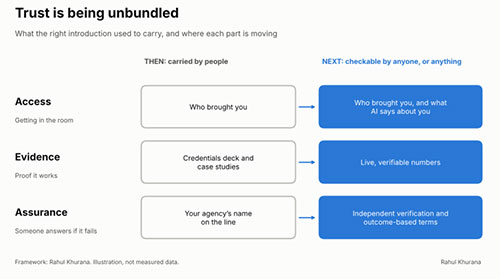
The right introduction always carried three things at once. Access: someone got you into the room. Evidence: someone had seen your work. Assurance: someone would answer for you if it failed. For decades, one trusted person delivered all three. That’s why relationships were everything.
Those three are now coming apart. Access still runs through people, but increasingly also through what AI says about you. Evidence is moving from credentials decks to live, verifiable numbers: server-side tracking, incrementality tests, clean-room matches. Assurance is moving from an agency’s name on the line to independent verification and outcome-based terms.
Notice what doesn’t move: judgement. Machines can check numbers. They can’t yet decide which new idea is worth backing. That’s where human trust will concentrate.
This is the shift nobody in our industry is pricing in yet. The partners who win the next decade won’t just be well connected. They’ll be verifiable.
What this means for agencies of record
Here’s the uncomfortable part. If your agency’s value is lunch with the CMO, a machine is coming for your seat. The best-connected person in the room is about to become the least useful one, unless they can prove what they’re vouching for. I say this as someone whose own career has run on relationships. But the AORs that move first could become more powerful, not less. Brands will need someone to verify the creators, audit the retail media numbers, test the incrementality and check what AI says about every partner. The AOR of the future sells verification, not just vouching. That means vetting creators, auditing commerce media numbers, running incrementality tests and checking what AI says about every partner on the plan.
“The AOR of the future sells verification, not just vouching.”
What this means for marketers inside brands
Your career has always been built on the partners you sponsor. In the unbundled world, “someone I trust recommended them” won’t be enough cover when a campaign fails. “We verified them” will be. CMOs who still choose partners on who they know aren’t avoiding risk. They’re taking it. Build the verification habit before your CFO asks for it.
What this means for platforms and new-age agencies
Keep the human layer. Introductions still open doors, and will for a while. But start making your trust checkable:
- Check what AI says about you. Describe the brand problems you solve to the assistants CMOs use, the way a CMO would. If you don’t show up as the solution, or show up wrong, that’s your first fix.
- Publish numbers someone else can verify. Live dashboards, incrementality results, third-party tracking. Not screenshots.
- Get independently validated. Having been close to recognition and awards frameworks for years, I’ve seen smaller players become credible almost overnight once someone independent said yes.
- Make every case study checkable. Named metrics, dates, a client willing to confirm it.
- Offer assurance, not just promises. Outcome-based pricing and clear exit terms tell a CMO you’ll answer for the result.
The test in the age of AI: if you could have generated it yourself, it isn’t proof.
Seven predictions this industry won’t like
- Partner shortlists will start with an AI assistant, not a phone call. Within a few years, the first person to evaluate you won’t be a person.
- The credentials deck will die. Live dashboards and verified results will replace the 40-slide intro. Nobody will believe slides they know a machine could have made.
- The AOR that can’t verify will lose the brief to the one that can. Relationships will get you invited. Verification will get you renewed.
- “Who you know” will become an entry ticket, not a moat. Everyone will have the introduction. Only some will have the proof.
- Your best salesperson will be what an AI says about you. It works every hour, in every shortlist, and you never briefed it.
- The person who “knows everyone” will be the hardest hire to justify. Access without proof is about to become the most expensive line on a sales team.
- Case studies that can’t survive one reference call will quietly cost you the shortlist. Nobody will tell you why. You just won’t be called.
Disagree? Good. Tell me where I’m wrong. Or check back in three years.
The new trust tax
Every deal has two prices: what you charge, and what the buyer risks by choosing you. For decades, a trusted introduction brought the second price down. Now that price is set before the introduction, by what can be checked about you. Players who can’t be verified will keep paying the tax: longer pitches, unpaid pilots, cut rate cards. Players who can will be shortlisted, by people today and by machines tomorrow.
That’s also the good news for smaller players. For the first time, a young platform can be as verifiable as a big one. Verified trust doesn’t care about the size of your office. The winners won’t choose between relationships and proof. They’ll bring both: the introduction and the evidence behind it. Your product gets you considered. Verified trust gets you chosen.
RULE #1
Old rule: Who you know decides who you win.
New rule: Trust must be checkable, by marketers today and by machines tomorrow.
THE MONDAY QUESTION
If a CMO described a brand problem to an AI assistant tonight, one your platform solves, would you show up as the solution? And would what it says about you be true?
Next week, Rule #2: “The Media Plan Is Dead. The Commerce Plan Has Replaced It.”
ABOUT THE AUTHOR
Rahul Khurana is the founder of ScaleMind Media, which designs trust-led go-to-market strategies for platforms and agencies selling to India’s largest brands, and of Few Found, where businesses find service providers whose work has been verified. He spent over a decade at Ogilvy, Geometry Global and WPP, where he was part of the team that won Coca-Cola’s global account, and built KIT Global’s India business from zero to US$4 million in two years.
Read more news about Marketing News, Advertising News, PR and Corporate Communication News, Digital News, People Movement News
For more updates, be socially connected with us onInstagram, LinkedIn, Twitter, Facebook, YouTube & Google News