#e4mXplains: Meta closes the advertising gap with Google as Q3 revenues converge
Meta's ad revenue has reached 77% of Google's, with the two now generating almost identical quarterly revenues. But convergence raises questions about where digital advertising growth is coming from
 by
Published: Nov 3, 2026 9:25 AM | 5 min read
 Follow Us


- In Q3 2026, Meta's advertising revenue reached $63.06 billion, a 26% increase from the previous year, while Google's advertising revenue was $82.01 billion, up 10.6%, narrowing the gap between the two companies.
- Meta's advertising revenue now represents approximately 76.9% of Google's, up from 67.5% a year earlier, with Meta generating nearly equal revenue to Google's Search and other advertising segments.
- Meta's growth is driven by a 10% increase in ad impressions and a 14% rise in average ad prices, whereas Google's growth is more uneven across its advertising properties.
- Both companies face significant capital investment requirements, with Meta heavily reliant on advertising for 97.6% of its revenue, while Google is diversifying with a rapidly growing Cloud division.
For much of the digital advertising industry's history, Google and Meta have occupied distinct positions in the marketing ecosystem.
Google captured demand. Meta generated attention.
Search advertising allowed brands to reach consumers already looking for products, services or information. Facebook and Instagram, meanwhile, built advertising businesses around feeds, social connections, interests and increasingly sophisticated recommendation systems.
Both became extraordinarily profitable. But Google remained comfortably ahead in advertising revenue.
That lead is narrowing.
In the third quarter of 2026, Meta generated $63.06 billion in advertising revenue, an increase of 26% from $50.08 billion a year earlier.
Alphabet's Google advertising business, comprising Search and other, YouTube advertising and Google Network, generated $82.01 billion, up 10.6% from $74.18 billion.
Google remains the larger advertising company by nearly $19 billion in quarterly revenue. But Meta is growing substantially faster.
A year earlier, Meta's advertising revenue was equivalent to approximately 67.5% of Google's. Today, that figure stands at 76.9%.
The difference becomes even more striking when comparing Meta's advertising business with Google Search and other advertising alone.
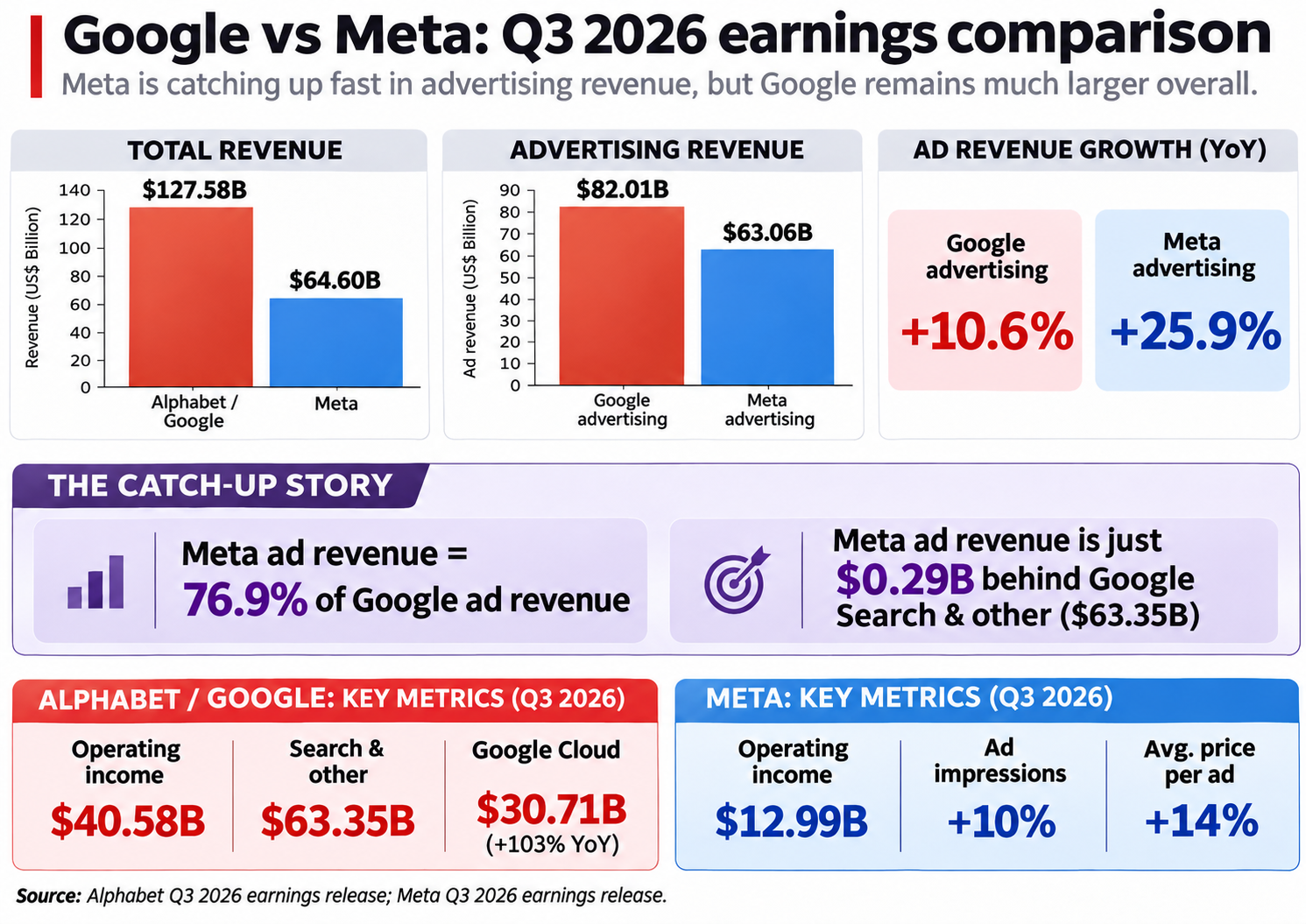
Google Search and others generated $63.35 billion during the quarter.
Meta generated $63.06 billion.
The difference was just $289 million, or less than half a percent.
These are not identical advertising businesses, and the comparison should not be mistaken for evidence that Meta has overtaken Google Search in market share. But the convergence illustrates how dramatically the relative scale of the two businesses has changed.
The direction of growth is equally revealing.
Meta added $12.98 billion in year-on-year advertising revenue during Q3. Google added $7.83 billion across its advertising properties.
In other words, Meta generated approximately 66% more incremental advertising revenue than Google during the quarter.
The trend predates the latest earnings season. A comparison of quarterly company disclosures compiled by Minotaur Capital shows Meta's advertising revenue was approximately 52% of Google's in the first quarter of 2023, compared with nearly 77% today.
Meta has also recorded faster year-on-year advertising revenue growth than Google in every quarter over that period.
The most recent quarter, however, reveals differences in how the two platforms are expanding.
Meta reported a 10% increase in advertising impressions across its Family of Apps and a 14% increase in average price per advertisement.
Together, those movements helped produce 26% advertising revenue growth, supported by greater monetisation of its existing platforms and advertisers' willingness to pay higher average prices.
For Google, the picture was more uneven.
Search and other advertising grew 12% to $63.35 billion. YouTube advertising increased approximately 9% to $11.21 billion, while Google Network revenue grew about 1% to $7.46 billion.
Google's overall advertising revenue consequently grew more slowly than Meta's, even as Alphabet's consolidated revenue rose 25% to $127.58 billion.
The distinction matters because Alphabet is no longer growing primarily through advertising.
Google Cloud revenue more than doubled to $30.71 billion in Q3, generating substantially more incremental revenue than Search.
Meta, by contrast, remains overwhelmingly dependent on advertising. Of its $64.60 billion in total quarterly revenue, approximately 97.6% came from advertising.
That dependence makes Meta's growth impressive, but also exposes the company to fluctuations in advertiser spending.
It also complicates any argument that the advertising industry is broadly losing its appetite for the largest digital platforms. Meta's results suggest that substantial advertiser demand remains, even as growth rates diverge between companies and advertising environments.
What the figures cannot establish is whether advertisers are actively shifting budgets from Google to Meta.
Revenue growth is influenced by pricing, impressions, user engagement, advertising formats, currency movements and other factors. Faster growth on one platform does not necessarily imply spending has been withdrawn from another.
Nevertheless, the figures raise a question about how commercial intent is distributed across the digital ecosystem.
Traditional Search has historically been particularly valuable because it allows advertisers to respond to explicit consumer demand. Social and recommendation-led environments can introduce products earlier in the purchase journey, influencing consumer preferences before a search takes place.
Instagram, Facebook, Reels and other recommendation surfaces are increasingly commercial discovery environments, while Google is itself expanding shopping and commerce capabilities across YouTube and AI-powered Search.
The distinction between capturing demand and creating it is becoming less clear.
Artificial intelligence adds another complication.
Google has acknowledged that its conversational AI Mode currently monetises less effectively than traditional Search, even as Search query growth accelerates. Search and other advertising revenue grew 12% in Q3, down from approximately 17% in the preceding quarter, with management citing currency effects and advertiser spending patterns among the reasons for the slowdown.
Meta, meanwhile, is investing heavily in AI-powered recommendations, advertising systems and infrastructure intended to improve engagement and advertising performance.
Both companies face substantial investment requirements.
Meta reported $34.91 billion in quarterly capital expenditure, while Alphabet's reached $51.36 billion. Both recorded negative quarterly free cash flow as infrastructure investment accelerated.
The question is therefore not simply which company can generate more advertising revenue. It is also how effectively that revenue can support the increasingly capital-intensive systems required to sustain growth.
For advertisers and agencies, the narrowing gap has several implications.
Google's continuing strength in Search does not guarantee that it will capture a proportionate share of every additional dollar spent on digital advertising. Equally, Meta's faster growth does not mean social advertising will replace search-led performance marketing.
The platforms address different stages of consumer behaviour, and many advertisers will continue investing in both.
But Meta's gains suggest that the balance of advertising growth is becoming harder to explain through conventional platform dominance alone.
Google still commands the larger advertising business. Alphabet also has a rapidly expanding Cloud division, making its overall financial position substantially different from Meta's.
Yet the company that once enjoyed an enormous lead in digital advertising revenue is facing a rival whose advertising business has grown considerably faster for several years.
The next question is not necessarily whether Meta will overtake Google, or when.
It is whether the structure of digital advertising is changing in ways that allow recommendation-driven platforms to capture a growing share of future revenue, even while Search remains profitable and widely used.
Google still leads.
But the distance between the two advertising businesses is no longer what it was.
Read more news about Digital Media, Internet Advertising, Marketing News, Television Media, Radio Media
For more updates, be socially connected with us onInstagram, LinkedIn, Twitter, Facebook, YouTube & Google News