D2C brands should rethink ad allocation across channels: Pratham Hegde, Truelift
At e4m D2C Summit, Pratham Hegde, Founder, Truelift, spoke in a session titled ‘Think Incremental! Optimizing Ad Spend for Demand Creation Vs Demand Capture’
 by
by
Published: Sep 11, 2026 9:08 AM | 5 min read
 Follow Us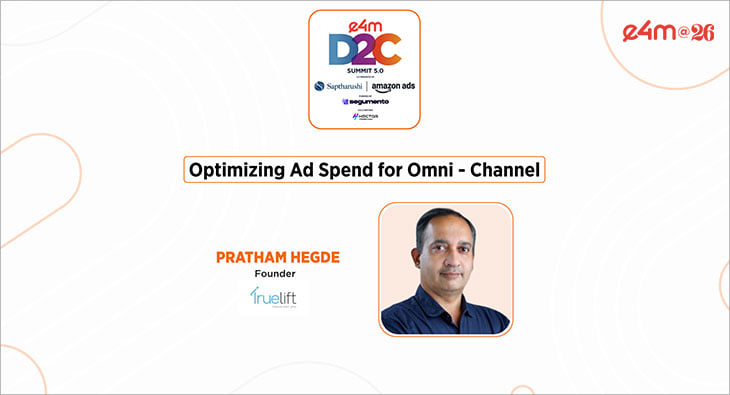

- At the e4m D2C Summit, Pratham Hegde, Founder of Truelift, emphasized the need for incrementality measurement to assess the impact of advertising on sales in a fragmented sales ecosystem, particularly as brands expand across various platforms.
- Hegde highlighted the challenges marketers face in tracking conversion signals as sales shift from brand websites to e-commerce platforms, complicating the evaluation of individual advertising channels' contributions.
- Truelift employs incrementality models that combine granular data from multiple sources, including websites and marketplaces, alongside experimental approaches to isolate advertising impacts, leading to actionable insights for brands like Sweet Karam Coffee.
- As D2C companies scale, there is a growing need to understand the short-term effects of brand advertising on traffic and sales, prompting a shift towards more sophisticated measurement methods beyond traditional attribution.
As D2C brands expand across websites, marketplaces, quick commerce and offline stores, understanding the actual impact of advertising on sales is becoming a tougher measurement challenge.
Speaking at the e4m D2C Summit, Pratham Hegde, Founder, Truelift, addressed the challenge in a session titled “Think Incremental! Optimizing Ad Spend for Demand Creation Vs Demand Capture”, making the case for incrementality measurement as brands look to understand the impact of advertising across an increasingly fragmented sales ecosystem. The summit was held on September 10 in Gurugram.
Hegde pointed to a fundamental problem facing marketers: while brands can get conversion signals from their own websites, those signals become harder to track as sales move to e-commerce platforms and marketplaces. This makes it difficult to determine the incremental contribution of individual advertising channels, particularly when brand advertising and marketplace advertising are running simultaneously.
At the centre of Truelift’s approach are incrementality models. Hegde explained that the methodology applies the same basic concept as market-mix modelling but with more granular data, combining information from websites, Amazon and marketplaces with ad-level data. This is supplemented with experiments designed to isolate advertising impact, including switching ads on and off, doubling down on a city or isolating a particular city.
The inputs, he said, are a brand’s own sales and advertising data rather than platform-reported metrics. The resulting measurement is aimed at answering questions such as how much incremental sales on Amazon Meta advertising generated, or what incremental sales brand advertising generated on a marketplace.
One of the examples Hegde highlighted was Sweet Karam Coffee. The brand had undergone a major shift in its sales mix, moving from 80% of its business coming from its website and 20% from quick commerce to 80% quick commerce and 20% B2C, according to Hegde.
As the brand looked to scale, it wanted to determine where its advertising money should be deployed. Truelift designed a six-week plan in which advertising across Meta and quick commerce was stopped to assess the contribution of the different channels. The analysis found that Meta was driving around 60-70% of new users and that its efficiency was understated by 50% when assessed without the quick-commerce sales it was influencing.
The findings led Sweet Karam Coffee to change its advertising strategy, moving half of its quick-commerce ads to Meta. Hegde said the brand subsequently saw a 20% increase in sales in the following months. Truelift’s current case-study material independently describes the broader outcome, saying the brand reallocated nearly 50% of its marketing budget to higher-performing channels and saw a 20% uplift in overall sales.
The example illustrates the measurement challenge that emerges as sales and advertising investments become fragmented across channels. A channel’s performance cannot necessarily be assessed in isolation when advertising on one platform can influence a purchase on another.
Hegde also discussed an analysis conducted with Meta to understand how Meta advertising influences marketplace sales. He said that looking only at the direct impact of social advertising meant missing 50% of the outcome Meta was providing. He clarified that the figure was an average and could vary by client.
The same approach is being applied to offline sales. Hegde said Truelift had worked with large fashion brands to identify how different types of digital advertising were influencing offline walk-ins and sales. The analysis helped brands understand which campaign types were contributing more to store visits as they expanded their physical presence. Truelift’s current case-study material similarly describes measuring media’s impact on store footfall and sales for an omnichannel fashion business.
The question marketers are asking about brand advertising is also changing as D2C companies scale, according to Hegde. He said that while he used to be asked whether brand advertising could build long-term brand value, the question he increasingly encounters is whether brand advertising can generate a short-term lift in traffic.
The objective, he explained, is to use brand advertising to reach beyond the smaller audience targeted by performance advertising and help performance campaigns work better. As D2C companies scale, he said, brands are considering channels including YouTube, CTV and television alongside digital advertising.
For CTV, Truelift uses a distributed media plan to isolate its contribution across the funnel. Hegde said the company is able to track the impact from sessions through to orders and determine what CTV contributes.
Hegde also argued that attribution alone is becoming insufficient as businesses become more omnichannel. While attribution is convenient and easy to understand, he said marketers need more sophisticated methods to understand what their advertising is actually doing across channels.
“Incrementality measurement is here to stay, whether we like it or not,” Hegde said.
For companies with substantial analytics capabilities, Hegde said, building such a measurement capability internally could take six months to a year. Truelift offers a plug-and-play alternative combining its backend, frontend and advisory capabilities.
For D2C marketers, the implication is a shift in focus from measuring advertising only through the conversions reported by individual platforms to understanding the incremental sales generated across channels. As sales and advertising become increasingly distributed across the omnichannel ecosystem, that measurement can inform how brands allocate their advertising spend.
Read more news about Marketing News, Advertising News, PR and Corporate Communication News, Digital News, People Movement News
For more updates, be socially connected with us onInstagram, LinkedIn, Twitter, Facebook, YouTube & Google News