Broadcast rules get tougher: MIB adds graded penalties, eases some obligations
Revised Telecom Rules 2026 mark a shift from broad consolidation to a more structured compliance regime, while changes to radio programming and renewal provisions offer some relief to operators
 by
by
Published: Sep 3, 2026 8:39 AM | 10 min read
 Follow Us

- The Ministry of Information and Broadcasting has revised its proposed regulatory framework for television and radio, now comprising 76 pages, which includes a detailed compliance and penalty structure based on stakeholder feedback from the initial draft released in June.
- Key changes in the revised rules include a formal hierarchy for civil penalties categorized by severity of breaches, clarified renewal conditions for broadcasting licenses, and enhanced obligations for IPTV providers regarding content and compliance.
- The updated framework also mandates compliance with the Rights of Persons with Disabilities Act and introduces additional disclosure requirements for foreign personnel involved in broadcasting operations.
- While some provisions have been eased, such as the public-interest programming requirements for private radio, the overall approach indicates a move towards a more structured and formalized regulatory environment for broadcasters in India.
The Ministry of Information and Broadcasting has substantially reworked its proposed regulatory framework for television and radio, introducing a more detailed compliance and penalty architecture while simultaneously easing or clarifying several provisions that had raised concerns in the first draft released in June.
The revised Telecommunications (Television, Radio and Associated Services) Rules, 2026, published on September 2, are now 76 pages long, compared with 43 pages in the June 12 consultation draft.
The government said it examined and incorporated stakeholder representations received during the first consultation "wherever considered appropriate". It has opened the revised draft for another round of public consultation, with comments invited until October 2.
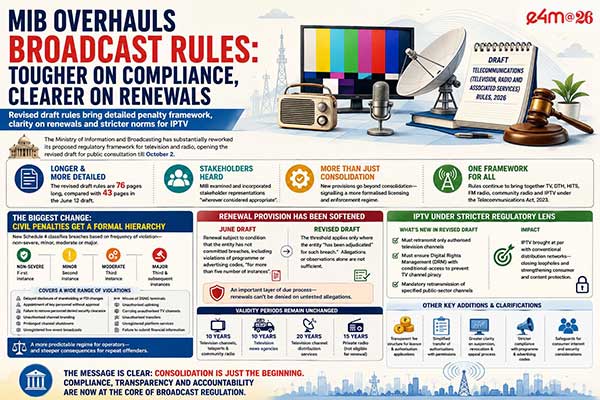
At first glance, the revised version looks longer and more comprehensive than the June draft. But the additional pages are significant: they include a new schedule classifying civil penalties, new compliance obligations and several clarifications that could change how broadcasters, distribution platforms, radio operators and IPTV providers interact with the government.
The June draft proposed a consolidated rulebook bringing together the existing frameworks governing satellite television, DTH, HITS, FM radio, community radio and IPTV under the Telecommunications Act, 2023.The September version retains that basic architecture.
But the revisions suggest the government is moving beyond consolidation toward a more formalised licensing and enforcement regime.
Also Read: MIB proposes overhaul of broadcasting regulatory framework
BARC ratings race against time: Industry awaits MIB nod as festive clock ticks
BARC faces up to ₹150 crore hit over six months as ratings blackout drags on
The biggest change: civil penalties get a formal hierarchy
The most consequential addition is Schedule 4, which did not form part of the June draft.
The revised rules expressly state that breaches of authorisation conditions will be subject to a civil-penalty categorisation under Schedule 4. The schedule classifies violations as non-severe, minor, moderate or major, depending on whether the breach occurs for the first, second or third-and-subsequent time.
The list covers a wide range of operational failures, including delayed disclosure of shareholding or FDI changes, appointment of key managerial personnel without approval, failure to remove personnel denied security clearance, unauthorised channel branding, prolonged channel shutdowns, unregistered live-event broadcasts, misuse of DSNG terminals, unauthorised uplinking, carrying unauthorised television channels, unauthorised transfers, unregistered platform services and failure to submit financial information.
The June draft already contained adjudication and appeals provisions, but it did not attach a dedicated schedule mapping specific breaches to escalating penalty categories. The September version therefore makes the compliance regime considerably more predictable on one hand—and potentially more consequential for repeat offenders on the other.
For broadcasters, the practical significance is that relatively mundane licensing and operational lapses can now sit within an expressly graded enforcement framework rather than being treated only as generic breaches.
Renewal provision has been softened
The June draft said renewal would be subject to the condition that an authorised entity had not committed breaches of the authorisation terms, including violations of the programme or advertising codes, "for more than five number of instances."
The revised text adds a crucial qualification: the more-than-five breach threshold applies where the entity "has been adjudicated for such breach."
An allegation, complaint or regulatory observation by itself is no longer worded as sufficient to trigger the five-breach threshold. The breach must have gone through adjudication.
For broadcasters, this provides an important layer of due process and could prevent renewal decisions from being based simply on untested allegations.
The basic validity periods, however, remain unchanged: 10 years for television channels, teleports and community radio; 10 years for television news agencies; 20 years for television channel distribution services; and 15 years for private radio. Private radio continues to be ineligible for renewal under the framework.
IPTV moves deeper into the broadcasting regulatory framework
The revised draft also strengthens the treatment of IPTV.
The June version treated IPTV as a distinct service and required preservation of programme recordings, notification of suspension or cancellation of the underlying internet authorisation or MSO registration, and compliance with government directions, including programme and advertising codes.
The September version adds two significant obligations: IPTV providers must retransmit only authorised television channels and must ensure that the service contains a digital rights management system with conditional-access functionality to prevent television-channel piracy. It also provides for mandatory retransmission of specified public-sector channels.
This is important because the government is effectively bringing IPTV closer to the regulatory discipline applied to conventional distribution networks.
The revised framework also explicitly includes IPTV within the definition of television channel distribution services.
That makes the distinction between traditional distribution infrastructure and internet-based television distribution less pronounced from a regulatory perspective.
Government adds disability compliance
The revised general obligations clause now expressly requires authorised entities to comply with applicable laws, including the Rights of Persons with Disabilities Act, 2016 and rules made under it.
The June draft required compliance with the programme code, advertising code and government directions but did not contain this specific reference.
The change may have implications for accessibility obligations across television and associated services, although the revised rules themselves do not spell out a detailed technical accessibility standard.
Foreign personnel face an additional disclosure requirement
Both drafts require security clearance for foreign personnel deployed for installation, maintenance or operation of broadcasting networks. The September version, however, additionally requires authorised entities to disclose the name, address and details of any foreigner or non-resident Indian engaged as a consultant or under another designation for more than 60 days a year, or as a regular employee.
This takes the government's oversight beyond conventional key managerial personnel.
It creates a broader compliance obligation for broadcasters and distribution companies that rely on foreign consultants, technical specialists or expatriate personnel.
Private radio gets both clarity and a relaxation
Private radio is another area where the September text differs materially from June.
The June draft required private radio operators to devote at least one hour a day to programmes focused on themes of national importance and social relevance. The revised draft instead requires broadcasters to carry public-interest announcements as may be required by the Central Government or concerned state government, for a maximum of one hour a day, interspersed during the day.
The earlier formulation potentially gave the government a broader programming mandate over editorial output. The new formulation is narrower and more operationally defined: public-interest announcements, rather than a prescribed hour of thematic programming.
The revised provision also changes the description of prohibited news content from "news and current affairs" to transmission of messages relating to "news", except for unaltered Akashwani news.
At the same time, the existing 20% local-content requirement and restrictions on ownership concentration remain.
Devotional channel route disappears
The June draft specifically permitted an authorised entity to apply to change the category of a television channel from non-news to devotional channel.
That provision does not appear in the corresponding September clause, which covers changes between news and non-news, changes between satellite and terrestrial transmission, and change of teleport.
The change is subtle but noteworthy because the June framework had separately contemplated devotional channels in its fee schedule.
The September schedule nevertheless continues to recognise a "devotional channel" for fee purposes and provides no fee for live broadcasts by such channels where the content is devotional, spiritual or yoga-related.
This creates an interesting drafting disconnect: devotional channels remain recognised in the fee architecture, but the explicit non-news-to-devotional migration route has disappeared from the change-of-category provision.
Satellite regulation gets a small but important expansion
The June draft referred to satellite capacity authorised by the Department of Space or designated agencies.
The revised version specifically includes Indian National Space Promotion and Authorisation Centre (IN-SPACe) alongside the Department of Space or another designated government agency.
For the satellite television ecosystem, this brings the broadcasting rules more explicitly in line with India's evolving space-sector institutional structure.
Landing-page provision remains intact
Despite the regulatory debate surrounding television ratings and landing-page measurement, the revised rules retain the requirement for broadcasters to disclose the availability of their channels on landing pages to the government and registered television rating agencies.
The definition of a landing page also remains: the default channel display when customer premises equipment is switched on, including during navigation or switching, where the display occurs without specific user selection.
Therefore, the revised draft does not retreat from the government's attempt to formally capture landing-page exposure within the broadcasting framework.
Most financial provisions remain unchanged
Despite the additional 33 pages, the core fee architecture has not been substantially rewritten.
The television channel application fee remains ₹10,000, performance bank guarantees remain ₹2 crore for a news channel and ₹1 crore for a non-news channel, and the annual fees remain ₹7 lakh for terrestrial transmission, ₹2 lakh for uplinking and ₹5 lakh for downlinking of an India-uplinked channel, rising to ₹15 lakh for a channel uplinked from outside India.
DTH continues to carry a ₹10 crore entry fee, with an annual authorisation fee of 8% of adjusted gross revenue or 10% of the entry fee, whichever is higher.
Private radio continues with a ₹50,000 application processing fee, auction-determined entry fee and annual authorisation fee of 4% of adjusted gross revenue, with a reduced 2% rate for specified northeastern and island territories for the first three years.
The revised schedule does, however, explicitly provide a ₹10,000-per-channel processing fee for international television turnaround services at a teleport—an item that was not separately reflected in the June schedule.
The government retains strong enforcement powers
The revised rules continue to give the Central Government extensive powers over suspension, curtailment and revocation.
Orders following recommendations under Section 32 can result in suspension, revocation or curtailment, subject to an opportunity of hearing. Such orders become effective from the 61st day after the order and must be made public. The government can also reverse the action if the underlying substantial violation is remedied to its satisfaction.
Separately, authorisations can be revoked where representations or documents submitted during the application process are found to be false, or where an entity is ordered to be liquidated or wound up. A show-cause process is prescribed for the false-representation ground.
The framework therefore combines a more structured adjudicatory process with substantial executive oversight.
The September document is best understood not as a radically different broadcasting policy, but as a second-generation version of the June proposal.
The June draft established the architecture: authorisations, eligibility, fees, ownership restrictions, security clearances, operational requirements, transfer rules and government enforcement.
The September version fills many of the gaps.
It formalises civil-penalty categorisation, strengthens IPTV obligations, adds foreign personnel disclosures, expressly brings disability law into general compliance, clarifies the treatment of adjudicated breaches for renewal and updates satellite regulation.
At the same time, it eases some provisions. The renewal clause now links the five-breach threshold to adjudicated violations; the private-radio public-interest obligation is narrower; and the revised framework does not retain the explicit route for changing a non-news channel into a devotional channel.
The larger message for the broadcasting industry is clear: the government is willing to simplify the rulebook, but simplification does not mean lighter regulation.
If anything, the revised draft moves India closer to a formal authorisation-based broadcasting regime in which compliance, security, financial reporting, programming obligations and operational conduct are all tied directly to the continuation of an authorisation.
The government has invited another round of stakeholder comments until October 2, leaving room for further changes before the rules are notified and brought into force.
Read more news about Television Media, Digital Media, Advertising India, Marketing News, PR and Corporate Communication News
For more updates, be socially connected with us onInstagram, LinkedIn, Twitter, Facebook YouTube & Google News