TV to remain central to Indian homes; hybrid OTT model a catalyst: Dish TV’s Manoj Dobhal
In an exclusive conversation with e4m, Dish TV CEO Manoj Dobhal said the DTH industry must first stabilise amid subscriber losses and OTT competition before it can return to growth
 by
by
Published: Mar 24, 2026 9:41 AM | 5 min read
 Follow Us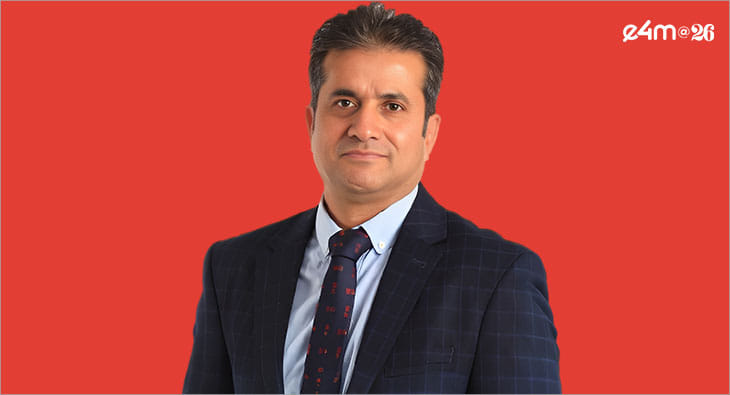

“TV is not going anywhere. It is just that if TV can be given a little bit of a catalyst or even a level playing field, it is going to flourish,” said Manoj Dobhal in an exclusive conversation with exchange4media, pushing back against the narrative of structural decline in the DTH sector.
Emphasising that television will remain central to Indian homes, Dobhal called for regulatory parity, and flagged fragmentation in the content ecosystem as a key barrier to monetisation.
His comments come at a time when the pay-TV industry in India is under sustained pressure. Subscriber erosion has accelerated due to a combination of factors: rising channel prices, the rapid expansion of OTT platforms, and the growing reach of free-to-air (FTA) services on DD Free Dish.
As per the latest performance indicator report by the Telecom Regulatory Authority of India, the DTH industry’s active subscriber base fell to 50.99 million in the third quarter of FY26 (ending December 31, 2025), down from 52.78 million in the previous quarter.
On a year-on-year basis, the decline is even sharper — from 58.22 million in the corresponding period of 2024, indicating a drop of nearly 8 million subscribers. These figures exclude users of DD Free Dish, Prasar Bharati’s free DTH platform.
Stabilising the base before chasing growth
Against this backdrop, Dobhal made it clear that the immediate priority is not aggressive expansion, but survival. “We are working towards first sustaining and then growing the business,” he said, adding that the company is actively exploring new strategic interventions.
Without divulging specifics, he admitted that the status quo is untenable: “Definitely there is something different which needs to be done. The way we are operating, this is not going to help.”
He hinted that current initiatives such as TV-OTT integrations are only an early step. “That’s the beginning of the solution. There are many things which will get added to that,” he noted, indicating a broader transformation strategy in the works.
Hybrid TV-OTT model will define the future
As viewing habits continue to shift, Dobhal positioned hybridization—rather than disruption — as the defining trend. “Maybe the content pipeline would change, but TV would remain there,” he said, reinforcing the idea that distribution formats may evolve, but the television screen will remain relevant.
He argued that the real challenge lies in ensuring a level playing field between traditional distribution platforms and digital services. “Even a level playing field - by the regulator, by the broadcasters, I think it is going to flourish,” he said, alluding to concerns around differential pricing, regulation and competitive parity.
Regulatory burden continues to weigh on the sector
Dobhal also touched upon long-standing regulatory concerns, particularly around licensing costs and the adjusted gross revenue (AGR) framework. The issue has been a point of contention across the broader telecom and broadcasting ecosystem.
“The government is not doing anything about it. It has been written repeatedly,” he said, while acknowledging that some discussions are underway following recommendations from the Telecom Regulatory Authority of India (TRAI).
He added that while AGR is more telecom-centric, licensing remains a critical issue for DTH players. “There are AGR burdens… there is a licensing issue on DTH as well,” he said, underlining the need for policy support to ease financial stress.
In August 2023, TRAI issued its "Recommendations on License Fee and Policy Matters of DTH Services," advising that the annual license fee for DTH operators be reduced from 8% to 3% of AGR, and ultimately phased out by FY 2027.
DTH platforms in India, including major players like Tata Play and Dish TV, had voiced their concerns to TRAI about the severe financial strain they face due to the high licence fee imposed on them.
Fragmentation limiting India’s content potential
Beyond distribution economics, Dobhal flagged a structural issue in India’s content ecosystem — fragmentation. Despite being one of the world’s largest producers and consumers of content, he believes the industry is not fully capitalising on its scale.
“There is so much scale and might in the Indian content and entertainment industry… but the whole ecosystem is working in silos,” he said. “Fragmentation is not allowing real growth to take place. And it is being under leveraged for monetization.”
He described the current phase as a “content tsunami,” but one that lacks cohesion. “All of them are moving at a great pace but not necessarily in the same direction,” he added.
Collaboration over expansion into production
While some distribution platforms globally have ventured into content creation, Dobhal ruled out such a move for Dish TV. Instead, he called for stronger collaboration across stakeholders.
“There is a need to collaborate a lot. Maybe co-production frameworks need to be identified. There is a lot to learn from each other,” he said.
He emphasised that the ecosystem already has sufficient players across the value chain, but lacks a common platform for interaction. “What is missing is that they don’t have a platform to interact,” he noted.
Read more news about Television Media, Digital Media, Advertising India, Marketing News, PR and Corporate Communication News
For more updates, be socially connected with us onInstagram, LinkedIn, Twitter, Facebook YouTube & Google News