Broadcasters court the creator economy to boost reach and revenue
With ad spend increasingly tied to engagement rather than traditional reach, broadcasters are recognising creators as key players in the attention economy
 by
by
Published: Mar 3, 2026 9:22 AM | 8 min read
 Follow Us

India’s broadcast news industry is witnessing a decisive realignment, as legacy networks, confronted by the surging clout of digital creators, move swiftly to embed influencer-led programming into their distribution and advertising strategies.
As advertising budgets follow engagement metrics rather than legacy reach indicators, broadcasters are recognising that creators are no longer peripheral participants but central actors in the attention economy.
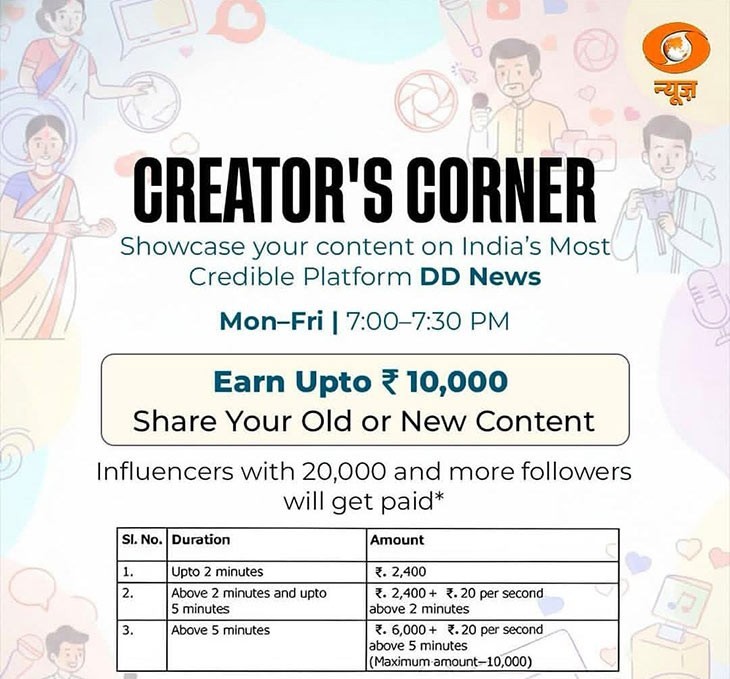
Public broadcaster DD News has already tested this shift through the launch of “Creator’s Corner”, inviting digital creators with over 20,000 followers to showcase their content on national television for compensation of up to ₹10,000 per submission.
Under the initiative, payouts begin at ₹2,400 for videos up to two minutes in duration. For content exceeding two minutes and up to five minutes, creators receive ₹2,400 plus ₹20 per second beyond the initial two minutes. For videos longer than five minutes, the payment is ₹6,000 plus ₹20 per second beyond five minutes, capped at ₹10,000.
Gaurav Dwivedi, CEO of Prasar Bharati, said the idea is to open up DD News as a platform rather than commission fresh content at this stage. “We plan to put out content across various social media platforms inviting creators to share their existing videos with us. The idea is to curate some of this material and offer it a national platform on DD News. Today, a large number of people are already engaged in video creation, and in the initial phase, our aim is simply to give them wider reach while also bringing in fresh and interesting programming for our viewers,” he said.
Independent journalist Sanket Upadhyay, revealed that the entry of creators on Doordarshan should be viewed in historical context. “At a time when there was no other platform, there was only Doordarshan, and everyone who acted in iconic serials back then were content creators of their time. The content creators of today are on the internet. So, giving them space on the national broadcaster should not, by default, be a concern,” he said.
Upadhyay, however, underlined the need for clear guardrails. “One, will this become a platform for political propaganda? Two, will low-quality or low-brow content find space? And three, if you are truly opening the doors to creators, will you also platform those who may not always say complimentary things about the government? We have seen anti-establishment work find space on Doordarshan in the past, films like Jaane Bhi Do Yaaro. So yes, creators should be there, but with the right checks in place. Let us not throw the baby out with the bathwater,” he said.
Meanwhile, last year Republic Media Network launched its ‘Positive Influencer Program’, positioning itself as an accelerator for 40 to 50 young creators across governance, culture, economics, space and technology.
Announcing the programme, Arnab Goswami said, “We have the resources to support positive influencers in this country. As one of India’s top three news networks across TV and digital, reaching 480 million people, Republic now takes the responsibility to empower the next generation of digital voices.”
“I see so many young people producing fantastic content on history, culture, and civilizational values. Digital is a great space, and we want to ensure that the right influencers get the right platform to amplify their voices,” Arnab emphasised.
“This is about co-creating and co-learning. We want digital storytelling to be inspiring, responsible, and never compromising on national interest. Content should be cool, but also meaningful,” he said.
“Some influencers have the money but misuse their opportunity. Republic wants to support those who uphold real values and use their influence for good,” he added.
The development is not merely editorial experimentation but a calculated economic response to shifting audience loyalties and the steady migration of advertising capital towards creator-driven ecosystems.
According to projections by EY, India’s influencer marketing sector is expected to reach ₹3,375 crore by 2026, expanding at an annual growth rate of 18 percent. Globally, the market is projected to grow to $32.55 billion in 2025 and further to $38.9 billion by 2031, driven by rising digital advertising expenditure and the accelerating integration of social commerce into mainstream retail ecosystems.
Government Push on Monetisation
The broader regulatory climate is also evolving. Union Minister Ashwini Vaishnaw recently stressed that digital platforms must ensure fair revenue sharing with creators and news organisations.
“I request all platforms to rethink their negotiation policies. If voluntary action is not taken, many countries have already shown that legal pathways exist,” he said.
Vaishnaw stressed that intellectual property must be respected and fairly compensated, noting that progress in science, technology, arts, and literature depends on it.
His remarks resonate with creator concerns across platforms.
Neha Puri, LinkedIn Creator, said, “Content creation may look glamorous from the outside, but the backend process is intense. From structuring long-format pages to voice production and editing, it can get overwhelming. Creators need to invest serious thought into how their content is built and presented.”
YouTuber Mithilesh Patankar, popularly known as Mythpat, Gaming Video Creator, added, “For the longest time, YouTube has had one of the strongest revenue-sharing models for creators. Other platforms will eventually figure it out too, because when creators make money, platforms make money. It has to be a win-win ecosystem.”
Sunita Thapa Magar aka Sooneeta Gamer, a Gaming Creator, said, “Different platforms offer different monetisation streams, from direct views to brand integrations. But creators need clarity and transparency in how those streams work. Without the right structure, it becomes difficult to sustain growth.”
Ujwal Chaurasia, Gaming and Tech Creator (Techno Gamerz), said, “YouTube still provides strong reach and long-term discoverability. But beyond reach, what truly matters is alignment, creators should choose platforms that match their content style and audience expectations.”
Arsh Goyal, AI and Tech Creator, said, “I’ve been creating content in AI and tech for four to five years, and today it’s a full-time profession for many of us. Content creation involves research, scripting, production, and editing. It deserves fair compensation, timely payments, and recognition as a serious career.”
Saumya, Creator, said, “Payment delays are a major issue, especially for small creators. While registered creators under MSME or GST frameworks face fewer hurdles, many smaller creators struggle for months to clear dues. Equal treatment and stronger regulations are needed to protect everyone in the ecosystem.”
Social Media as the New Battleground
In the great churn of India’s digital news economy, legacy broadcasters have amassed formidable YouTube armies, numbers that would have once seemed improbable for television-led brands but now stand as proof of the platform’s centrality to news consumption.
As of March 2026, subscriber tallies reveal the scale of this migration. Aaj Tak leads the pack with over 74.6 million subscribers, followed closely by India TV and ABP News, both hovering around the 50 million mark. Zee News commands roughly 41 to 42 million subscribers, while News18 India stands in the 38 to 40 million range.
Further down the table, Republic Bharat has built a base of 30 to 31 million subscribers, and TV9 Bharatvarsh counts around 26 million. NDTV India registers approximately 23 to 24 million subscribers, while DD News, the public broadcaster’s news arm, has crossed the 7 million mark.
English-language brands, too, have carved out significant digital real estate. India Today maintains about 10 to 11 million subscribers, Times Now Navbharat falls in the 10 to 15 million range, and WION has built a global-facing base of nearly 10 million subscribers.
Yet the more striking reality lies in comparison. Several independent influencers in gaming, finance, comedy and technology command subscriber bases that rival, and in some cases surpass, mid-tier news networks. A single creator today can aggregate 20 to 30 million followers without the infrastructure of satellite uplinks, OB vans or legacy distribution deals.
While some networks are onboarding creators, others are building internal digital muscle. NDTV offers a case study in newsroom-led digital expansion.
According to data released by DataBeings, NDTV India recorded 2,455 million views on YouTube, while NDTV 24x7 garnered 119 million views during a high-intensity news cycle.
Rahul Kanwal, CEO and Editor-in-Chief, NDTV, said, “February was a month when the news cycle moved at extraordinary speed - from the Union Budget to global trade shifts, from election momentum across states to India’s T-20 World Cup campaign. The fact that audiences chose NDTV in such large numbers on YouTube reflects the growing trust in our digital-first journalism. It shows that viewers trust us to deliver news that matters, when it matters most.”
The message across the industry is unmistakable. Whether through curated creator slots, accelerator programmes, regulatory intervention or digital-first newsroom strategies, broadcasters are actively courting the creator economy. In an era where influence translates directly into advertising revenue and audience loyalty, collaboration with creators is no longer optional. It is increasingly becoming central to the future architecture of Indian news media.
Read more news about Television Media, Digital Media, Advertising India, Marketing News, PR and Corporate Communication News
For more updates, be socially connected with us onInstagram, LinkedIn, Twitter, Facebook YouTube & Google News