Reimagining the media mix in 2026 with scale, signals and service
At e4m India Brand Conclave 2026, marketing leaders agreed that while digital now operates as the core decision-making engine, successful omnichannel strategies hinge on retaining a unified brand idea
 by
by
Published: Feb 12, 2026 8:17 AM | 10 min read
 Follow Us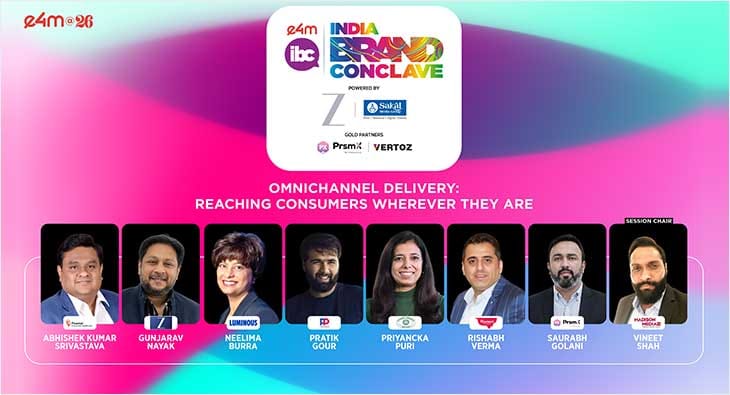

At the e4m India Brand Conclave 2026, industry leaders gathered to decode what omnichannel truly means in an ecosystem where digital is expanding rapidly, yet offline continues to dominate large parts of consumption.
Moderated by Vineet Shah, Vice President – Digital, Madison Media, the session titled “Omnichannel Delivery: Reaching Consumers Wherever They Are” brought together Abhishek Kumar Srivastava, Chief Marketing Officer, Piramal Consumer Healthcare; Gunjarav Nayak, Chief Sales Officer – Hindi Movies, Digital & IP Business, ZEEL; Neelima Burra, Chief Strategy Transformation and Marketing Officer & Business Head – Ecommerce and Organised Retail, Luminous Power Technologies; Priyancka Puri, Senior Vice President – Marketing, HRIPL; Rishabh Verma, Head of Marketing, Lotte Havmor Ice Cream; and Saurabh Golani, Country Head, PrsmX by Mobavenue.
Setting the context, Shah noted the structural shift underway in media consumption. “Last year, we saw that digital has almost become the largest medium in the ecosystem,” he said. He added that digital is now at the cusp of accounting for more than half of Indian AdEx, driven by shifts in both media consumption and purchase behaviour.
While acknowledging digital’s rise, Shah pointed out that television will continue to play a role, with connected TV redefining the large-screen phenomenon and other media formats remaining relevant. He emphasised that the real question now is how brands structure the right omnichannel mix.
Opening the discussion from an impulse category lens, Rishabh Verma framed the debate as one between “minimum viable omnichannel versus over-engineering”.
“I think every marketer goes through this trade-off, and it’s important to make choices aligned with the business,” he said. For ice creams, he explained, omnichannel is shaped by category dynamics and the consumer’s path to purchase.
70 per cent of category consumption happens in the top 30 towns, and 80 per cent occurs at the point of sale, largely offline and impulse-driven. At the same time, per capita ice cream consumption in India remains close to one litre per year, even lower than some neighbouring countries, leaving significant headroom for growth.
Given this, Verma said digital enables sharp targeting in key towns, while summer months see television “sit on digital” to leverage large consumption occasions. However, he stressed that retail readiness is critical. “The eventual conversion happens at the point of sale,” he noted, underlining the importance of cold-chain infrastructure and visible freezers.
“For us, over-engineering would be investing in campaigns and media without looking at our retail footprint, or doing pan-India media with massive spillover,” he said.
Priyancka Puri built on the consumer-first approach, outlining two clear pivots for omnichannel strategy.
“The first is how you make your brand mentally available,” she said, noting that the channel for building mental availability may differ across cohorts, from TV to YouTube. The second, she explained, is engagement, especially in a world where delivery has moved within minutes and proximity to the consumer has dramatically reduced.
Using brand examples, she explained how platform roles shift depending on target audience and category. “For any brand strategy, you need two pivots, mental availability at reach level and engagement level. That combination really works,” she said.
The conversation then moved to television’s role in an evolving landscape. Srivastava described the media mix question as “a very big question in the boardroom today”.
Representing categories spanning OTC, baby skincare and beauty, he outlined the continuing relevance of television. “TV gives you scale. TV also gives you trust at scale,” he said, particularly for OTC brands where chemists are destination channels and distribution is strong.
However, for baby and beauty categories concentrated in 30 to 50 key markets, the mix changes. Srivastava shared that his organisation has moved from being 90–95 per cent TV-led to roughly a 50–50 split between TV and digital.
“The shift is visible, and the transformation is not impacting business,” he said. “I’m spending possibly less money than before, but my sales scores are fairly high, my market share gains are happening, and I’m able to distribute my brand.”
Calling integrated media the core of future thinking, he added that TV remains relevant for some brands, while others require a sharper digital blend.
From a broadcaster’s perspective, Nayak addressed the recurring question around television’s staying power. “For us, omnichannel is not about being present everywhere. It’s about being present wherever the consumer is,” he said.
He described ZEEL’s ecosystem as “TV plus plus”, spanning linear television for mass scale, YouTube for scale, ZEE5 for deeper engagement, live events and a strong influencer network.
Nayak also emphasised the importance of regionalisation. With multiple language offerings within ZEE5, he explained that even local brands can cohort audiences in specific markets through language-led content. “We are present in every part of this ecosystem,” he said.
Neelima Burra shifted the lens to a technically complex category like solar and inverter batteries, where the journey stretches over one to one-and-a-half years.
“Omnichannel as a thought process started with the purpose of bringing a seamless brand experience,” she said. In her category, discovery and information search are heavily digital, while deeper understanding may occur offline, and conversion can happen on either channel.
Digital, she explained, becomes the core of discovery and consideration, supported by TV for awareness in cluttered categories and other media for sustained engagement. “The journey is long, and it needs engagement across mediums,” she noted.
Burra added that AI, agentic AI and chatbots are improving conversion journeys by helping consumers navigate complex information. “The learning models we have put together are helping consumers to buy,” she said, particularly in a market where excessive information can also cause confusion.
Returning to digital’s broader role, Puri argued that digital is no longer just a channel. “It’s an operating system on its own,” she said.
From discovery and influence to commerce, she described digital as spanning the entire funnel. More importantly, it offers a feedback loop unavailable in traditional media. “What digital gives us is the ability to shift gears within weeks,” she said, enabling faster strategy correction and sharper customer experience.
While the final purchase may occur in a physical store or via quick commerce, she noted that “the entire decision-making and influencing now happens on digital”.
On the precision versus breadth debate, Srivastava advocated starting wide. “Imagine some of the FMCG brands we know today were built by speaking to five per cent of India. I’m not very sure if that is possible,” he said.
He suggested brands should begin broad, then narrow based on traction and conversion signals. For categories with extensive offline presence across thousands of chemists, going wide remains essential before converging down the funnel.
Saurabh Golani reinforced this with a metaphor. “The signals don’t decide what traffic comes in,” he said. Brands should go broad, optimise smartly, and let signals determine who enters and exits at what price point.
“Your approach has to be broader, and then you decide down the funnel,” he explained, cautioning that lower customer acquisition cost does not automatically indicate new users, but could reflect remarketing.
He added that consumers are not in silos. “You cannot say this consumer is coming from branding or from performance. At the end of the day, I have to make sure I win over my consumers and they come back to me again,” he said.
The discussion moved to the role of creators in impulse categories. Verma cautioned against viewing content creators merely as media vehicles.
“Everybody wants to get into content creators because we don’t want to miss out,” he said, noting the rising cost of influencer collaborations. Treating them purely as media, he warned, would be inefficient.
“For me, a content creator is someone who brings relevance and meaning to the brand,” he said. When brands over-script messaging, engagement drops. But when creators are given freedom within guardrails, “you see your engagements and conversations going up, and it’s far more organic”.
“I think you need to see them as your creative partners rather than a media vehicle,” Verma concluded.
As the discussion progressed, the focus turned to messaging discipline in an omnichannel world. With platforms demanding different formats, tones and durations, how do brands decide what must remain constant across channels?
Srivastava was clear that the non-negotiable lies at the core. “The brand messaging, either it is the brand purpose or the campaign idea, has to straddle across channels, whatever medium you choose. That’s non-negotiable,” he said.
While the core remains intact, he emphasised that each medium must play a distinct role. Television, he explained, delivers scale, salience and trust. But platforms such as Instagram, particularly in beauty and skincare, allow brands to demonstrate regimen, usage occasions and application - elements not easily conveyed in a traditional TV format.
The era of producing one 30-second film and running it across all platforms is fading, he argued. “Gone are the days where you made one 30-second and ran the same content on TV, digital, YouTube, Instagram, everywhere. I’m not very sure if that is what is happening nowadays. And even if it is, in no time you will see that dying out.”
What remains constant is the brand core and campaign idea; what evolves is execution. Srivastava described this as a natural progression across categories, whether a sensitive one like i-pill contraceptives or widely distributed beauty and baby brands.
Burra approached the question from a category where post-purchase assurance is as critical as purchase itself.
“For us, the messaging has to be integrated with a lot of credibility of the company to service and install,” she said. In solar solutions, she explained, buying is often the easiest part of the journey. The real concern for consumers is longevity and service.
“If you put a solar roof today, it has to last for 25 years, but the company who installed it may not last for 25 years,” she said. This makes brand credibility and long-term service assurance central to communication.
Burra pointed out that consumers today face information overload, from government notifications and influencers to aggregators and educational institutions.
In such categories, the medium must align with the job to be done. While digital plays a strong role in knowledge discovery, it does not always help shortlist choices. Physical interaction, through distributors, retailers, system integrators, expos and exhibitions, becomes critical in mapping requirements and evaluating space.
E-commerce, in her view, plays a decisive but final role. “It is helping me drive that last-mile conversion,” she said, once trust has been established and the consumer understands the full service package, including installation, AMC and maintenance.
Across both perspectives, the message was that the brand’s core idea must remain intact, but execution must flex by platform, purpose and consumer need.
Read more news about Marketing News, Advertising News, PR and Corporate Communication News, Digital News, People Movement News
For more updates, be socially connected with us onInstagram, LinkedIn, Twitter, Facebook, YouTube & Google News