'Relevance lies in building long-term brand equity, not riding short-term product cycles'
At IBC, Deepesh Ladiwal, Marketing Lead – Consumer Business, ASUS India, shared how tech brands are moving beyond hardware specifications to build purpose-driven narratives
 by
by
Published: Feb 11, 2026 5:58 PM | 5 min read
 Follow Us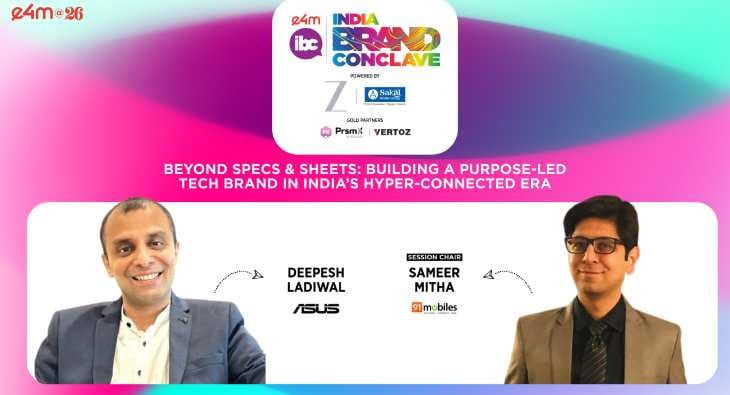

The ninth edition of the e4m India Brand Conclave (IBC) 2026, held today (February 11) in Mumbai, saw some of the sharpest minds in marketing converge to explore the theme ‘Reimagining Brands in the Age of Acceleration’.
One of the most engaging conversations of the day was a fireside chat titled, Beyond Specs & Sheets: Building a Purpose-Led Tech Brand in India’s Hyper-Connected Era. Featuring Deepesh Ladiwal, Marketing Lead – Consumer Business, ASUS India, in conversation with Sameer Mitha, Associate Director – Marketing & Business Development, 91mobiles, the session unpacked how tech brands are moving beyond hardware specifications to build purpose-driven narratives and long-term consumer relationships.
The discussion opened with Mitha setting the context around how consumer behaviour in India’s PC market has evolved. He noted that for years, purchase decisions revolved around specifications, RAM, storage, processor speed and screen size, but that narrative is steadily shifting. “Earlier, people would walk into a store asking how much RAM or storage a device had. Today, the question is far more outcome-driven, what can this device help me achieve?” Mitha observed.
Building on that, the conversation explored how Indian consumers are no longer driven purely by specs, but by what a device enables them to do in everyday life.
Elaborating on this shift, Ladiwal said, “Today’s customers are far more informed, especially college students, who are among the most gadget-savvy audiences in India. They understand specs, but what’s evolving is the deeper understanding of what technology truly enables. It’s no longer about listing features. We first understand what users aspire to become through our devices, and then align the specs to that purpose in our communication.”
Taking the conversation further, Mitha then moved to how brands keep their messaging relevant at a time when technology refresh cycles are becoming increasingly shorter. With global showcases like CES and Computex accelerating innovation and product upgrades, devices today are refreshed far more frequently than before, often shrinking replacement cycles to just two or three years.
Addressing this, Ladiwal noted that relevance today is less about chasing faster processors and more about contextualising value.
He explained that Indian consumers have evolved from evaluating devices on sheer technical superiority to assessing how effectively a product enhances productivity, mobility and efficiency.
He further pointed out that in a market where multiple players enter and exit rapidly, legacy and trust become key differentiators. Sustained relevance, he suggested, lies in building long-term brand equity rather than riding short-term product cycles.
The dialogue also touched upon the growing digital clutter and the challenge of cutting through noise without simply increasing volume. In a hyper-connected ecosystem where consumers are exposed to constant advertising across social media, e-commerce platforms and influencer networks, ASUS has leaned into storytelling rather than specification-led communication.
Ladiwal further highlighted how the brand’s gaming sub-brand, ROG (Republic of Gamers), has successfully built a strong community narrative. With the gaming total addressable market witnessing significant growth post-pandemic, ASUS focussed on creating campaigns that showcased diverse gamer journeys, from an army veteran to a girl gamer to a young aspirant from a small town, positioning the brand as an enabler of ambition rather than just a hardware provider.
From gaming, ASUS has drawn key learnings around advocacy and community-building, which it is now applying across other portfolios including VivoBook and ZenBook. Instead of product-specific pushes, the brand is increasingly adopting umbrella campaigns tailored to distinct consumer segments such as students, creators and premium professionals.
The discussion also explored geographical expansion and the rising demand from tier-2 and tier-3 markets. While e-commerce has widened reach, Ladiwal emphasised the importance of strengthening offline infrastructure and after-sales service. With over 350 exclusive stores and plans to expand further, ASUS is also introducing localised service initiatives such as drop zones to improve accessibility and customer experience.
After-sales, he noted, is no longer a backend function but a central pillar of brand perception. The brand has invested in service camps, device health check-up programmes and consolidated feedback systems to proactively track customer sentiment and Net Promoter Scores. Complaints, he said, are treated as “signals” rather than alarms, inputs that help refine processes and strengthen trust.
The conversation also turned to the complexity of marketing in a fragmented, multi-platform ecosystem. With publishers, influencers, e-commerce platforms and offline retail all playing distinct roles across the funnel, Mitha asked how ASUS ensures that the right message reaches the right audience at the right time. Ladiwal explained that channel strategy is deeply audience-led.
He broke down ASUS’s annual marketing cadence, sharing that Q1 is largely dedicated to strategic planning across product and marketing teams. Q2 focuses on communication build-up, while Q3 is the peak back-to-school and back-to-college sales season. “That’s when conversion becomes critical. Our budgeting and planning integrate product, marketing, web development and consumer experience teams to ensure alignment,” he said, adding that while the larger goal is ecosystem-building, execution varies significantly by channel and segment.
As the session drew to a close, Ladiwal flagged emerging challenges such as rising component costs and pricing pressures for the industry. The critical question, he suggested, is whether consumers will continue to accept premium pricing in exchange for enhanced value, and how brands must evolve their communication to reflect that balance.
Read more news about Marketing News, Advertising News, PR and Corporate Communication News, Digital News, People Movement News
For more updates, be socially connected with us onInstagram, LinkedIn, Twitter, Facebook, YouTube & Google News
