Rented AI makes platforms smarter, not you: Tarun Kishore, CBO, Saptharushi
At e4m D2C Summit, Tarun Kishore, CBO, Saptharushi, broke down the question of how can a brand efficiently reach the consumer and the cost behind it
 by
by
Published: Sep 10, 2026 5:51 PM | 8 min read
 Follow Us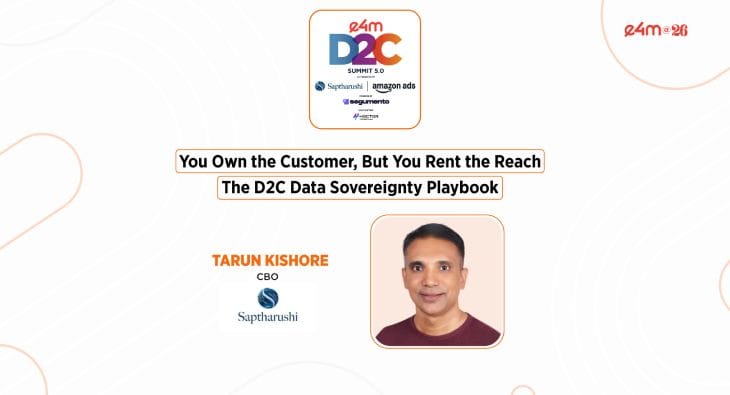

- D2C brands may be underestimating their customer acquisition costs by not accounting for additional "rents" such as reach rent, signal rent, and memory rent, which affect their understanding of customer relationships.
- Tarun Kishore, CBO of Saptharushi, emphasized the importance of brands owning their customer data and insights, warning that reliance on external platforms can lead to a loss of valuable customer knowledge once they stop using those platforms.
- The evolving landscape of consumer consent requires brands to integrate consent management into their infrastructure, moving beyond simple compliance to ensure explicit and revocable consent from customers.
- Kishore proposed five actionable steps for D2C brands, including auditing hidden costs, enhancing customer understanding through data exchange, and measuring their own customer insights rather than relying on platform-specific metrics.
D2C brands may be paying far more than the customer acquisition cost they see on their balance sheets. While brands spend on marketplaces, quick-commerce platforms, retail media and other digital channels to reach consumers, they may also be giving away valuable customer signals and behavioural learning to the platforms through which those transactions happen.
Tarun Kishore, CBO, Saptharushi, at the e4m D2C Summit in Gurgaon explained to D2C marketers that the real question is no longer just how efficiently a brand can reach a consumer, but who owns what the brand learns about that consumer along the way.
"You own the customer, but you rent the reach," Kishore said, arguing that brands are increasingly focused on reaching consumers "better, faster, cheaper" without asking what they are giving up in the process.
Kishore broke this cost into three different "rents" that businesses pay while acquiring a customer. The first is the reach rent, which brands already track through marketplace fees, retail media and customer acquisition costs. The second is what he called the "signal rent", where every campaign and transaction teaches the platform something about the consumer while the brand often sees little more than its CAC.
The third, according to Kishore, is the "memory rent", or the value of customer understanding that a brand loses when it does not own the underlying relationship and learning.
"Every campaign that we run teaches the platform something about our customers while the brand is only seeing a CAC," he said.
He urged brands to ask a simple but uncomfortable question: if the business stopped using a particular platform tomorrow, what would it actually know about the customers it had acquired through that platform?
"Because till the day I'm on the platform, I'm only talking about number of customers, number of orders, everything. The day I'm off the platform, do I know anything about it? Nothing," Kishore said.
His larger warning was blunt: "You're not just paying to reach her, you're paying to forget her. Because the day you go off the platform, everything's gone."
The customer is no longer one customer
The problem, Kishore said, is becoming more complicated as consumers move across quick commerce, marketplaces, brand websites, physical stores and other touchpoints. Each platform can see a different version of the same individual, based on the behaviour taking place within its own ecosystem.
A consumer buying a late-night refill on a quick-commerce platform may be classified as a late-night shopper. The same person may appear as a weekend shopper on a marketplace, a loyal customer on a brand website and a traditional touch-and-feel buyer in a physical store.
"Nobody knows the customer as a whole," Kishore said. "Everybody is talking to you and telling you about the customer in their own pieces, which they define as a full customer profile."
For brands, however, this fragmentation also represents an opportunity because they are among the few players that can potentially connect those different interactions.
"Nobody else sees the customer in full," he said. "The only person who has a chance to meet this customer more than once is the brand."
The challenge, he added, is that brands are not necessarily using that advantage to its full potential.
Consent moves from checkbox to infrastructure
The other major shift Kishore highlighted was the changing role of consumer consent, particularly as India's data protection framework evolves.
He argued that consent can no longer be treated as a checkbox buried in a website footer. Instead, it needs to become part of the underlying architecture through which brands manage customer relationships.
"The consent becomes the infrastructure," Kishore said.
According to him, brands will need to prepare for a system in which consent is explicit, revocable and auditable, and where the consumer retains control over how that consent is used.
"The checkbox in the footer, that's what consent is all about today," he said. "But that's not going to be after eight weeks. You have to have explicit consents which can be revocable. It can be audited."
Kishore also pointed to November 2026 as an important date for brands preparing for consent management changes, saying businesses need to start preparing rather than treating the issue as a future compliance exercise.
For D2C companies that have traditionally focused heavily on acquisition, the implication is that customer data infrastructure could become as important as media buying. The question is not merely whether a customer has been acquired, but whether the brand can continue to understand that customer across channels.
AI may make platforms smarter, not brands
Kishore then connected the data ownership question to the rapid adoption of AI.
The current conversation, he said, is often centred on finding a better AI model. But models are increasingly becoming interchangeable, while the proprietary customer data and relationships that sit behind them could become a much more valuable competitive advantage.
"No model is the best. You will always find a better model. You will find a different model. What makes a difference is the graph," he said.
He described the customer graph as an important layer that can make AI models more effective because it brings together the brand's own understanding of its customers.
His warning to marketers was particularly pointed: "AI models rented on somebody else's infra makes them smarter, not you."
For brands, building their own customer graph therefore becomes a way of ensuring that AI improves the organisation's understanding of its consumers rather than simply improving the performance of an external platform.
"The more we focus on our own graphs, it will make you as the brand, as the marketer more smarter than the platform, which is owning all the learning," Kishore said.
Five questions for D2C brands
Kishore's session eventually moved from provocation to a practical playbook, asking brands to examine the data and customer relationships they currently control.
The first step, he said, is to "audit the rent bill you cannot see". While reach cost is visible in the P&L, brands need to separately examine the signal and memory they are accumulating, or losing, through every platform.
"Cost of reach is a finance number... but signal is a strategy discussion and this is a long term strategy for the brand," he said.
The second is to build consent into the architecture of the business, rather than treating it as a compliance exercise. The third is identity resolution. Brands need to know whether the same person interacting with them across different channels is actually being recognised as one customer.
"We do omni-channel creatives and communication without even knowing if I am talking to the same customer on different platforms," Kishore said. "Before I go to the communication, I need to understand my omni-channel behaviour of my customer first."
He suggested that CMOs and data teams ask not simply how many customers they have, but how certain they are about that number.
"If they say x million, ask them how sure are they? The confidence level and the surety will tell you where you are," he said.
The fourth step is to enrich customer understanding through data exchange rather than simply purchasing more third-party signals. Kishore suggested that brands identify non-competing businesses that may have complementary customer profiles and explore ways to build a richer understanding of consumers within appropriate consent frameworks.
The fifth is to measure the brand's own customer graph instead of relying entirely on the ROAS reported by individual platforms.
"A platform will give you a ROAS which is their own rate, their own scorecard. It is not your brand's scorecard," he said.
His argument is particularly relevant as D2C brands increasingly operate across multiple walled gardens, where every platform has its own measurement system and incentives.
"We mistake a platform's scorecard as my brand's scorecard," Kishore said. "That is a mistake we should not do going forward because there are so many wall gardens."
For D2C marketers, therefore, the next phase of growth may not be about simply acquiring more customers or finding cheaper channels to reach them. It could be about ensuring that every customer interaction leaves the brand with more knowledge than it had before.
Kishore's closing message brought the argument back to the customer himself. "Sovereignty does not end with her, with the brand... The sovereignty is with the customer."
And his final provocation was even simpler: "You own the customer. Don't pay to forget her."
For an industry built around customer acquisition, that may be the more uncomfortable metric to track: not just what a brand paid to acquire a consumer, but what it actually retained after the acquisition.
Read more news about Marketing News, Advertising News, PR and Corporate Communication News, Digital News, People Movement News
For more updates, be socially connected with us onInstagram, LinkedIn, Twitter, Facebook, YouTube & Google News