Pitch CMO Summit: Industry heads decode how to build lasting brand love
Lavanya Nalli of Nalli Group, Manas Gupta of Lenovo Digital Commerce & Rishabh Shekhar, Pepper broke down how brands can remain relevant as consumer categories evolve
 by
by
Published: Sep 4, 2026 8:55 AM | 4 min read
 Follow Us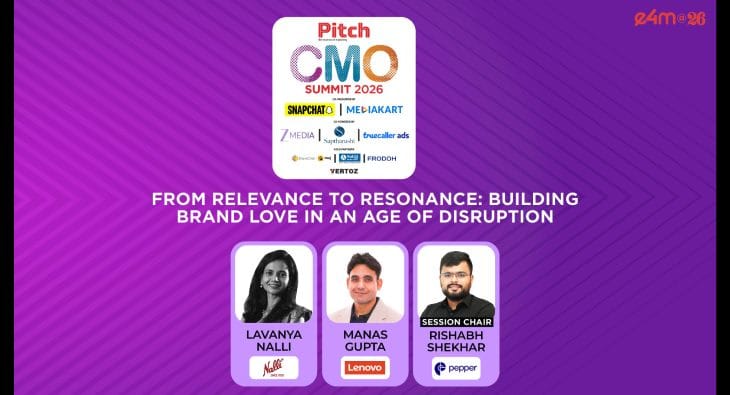

- Established brands should view new entrants as potential opportunities rather than threats, as increased competition can expand the overall market and consumer awareness within a category.
- The discussion at the Pitch CMO Summit emphasized that new competitors can attract younger consumers and enhance category visibility, benefiting both incumbents and newcomers.
- Brands in fragmented or underpenetrated markets have room for growth despite competition, while those in consolidated markets may face challenges in expanding without taking market share from others.
- The conversation highlighted the importance of evolving brand strategies to focus on category growth and consumer engagement, rather than solely on protecting existing market share.
In a market where new-age brands can quickly attract funding, consumer attention and category buzz, established businesses may be tempted to view every new entrant as a threat. But the bigger opportunity for brands could lie in looking beyond the immediate competition and focusing on how a growing ecosystem can expand the category itself.
This was among the key themes emerging from the fireside chat, ‘From Relevance to Resonance: Building Brand Love in an Age of Disruption’, at the Pitch CMO Summit. The session featured Lavanya Nalli, Chairperson, Nalli Group, and Manas Gupta, Worldwide Personalization Lead, Lenovo Digital Commerce, with Rishabh Shekhar, Co-founder and COO, Pepper, as the session chair.
The conversation examined the changing nature of competition and what it means for brands trying to remain relevant as consumer categories evolve. One of the central arguments was that the arrival of funded competitors can, in some cases, be beneficial for the incumbent because it brings more attention, investment and consumer awareness to the category.
“When competitors get funded, does it change for the house like yourselves?” the discussion posed, before highlighting that greater competition can also create positive momentum for the category.
This is particularly relevant for categories where the overall market is substantially larger than the share currently captured by individual brands. In such markets, competition does not necessarily have to be a fight over the same pool of consumers. Instead, the growth of new brands can encourage more people to enter the category, increasing the addressable market for established and emerging players alike.
The saree market was used to illustrate this point. Depending on how the category is defined, the overall saree market was estimated at anywhere between Rs 40,000 crore and Rs 80,000-90,000 crore, with the larger estimate including pure synthetic sarees and other segments.
Against this backdrop, Nalli, which was described as touching around Rs 1,000 crore, still accounts for only a relatively small portion of the broader opportunity. The numbers underline a larger point about legacy brands: even those with significant brand recognition may have substantial headroom before competition becomes primarily a market-share battle.
“My competition is not the brand that's coming up. I have a huge runway. I really haven't captured much of the market at all,” the speaker said.
The perspective challenges a conventional approach to competitive strategy, particularly for established brands. Instead of immediately reacting to every challenger through defensive pricing, advertising or positioning, brands can assess whether the challenger is actually helping create demand for the category.
A new brand entering an established space can bring younger consumers into the category, introduce new consumption occasions or make an otherwise traditional product more culturally relevant. Increased funding can also result in greater advertising and marketing activity, which in turn can increase overall category visibility.
For a brand such as Nalli, therefore, the opportunity is not necessarily limited to taking customers away from another saree player. The larger challenge is to bring more consumers into the category, retain existing customers and make the brand relevant to consumers whose shopping and discovery habits are changing.
The distinction between category growth and market-share competition becomes important as brands assess their long-term strategies. A company operating in a highly consolidated market, where it already commands a significant share, has fewer avenues for growth without taking business away from competitors. But a brand operating in a large, fragmented or underpenetrated category can continue growing even as new players enter.
“The day when I captured 10%, 20%, 40%, 50% in a highly consolidated industry, that's when I started thinking about it being a market share stealing game,” the speaker added.
The comments also point to a broader shift in how brands can think about disruption. New-age competitors are often seen as forces that challenge legacy businesses, but disruption can also stimulate a category by changing consumer expectations and creating new reasons to engage with a product.
For marketers, this makes brand building less about simply protecting existing equity and more about expanding the relevance of that equity. Brand love, in this context, is not created only by maintaining familiarity; it also requires understanding how the category is changing and ensuring that the brand evolves with it.
The conversation ultimately brought the focus back to the scale of the opportunity. For established brands, the biggest threat may not always be the emergence of another competitor. In many cases, the bigger risk could be failing to capture the untapped consumers and occasions that already exist within the category.
For brands operating in large markets, the road from relevance to resonance may therefore begin with a fundamental question: Is the competition really taking away the market, or is it helping create a bigger one?
Read more news about Marketing News, Advertising News, PR and Corporate Communication News, Digital News, People Movement News
For more updates, be socially connected with us onInstagram, LinkedIn, Twitter, Facebook, YouTube & Google News