India’s ₹1.55 Lakh Cr ad market has a measurement problem. Digital is winning by default
With IRS stalled, BARC ratings disrupted, no common OOH currency & radio seeking relevance, measurement gaps are making traditional media harder to justify - pushing ad dollars towards digital
 by
by
Published: Sep 3, 2026 8:58 AM | 9 min read
 Follow Us

- India's advertising market, valued at ₹1.55 lakh crore, lacks a unified measurement currency, complicating budget allocation decisions for marketers across traditional and digital media platforms.
- Digital advertising now comprises 60% of the market, with traditional media declining, as advertisers increasingly shift budgets to digital due to the absence of reliable metrics for TV, print, and radio.
- The last Indian Readership Survey (IRS) was conducted in 2019, and television ratings have been paused for several months, leading to a reliance on less reliable metrics and making it difficult for traditional media to justify ad spend.
- The advertising industry faces a measurement gap, with calls for a credible cross-media currency to ensure effective budget allocation and accountability, as marketers struggle to compare performance across fragmented measurement systems.
For marketers, one of advertising’s most consequential questions is becoming one of its hardest to answer: Where should the next rupee go?
India’s ₹1.55 lakh crore advertising market is currently operating without any unified currency, particularly the traditional media platforms. And it is beginning to influence where the money goes.
Television ratings have been paused for the last few months. Print has not had an Indian Readership Survey (IRS) since 2019. OOH is still searching for a universally accepted currency. Radio, with barely 1% of the ad market, is fighting to prove its relevance as an audience fragment.
Digital, meanwhile, keeps producing dashboards. That difference may sound technical. It is increasingly becoming a business problem.
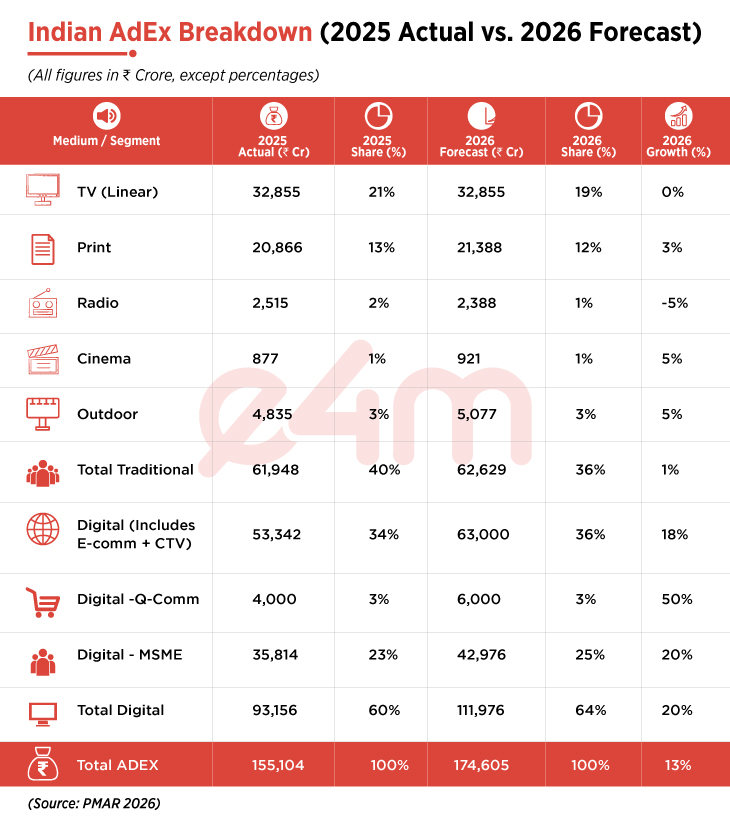
According to the Pitch Madison Advertising Report 2026, digital now accounts for 60% of India’s advertising market, with traditional media making up the remaining 40%. More tellingly, all net advertising growth in 2025 came from digital, while traditional media declined in absolute terms.
Changing consumer behaviour, targeting and performance marketing are obvious explanations. But there is another, less discussed force at work: measurement.
As one senior FMCG marketer puts it, “We are working in complete darkness, and it has come at the worst time.” With global headwinds, inflation and weakening demand putting greater pressure on marketing budgets, the absence of a common currency across traditional and digital media is beginning to influence allocation decisions.
In other words, measurement is no longer merely a media-planning issue. It is becoming a budget-allocation issue.
‘Digital often easier to defend’
Mumbai-based Parle Products offers a telling example. The biscuit maker’s digital allocation has risen from around 25% to 40% in just four months, while television has seen a significant reduction.
Mayank Shah, CMO, Parle Products, says the shift is not about abandoning television. “Parle remains a mass FMCG advertiser for whom reach is critical. But in the absence of TV ratings, we have no other option but to shift budgets to digital platforms. While third-party measurement is not available even for Google and Meta, we at least have ways to gauge where the money is going and how it is translating into business.”
That is the paradox confronting traditional media. Digital may not necessarily be more effective or have better measurement tools. But it is often easier to defend.
“If I cannot establish reach, frequency and incremental impact with confidence, it becomes difficult to defend the investment internally. Digital at least gives me a dashboard. Traditional media often gives me an estimate,” CMOs of two listed FMCG companies told e4m.
The distinction matters. A dashboard is not the same thing as proof. But in an organisation under pressure to justify every rupee, it can feel like proof.
Agencies dilemma
The measurement gap is increasingly complicating media planning, with agencies forced to reconcile fragmented currencies across traditional and digital media. While digital offers faster and more granular data, much of it remains platform-reported, leaving planners with limited independent, cross-media visibility.
Kartik Sharma, CEO of Omnicom Media India, says, “Measurement has been an integral part of planning in India for several decades. The complexity has increased with the advent of digital, where individual platforms have developed and reported their own measurement metrics, while traditional channels have continued to operate through industry-backed measurement frameworks like BARC.
The bigger gap is the lack of a unified, cross-media measurement currency. Several developed markets have initiatives underway to address this, but in India, advertisers still have to bring together multiple measurement systems to understand the complete picture of media consumption and, ultimately, business impact.”
Omnicom Media allocates budgets by combining industry measurement with intelligence from our proprietary platform, Omni, alongside client-specific market mix modelling and other analytical techniques to understand how different media investments contribute to business outcomes, Sharma highlighted.
According to Anil Solanki, Media Lead, dentsuX, advertisers today want greater accountability for every rupee. While TV has an established currency, print, radio and OOH need stronger and more consistent audience measurement, making cross-media comparison difficult.
Digital, he says, has an advantage because it provides faster and more granular data on reach, engagement and conversions. But there is a catch: much of that measurement remains platform-reported rather than truly independent.
The industry, Solanki says, needs “a credible, comparable cross-media currency so budgets are allocated on actual effectiveness rather than simply on which medium provides the most data.”
The missing IRS
Print media perhaps illustrates the problem most starkly. The last IRS was released in 2019. Nearly seven years later, the industry is still waiting for its return. A pilot announced in September 2025 has yet to begin fieldwork, with news publishers continuing to debate “methodology and questionnaire”.
IRS was more than a readership survey. It was the industry’s common language for planning, profiling audiences and comparing publications.
Read earlier report on - IRS remains elusive
Its absence has pushed marketers towards circulation figures, publisher studies, proprietary datasets and first-party analytics. Useful as these may be, they do not replace an independent, industry-wide currency. And when audiences now move fluidly between print, publisher websites, apps, social platforms and video, simply recreating the 2019 framework may not be enough.
Print remains a roughly ₹20,000-crore advertising medium, according to industry estimates. But without a current readership currency, its relative value becomes harder to establish.
BARC Ratings’ blackout
Television faces a different version of the same problem. BARC spent more than a decade becoming the industry’s common television currency in 2015. Its prolonged ratings disruption, more than six months now, has exposed just how dependent the market remains on a single measurement system.
The government’s Television Rating Policy 2026 could eventually make the ecosystem more transparent, with greater scrutiny, independent audits and technology-neutral measurement covering connected TV and OTT-delivered television. But there is a near-term risk: more measurement systems could mean more fragmentation before they mean more clarity.
Read e4m deep dive on the Barc blackout
The timing could hardly be worse for television. According to the Pitch Madison Advertising Report 2026, FMCG—which accounted for 46% of television advertising in 2025—saw spends fall from ₹15,853 crore to ₹15,183 crore. Its ₹670-crore decline accounted for 42% of the overall fall in TV advertising. E-commerce, the second-largest category at 16%, also declined 4%. Advertisers expect the ratings blackout to make the shift even more pronounced.
OOH and radio
OOH has long struggled with the absence of a universally accepted measurement currency.
Roadstar, backed by the Indian Outdoor Advertising Association, is attempting to address that gap using mobility data to estimate audiences across outdoor inventory. But becoming a common currency requires wider agency acceptance, including buy-in from major agency networks.
Read earlier report - Roadstar's OOH currency ambition
Radio faces an even tougher challenge. With advertising revenue estimated at ₹1,501 crore in 2025, according to the dentsu-e4m Advertising Report 2026, the medium accounts for roughly 1% of India’s total advertising market.
Its response has been to expand beyond traditional radio into digital audio, podcasts, influencers, social media and on-ground properties. But that creates another question: what exactly is the advertiser buying—and against what currency is it being evaluated?
Digital’s advantage
The industry risks replacing one measurement problem with another. A large portion of digital advertising operates inside closed ecosystems where platforms control the data, definitions and measurement infrastructure. Google and Meta offer sophisticated dashboards, but much of the underlying measurement remains platform-controlled, say industry experts.
Sandeep Amar, founder of PDlab.me, believes the industry is effectively trying to compare media that “don't even speak the same language”—with TV measured through BARC, print through IRS, radio through limited-city measurement, OOH without a fully established currency and digital through systems that are often platform-controlled.
Retail media's next challenge isn't scale, it's measurement. Read more here
His argument goes further: he believes traditional media may be over-reported while digital is under-credited for time spent and engagement. “Digital is winning the measurement game, since measurement is 100% possible,” Amar says. “Because it's self-attributed and immediate.”
He argues that digital deserves a greater share of advertising investment because consumers spend significantly more time on digital platforms, including apps on smart TVs.
Whether one agrees with that assessment or not, it points to a larger question: are marketers allocating money based on effectiveness—or based on the medium that can most easily produce a number?
The global warning
India is hardly alone. The US has a more mature measurement ecosystem, but even there marketers are struggling with standardisation.
A recent Association of National Advertisers (ANA) survey found that 55% of marketers identify lack of standardisation as their number one barrier to evaluating performance.
The ANA recommends standardised baseline metrics for impressions, viewability, clicks and invalid traffic before marketers attempt to compare outcomes such as ROI, sales lift or incrementality. It also calls for greater transparency around how networks define and calculate metrics, along with stronger independent, third-party assurance.
The message is simple: marketers cannot compare what the industry does not measure consistently.
That becomes particularly relevant as retail media expands. The sector may be growing rapidly, but impressions, clicks and platform-reported sales are no longer enough. Marketers increasingly want standardised attribution and proof of incremental sales.
The Real Problem
Digital's edge is not better advertising, it's better counting - immediacy, granularity and a dashboard for every rupee. But self-reported measurement is not independent measurement, marketers point out.
However, they warn, “Traditional media, meanwhile, cannot expect marketers to keep paying on historical credibility. The medium that can demonstrate what happened to the money is beating the medium that merely claims it happened.”
If we don't build independent, comparable and transparent measurement across media, the Rs 1.5 lakh crore market will not reward the medium that creates the most value. It will reward the one that produces the most convenient numbers.
Read more news about Digital Media, Internet Advertising, Marketing News, Television Media, Radio Media
For more updates, be socially connected with us onInstagram, LinkedIn, Twitter, Facebook, YouTube & Google News